India and BRICS 2026

India and BRICS 2026: How India Is Turning Global South Cooperation Into Real-World Action

Introduction
BRICS is no longer simply a meeting of large emerging economies. It has become an important platform through which developing countries seek a stronger voice in global finance, trade, technology, energy, food security, health and international governance.
India has been part of this journey from the beginning. But in 2026, as BRICS Chair, India moved beyond diplomacy and placed a strong emphasis on practical, development-oriented cooperation.
India hosted the 18th BRICS Summit at Bharat Mandapam in New Delhi on 12 and 13 September 2026 under the theme “Building for Resilience, Innovation, Cooperation and Sustainability.” An official Government of India backgrounder says more than 350 meetings and high-level engagements were held across 25 Indian cities during the Chairship, reflecting an effort to make the BRICS year a nationwide exercise rather than a two-day summit in Delhi.
This is an important part of India's larger BRICS story: India is trying to convert geopolitical influence into practical development.

What Does BRICS Mean to the World?
BRICS matters because it gives major emerging and developing economies a forum to coordinate positions on issues that have traditionally been shaped primarily by advanced Western economies.
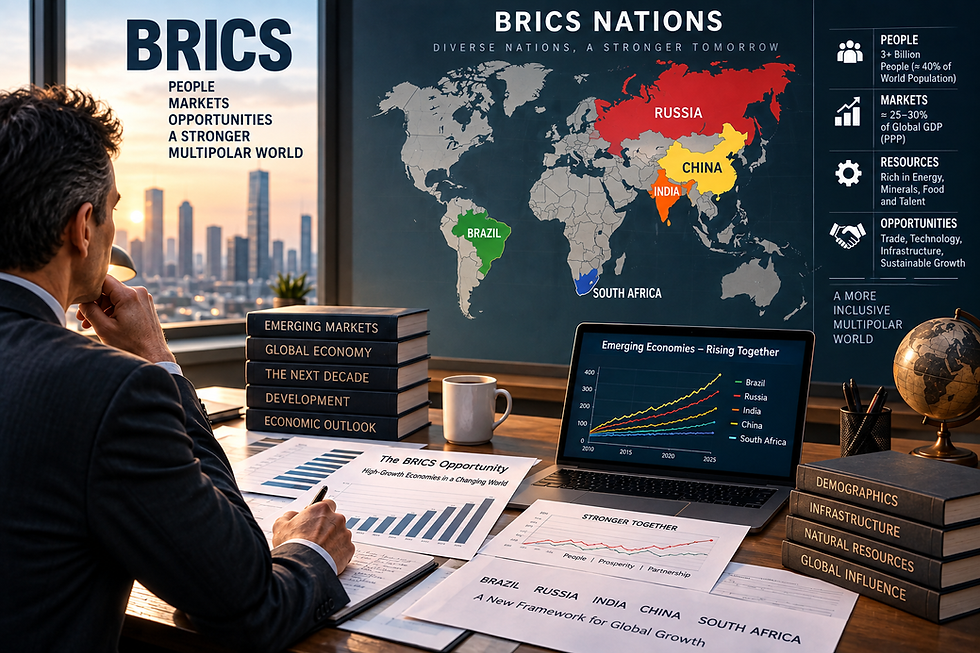
According to the Government of India's September 2026 BRICS backgrounder, the grouping represents about 49.5% of the world's population, 40% of global GDP and 26% of global trade. Its agenda now covers development finance, technology, trade, energy, agriculture, health, education and people-to-people cooperation.
For the wider world, therefore, BRICS represents three major ideas.
First, developing economies want greater representation in global decision-making. Second, countries want additional channels for development finance and economic cooperation. Third, many countries of the Global South want international institutions to better reflect the economic realities of the 21st century.
India's approach has been to make BRICS more solutions-oriented, with development, resilience, innovation and sustainability at the centre of cooperation.
How India Has Helped BRICS
Area | India's Contribution | How It Helps BRICS and the World |
Institution-building | India helped advance the idea of a BRICS development bank during its earlier Chairship | The idea eventually became the New Development Bank, providing infrastructure and sustainable-development finance |
Development finance | India continues supporting the NDB and development-focused cooperation | The NDB now reports $42.9 billion in approved financing across 139 projects |
Digital cooperation | India made digital infrastructure, cybersecurity, digital skills, innovation and future networks key 2026 priorities | Gives emerging economies a platform for sharing scalable digital-development models |
Energy | India launched the BRICS Digital Centre of Excellence for Smart Grids and Energy Storage | Supports resilient grids, renewable-energy integration, capacity building and energy technology cooperation |
Agriculture | India led the adoption of the Indore Declaration | Strengthens food security, farmer welfare, agricultural trade, climate-resilient farming and digital agriculture |
Trade and MSMEs | India led the Jaipur Consensus and MSME credit principles | Helps smaller businesses address trade-finance barriers and enter international markets |
Industry and startups | India proposed a BRICS Incubator Network and Startup Innovation Fund | Encourages startup, MSME, manufacturing, photovoltaic and logistics cooperation |
Healthcare | India promoted digital health, responsible AI, health equity and mental-wellness cooperation | Helps BRICS build more resilient and accessible health systems |
Education and skills | India prioritised skills, research, innovation and mutual recognition of qualifications | Helps create a future-ready workforce across emerging economies |
Disaster resilience | India hosted the 2026 BRICS Ministerial Meeting on Disaster Risk Reduction | Strengthens cooperation on resilient societies and disaster preparedness |
India and the New Development Bank
One of the clearest examples of BRICS moving from discussion to institution-building is the New Development Bank, or NDB.
The institution finances projects in areas such as renewable energy, transport, water, housing and other infrastructure.
The NDB currently reports $42.9 billion in approved financing across 139 projects, with expected development outcomes ranging from renewable-energy capacity and housing to urban rail and water infrastructure.
This matters globally because developing countries face an enormous infrastructure financing gap.
By supporting another multilateral financing institution, India is helping BRICS demonstrate that the Global South can not only demand reform but also create institutions of its own.

Digital India: A Practical Contribution to BRICS
India's strongest modern contribution may be its experience with population-scale digital infrastructure.
During India's 2026 Chairship, BRICS discussions on information and communications technology included digital ecosystems, cybersecurity, digital skills, AI, next-generation communications, startups and innovation.
India's relevance here is practical.
Instead of discussing digital transformation only as an abstract concept, India has experience deploying digital payments, digital identity, digital public services and health platforms across an enormous population.
The same philosophy is now entering BRICS cooperation: technology should expand access rather than simply create technological prestige.

India Is Helping BRICS Build the Energy Systems of the Future
Energy cooperation became another major focus of India's Chairship.
At the BRICS Energy Ministers' Meeting in Gurugram, India helped launch the BRICS Digital Centre of Excellence for Smart Grids and Energy Storage.
The centre is designed as a collaborative platform for knowledge sharing, capacity building, policy exchange and pilot initiatives. BRICS members also adopted guiding principles for smart grids and energy storage.
The significance goes far beyond electricity.
Emerging economies need to expand power access while simultaneously making electricity systems cleaner, more reliable and capable of supporting renewable energy.
India is helping create a platform through which developing countries can learn from one another instead of solving these problems independently.

Farmers and Food Security: India's Global Contribution Through BRICS
India also brought agriculture into the centre of its BRICS agenda.
The Indore Declaration, adopted in June 2026, addressed food security, farmer welfare, climate-resilient agriculture, agricultural trade, digital agriculture and research cooperation.
That has global relevance.
Food inflation, climate change, water stress and farmer incomes are not problems limited to India. They affect countries throughout Africa, Asia and Latin America.
India's contribution through BRICS is therefore not simply about promoting Indian agriculture. It is about building platforms through which countries with similar agricultural challenges can exchange technology, research and policy experience.

India Is Making BRICS More Relevant to Small Businesses
Major international organisations often appear remote from ordinary entrepreneurs.
India's 2026 Trade Chairship attempted to address that problem.
At the BRICS Trade Ministers' Meeting in Jaipur, members agreed on the Jaipur Consensus and Guiding Principles for MSME Credit. The measures were designed to reduce the trade-finance gap faced by smaller businesses and expand their participation in international markets.
India also pushed work on resilient global value chains, digitally delivered services and the Strategy for BRICS Economic Partnership 2030.
This shows how India is trying to change the meaning of international cooperation.
The objective is not just for leaders to meet. It is for businesses, startups, farmers, researchers and citizens eventually to experience economic benefits from those relationships.
India's Healthcare Model Enters BRICS Cooperation
Health became another major pillar.
India introduced new BRICS priorities around healthy lifestyles and mental wellness, while cooperation also covered health equity, digital health, TB research and resilient health systems. NIMHANS was selected to coordinate a BRICS Network of Centres of Excellence on Mental Wellness.
India also used its Chairship to showcase digital healthcare infrastructure.
A July BRICS health dialogue reported more than 940 million ABHA health IDs and one billion linked digital health records in India's digital health ecosystem.
For developing countries attempting to expand healthcare without replicating the cost structures of richer nations, such systems provide useful examples to study.
How India Is Shaping the World Through BRICS
India's influence through BRICS is therefore broader than traditional foreign policy.
India is helping shape conversations about how emerging economies finance infrastructure, digitalise public services, support farmers, manage energy transitions, develop resilient healthcare, train future workers and expand opportunities for smaller businesses.
The deeper idea is important.
India is increasingly presenting the Global South not simply as a group asking developed countries for assistance, but as a community capable of creating technology, financing institutions, policy models and development solutions of its own.
That is a significant change in global diplomacy.
Hosting BRICS 2026: India Used the Summit to Showcase the Country
The BRICS Summit was not simply conducted inside a conference hall.
India treated hosting as an opportunity to showcase its infrastructure, innovation, culture and ability to manage a major international gathering.
The main summit venue was Bharat Mandapam in New Delhi. Alongside the leaders' summit, the Ministry of Education organised the BRICS Bharat Innovates Exposition on 11 and 12 September, showcasing 37 Indian deep-tech innovators.
The message was clear: visiting delegations were not being shown only India's history. They were also being shown its technology and innovation ecosystem.

Delhi Lit Up for BRICS
Delhi itself became part of the presentation.
In the days before the summit, the New Delhi Municipal Council carried out a large beautification and civic-readiness programme along routes connecting the airport, hotels and Bharat Mandapam.
Prominent locations including Patel Chowk, Windsor Place, Mandi House, Teen Murti, Lok Kalyan Metro Station and the PMO roundabout were illuminated with decorative lighting. BRICS-themed LED signage was installed, roads were landscaped, floral displays were created and sanitation operations were intensified. Reports said about 15,000 plants were used and 17 roundabouts received beautification attention.
Bharat Mandapam itself was illuminated as Delhi prepared to welcome the delegations.
The preparation therefore combined diplomacy with urban presentation.
India wanted the physical setting of the summit to communicate the same message as the meetings inside: modern infrastructure rooted in Indian identity.

Clean Roads, Landscaping and Civic Readiness
Hosting world leaders also required less glamorous but equally important work.
Before the summit, civic agencies inspected VIP routes and identified issues including potholes, faulty streetlights, overgrown trees and problems with central verges. Authorities intensified cleaning, landscaping, street maintenance and sanitation.
NDMC's integrated command-and-control centre operated around the clock during the summit preparation period so that civic problems could be identified and addressed quickly.
This part of hosting rarely receives the same attention as bilateral meetings, but successful international diplomacy also depends on hundreds of municipal workers, engineers, gardeners, cleaners, police personnel and transport officials performing their roles.
How Delhi Managed Traffic During BRICS
Managing traffic was one of the most difficult logistical challenges.
Delhi Traffic Police created a controlled area in Central Delhi and established 22 diversion points, with restrictions affecting more than 35 roads during key periods. Separate route arrangements were prepared for people travelling to the airport and major railway stations.
Commuters were advised to plan journeys in advance, allow additional time, avoid unnecessary travel through VVIP corridors and use the Metro wherever possible.
The measures did create inconvenience, and some areas experienced congestion. But on the first day of restrictions, reports found that many roads were noticeably clearer than on a normal Friday, helped by school and government-office closures and reduced regular traffic.
That is an important detail because it shows that hosting a summit of this scale is not only an administrative exercise. It depends on public cooperation.
Citizens Were Also Part of India's BRICS Story
International summits are often described as events involving presidents, prime ministers and diplomats.
But Delhi's BRICS experience also involved ordinary citizens.
Residents were asked to adjust travel schedules, follow diversions, use the Metro and avoid unnecessary journeys around controlled areas. Many private organisations opted for work-from-home arrangements, while closures reduced routine traffic pressure.
That cooperation helped create space for delegations to move through one of the world's busiest capitals.
The experience was not perfect. Some commuters faced longer journeys and there were complaints about restrictions, while rain and vehicle breakdowns caused congestion on some corridors.
That balance is important to acknowledge.
Citizen participation did not mean everybody enjoyed the restrictions. It meant that millions of people adapted their routines so that Delhi could host an unusually complex international event.
Delhi's Hospitality Extended Beyond Bharat Mandapam
Visitors also experienced Delhi outside the summit venue.
Delegates and family members visited places including Akshardham, Connaught Place, Khan Market and Pradhanmantri Sangrahalaya, interacting with local businesses, cultural institutions and residents.
Hotels created specialised welcomes for foreign delegations, while India's cultural programme introduced visitors to crafts, food and traditions alongside the formal diplomatic agenda.
This matters because soft power is built not only through speeches but through the experience people carry home.

From Government Event to a Whole-of-India BRICS Year
The larger achievement of India's 2026 BRICS Chairship was its geographical spread.
A September PIB backgrounder recorded more than 350 meetings and high-level engagements across 25 cities, covering political, economic, security and people-to-people cooperation.
BRICS events were hosted in cities including Jaipur, Indore, Pune, Gurugram, Chandigarh, Bhubaneswar, Hyderabad, Gandhinagar and New Delhi.
This allowed visiting delegations to encounter different parts of India rather than seeing only the national capital.
For example, BRICS agricultural delegates visiting Indore experienced the city's urban infrastructure, hospitality and local food culture before the ministerial meeting.
India was therefore using its Chairship as both foreign policy and public diplomacy.
What India Is Trying to Tell the World Through BRICS
India's 2026 BRICS strategy sends a broader message.
Global influence should not be measured only by military power or the ability to dominate institutions.
Influence can also come from creating solutions that other countries find useful.
India's contribution to BRICS increasingly centres on exactly those areas:
digital infrastructure that improves access, financing that builds infrastructure, agricultural cooperation that protects food security, health systems that reach more citizens, technologies that enable clean energy, and trade frameworks that help smaller businesses participate in the global economy.
That is a different model of global leadership.
It is based less on telling countries what to do and more on building platforms through which countries can cooperate.

Conclusion: India Is Helping BRICS Move From Dialogue to Delivery
BRICS matters to the world because it gives emerging economies an increasingly influential platform to discuss development, trade, technology, finance and global governance.
India's role is becoming important because it is trying to make that platform more practical.
From the New Development Bank to smart-grid cooperation, from farmer-centred agriculture to digital health, from MSME finance to emerging technologies, India is helping BRICS build institutions and programmes that can produce real-world outcomes.
The 2026 summit also demonstrated another side of India's contribution.
Bharat Mandapam provided the global stage. Delhi's decorative lighting and landscaping provided the welcome. Police and civic agencies provided security and mobility. Municipal workers maintained the city. Businesses and cultural institutions hosted visitors. And ordinary citizens changed travel routines and cooperated with restrictions.
India did not host BRICS only inside Bharat Mandapam. Delhi, its institutions, workers and citizens collectively hosted BRICS.
That may be the strongest message of India's Chairship.
India is helping shape a BRICS in which global influence is connected to practical development, and international diplomacy is ultimately expected to improve the lives of people.
For India, BRICS is not only about having a stronger voice in the world. It is about using that voice to build a more inclusive, resilient and development-focused world.
Disclaimer
This article has been prepared and published solely for general informational, educational and awareness purposes.
The content represents a good-faith compilation and interpretation of information obtained from publicly available sources, official publications, media reports, research material and other references believed to be reliable at the time of writing. However, geopolitical developments, diplomatic positions, economic data, international memberships, government policies, leadership positions and institutional arrangements may change at any time.
Parikshit Khanna, Digital Training Jet Pvt. Ltd., Digital Training Jet, its founders, directors, employees, trainers, consultants, associates, contractors, representatives, partners and team members make no representation, guarantee or warranty, express or implied, regarding the completeness, accuracy, reliability, suitability, timeliness or continued validity of any information contained in this article.
The article should not be treated as legal, financial, investment, diplomatic, political, economic, tax, compliance, foreign-policy or professional advice. Readers should independently verify all material facts and consult appropriately qualified professionals, government authorities or official sources before taking any action based on the information contained herein.
Any discussion concerning BRICS countries, governments, political leaders, diplomatic relations, international conflicts, sanctions, currencies, economic policies, international institutions or geopolitical developments is intended only for neutral educational and analytical discussion. Nothing in this article should be interpreted as an endorsement, criticism, political position, diplomatic representation or official statement on behalf of any government, institution, organisation, political party, company or individual.
The mention of any country, government, public official, organisation, institution, company, publication, trademark, logo or third-party source is for identification, commentary, reference or educational purposes only and does not imply sponsorship, endorsement, affiliation, partnership or approval.
Images, maps, illustrations, infographics and AI-generated visuals accompanying this article are representational and illustrative in nature. They should not be interpreted as documentary evidence, official government material or a precise representation of political boundaries, diplomatic positions, historical events or current geopolitical conditions.
To the maximum extent permitted by applicable law, Parikshit Khanna, Digital Training Jet Pvt. Ltd., Digital Training Jet and all associated team members, employees, representatives and contributors shall not be responsible or liable for any direct, indirect, incidental, consequential, special, financial, reputational, commercial or other loss, damage, dispute, claim, misunderstanding, decision or action arising from or connected with the reading, interpretation, use, misuse or reliance upon this article or its accompanying materials.
Readers access and use this content entirely at their own discretion and risk.
No part of this publication should be construed as creating any contractual, fiduciary, advisory, professional or other legal relationship between the reader and Parikshit Khanna, Digital Training Jet Pvt. Ltd., Digital Training Jet or any member of their team.
Where information differs between official sources, media organisations or international institutions, such differences may reflect evolving events, terminology or diplomatic positions. Readers are encouraged to consult the latest official sources for verification.
The publisher reserves the right to correct, revise, update, modify or remove any portion of this article at any time without prior notice.
By reading, accessing, sharing or relying upon this article, the reader acknowledges and accepts the limitations stated in this disclaimer.
Copyright and Publication Notice:Unless otherwise stated, the original commentary and presentation of this article are published for educational and informational purposes. Third-party names, marks and references remain the property of their respective owners.
Important: No disclaimer can exclude liability where exclusion is prohibited by applicable law. This disclaimer should therefore be interpreted only to the fullest extent legally permissible.


Comments