WHAT IS BRICS, Full history explanied

BRICS Explained: Origin, Founding Members, Full History, Expansion and the Internal Tensions Shaping It in 2026
Introduction
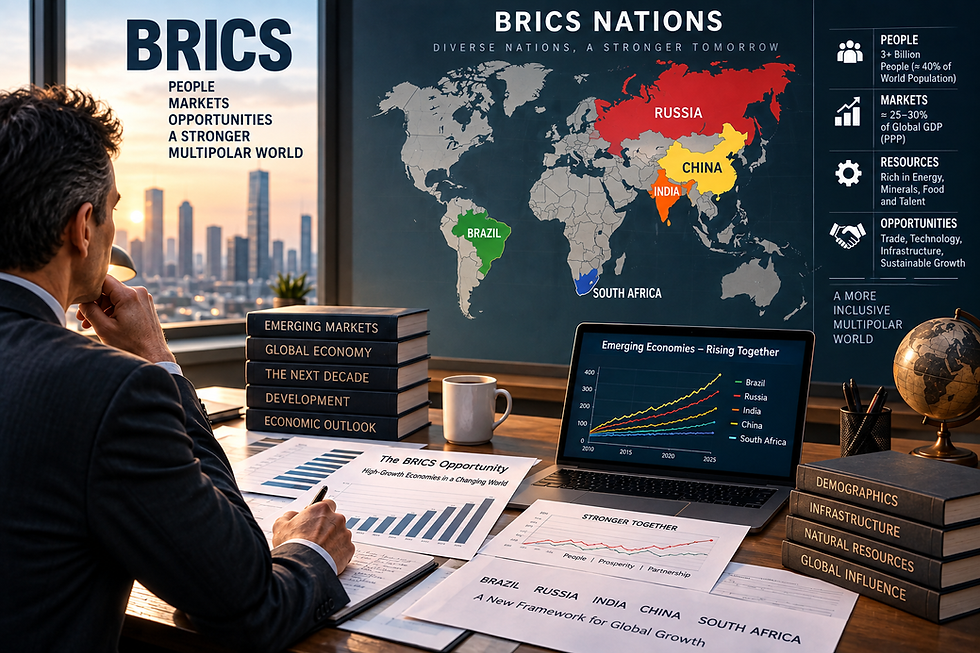
BRICS has evolved from a Wall Street investment acronym into one of the most closely watched political and economic groupings in the world.
What began as BRIC, referring to Brazil, Russia, India and China, gradually became a diplomatic platform seeking a larger voice for emerging economies in global institutions. South Africa later joined, turning BRIC into BRICS, and a much larger expansion began in 2024.
Today, BRICS is involved in discussions ranging from trade, development finance and reform of the United Nations to artificial intelligence, energy security, local-currency payments and the political representation of the Global South.
Its growth, however, has also created serious internal tensions. Members have different political systems, security interests, relationships with the United States and Europe, regional rivalries and ideas about what BRICS should ultimately become.
This is the story of how BRICS began, who founded it, how it expanded, what it has achieved, and what has caused friction inside the group.
1. Where Did the Word BRICS Come From?
The story begins not with a government summit, but with an investment-bank research paper.
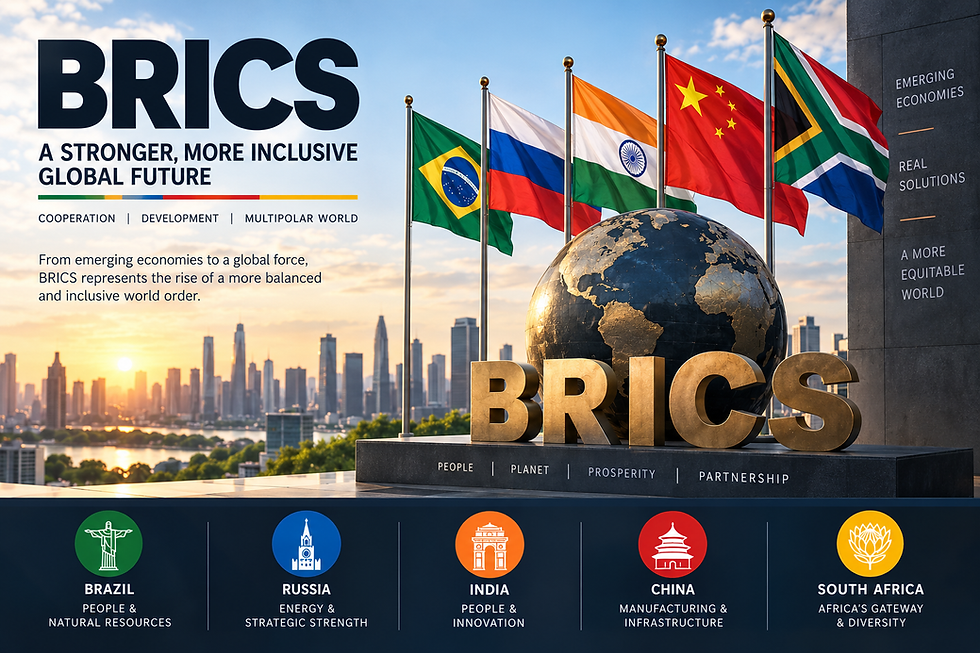
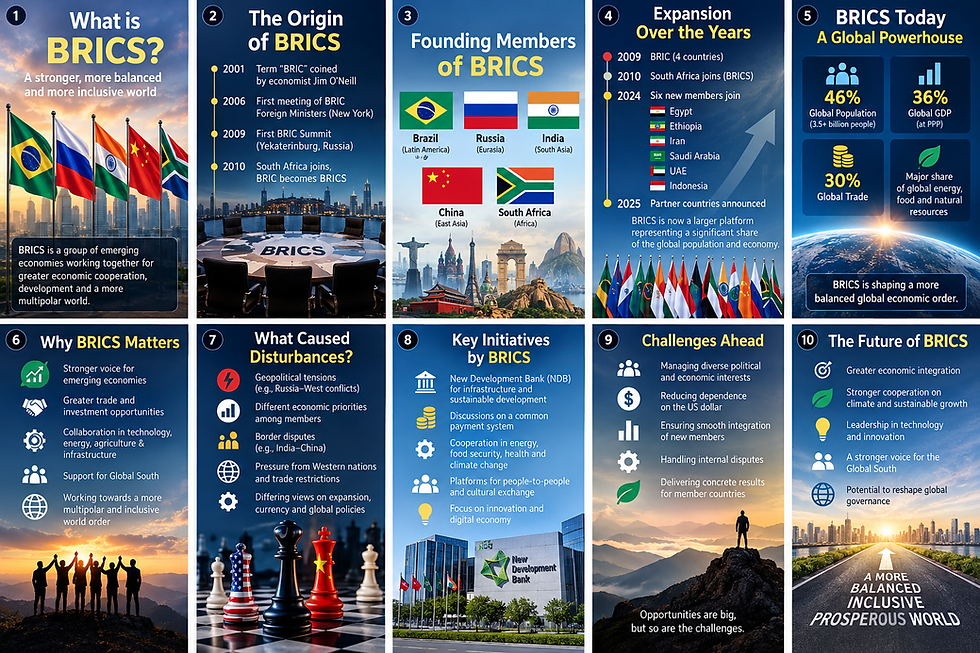
In 2001, Goldman Sachs economist Jim O'Neill used the term BRIC for Brazil, Russia, India and China. His analysis argued that these four large emerging economies were likely to occupy a much greater share of the global economy over the following decades.
This distinction is important:
Jim O'Neill created the acronym. He did not create the political organisation.
The actual diplomatic grouping emerged later through cooperation among the governments of Brazil, Russia, India and China.
Brazilian diplomat and former Foreign Minister Celso Amorim has recalled that Russian diplomat Sergey Lavrov suggested creating a forum among the countries represented by the BRIC idea. Governments then developed the concept into a political dialogue.
So BRICS has two different origin stories:
Origin | What happened |
Economic origin | Jim O'Neill coined BRIC in 2001 |
Diplomatic origin | Brazil, Russia, India and China turned the idea into an intergovernmental forum |
2. Who Were the Founding Members of BRICS?
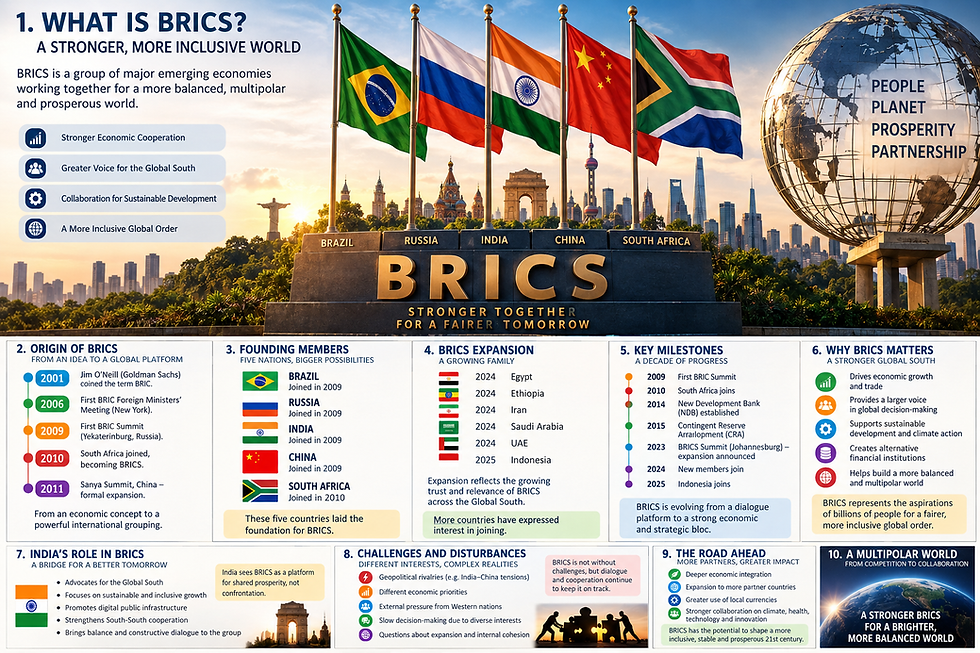
The four original members were:
Brazil
Russia
India
China
These countries constituted the original BRIC grouping.
The first formal meeting of BRIC foreign ministers took place on the sidelines of the United Nations General Assembly in New York in September 2006. India's Ministry of External Affairs describes this meeting as the formalisation of the grouping.
The first BRIC summit of heads of state and government followed in Yekaterinburg, Russia, on 16 June 2009.

The leaders participating in that first summit were:
Country | Leader at the first BRIC Summit in 2009 |
Brazil | President Luiz Inácio Lula da Silva |
Russia | President Dmitry Medvedev |
India | Prime Minister Manmohan Singh |
China | President Hu Jintao |
They should be understood as the leaders of the four founding states at the first formal summit, rather than as four individual "founders" of BRICS.
3. Why Was BRIC Formed?
Although the four economies were different, they shared an important concern.
The structure of global economic governance still largely reflected the balance of power that emerged after the Second World War.
Institutions such as the:
International Monetary Fund
World Bank
United Nations Security Council
broader Western-led financial system
gave emerging economies less influence than BRIC members believed their growing economic weight justified.
The 2008 global financial crisis strengthened the argument that the international financial architecture needed reform. BRIC countries increasingly coordinated positions through forums including the G20, IMF and World Bank.
At the first summit in 2009, the countries called for a more representative international financial architecture and a greater voice for developing countries.
BRIC was therefore gradually transformed from an investment concept into a platform for global-governance reform.
4. South Africa Joins and BRIC Becomes BRICS
A major turning point came in 2010.
The BRIC countries agreed to invite South Africa into the grouping.
South Africa then attended the 2011 Sanya Summit in China as a full member.
The letter S was added, transforming BRIC into BRICS.
South Africa's inclusion was strategically significant.
It gave the group stronger representation on the African continent and expanded BRICS beyond the four economies originally identified by Goldman Sachs.
The five-member configuration of:
Brazil, Russia, India, China and South Africa
remained the familiar BRICS format for more than a decade.
5. The 2008 Financial Crisis Gave BRICS Political Momentum
The global financial crisis was one of the most important events in BRICS history.
The crisis damaged confidence in the established financial system and accelerated demands from emerging economies for changes to international financial governance.
BRICS members argued that developing countries deserved greater voting rights and representation in major financial institutions.
This shared objective became one of the strongest sources of unity within BRICS.
Yet the organisation did not become a formal alliance.
BRICS remains an unusual structure. It has historically operated through rotating presidencies, ministerial meetings, working groups and consensus rather than through a NATO-style treaty or EU-style bureaucracy.
Official BRICS material notes that the grouping does not have a constitutive treaty, its own permanent budget or a permanent secretariat.
That flexibility is one reason very different countries can belong to it.
It is also one of the reasons implementation can be difficult.
6. The New Development Bank Changed BRICS from Dialogue to Institution Building
One of BRICS' biggest achievements came at the 2014 Fortaleza Summit in Brazil.
BRICS governments signed the agreement establishing the New Development Bank, or NDB.
The bank was designed to mobilise finance for infrastructure and sustainable-development projects in developing countries. Its authorised capital was established at US$100 billion.
The idea for such a bank had been discussed by BRICS leaders from 2012 onward.
The agreement was signed in 2014, and the NDB began operations in 2015.
Its headquarters were placed in Shanghai.
India supplied the bank's first president, K. V. Kamath.
The establishment of the NDB demonstrated that BRICS could build institutions rather than simply issue political declarations.
7. BRICS Also Created a US$100 Billion Emergency Reserve Arrangement
The Fortaleza Summit produced another important institution: the Contingent Reserve Arrangement, or CRA.
The CRA was created as a financial safety mechanism that could provide liquidity support when a member faced short-term balance-of-payments pressure.
Its initial committed resources totalled US$100 billion.
The original commitments were:
Country | CRA Commitment |
China | US$41 billion |
Brazil | US$18 billion |
Russia | US$18 billion |
India | US$18 billion |
South Africa | US$5 billion |
Together, the NDB and CRA gave BRICS a much more concrete economic dimension.
8. BRICS During the 2010s
Through the 2010s, BRICS broadened cooperation into numerous areas, including:
finance
trade
agriculture
energy
science
technology
education
health
counter-terrorism
climate policy
culture
academic cooperation
people-to-people exchanges
At the same time, the five governments continued demanding reforms to global institutions.
However, major political differences were already becoming visible.
BRICS was united around the idea that the international system should become more representative.
It was far less united on exactly what a new global order should look like.
That distinction remains crucial today.
9. The COVID-19 Period
The COVID-19 pandemic temporarily changed how BRICS operated.
Several summits and meetings moved to virtual formats.
The crisis also brought new attention to:
healthcare cooperation
vaccine access
supply chains
digitalisation
economic recovery
resilience
India hosted the 13th BRICS Summit virtually on 9 September 2021 under the theme of continuity, consolidation and consensus.

10. The 2023 Johannesburg Summit Triggered the Biggest Expansion
The next historic transformation occurred at the 15th BRICS Summit in Johannesburg in August 2023.
The five members agreed to invite six countries:
Argentina
Egypt
Ethiopia
Iran
Saudi Arabia
United Arab Emirates
to become members from 1 January 2024.
Argentina subsequently decided not to join after President Javier Milei took office.
Egypt, Ethiopia, Iran and the UAE entered the expanded grouping in 2024.
Indonesia formally joined in January 2025.
11. Is Saudi Arabia a BRICS Member?
This requires a special explanation because current sources do not describe Saudi Arabia's status consistently.
Official BRICS material published during Brazil's 2025 presidency, as well as an Indian Ministry of External Affairs brief, listed Saudi Arabia among 11 BRICS members.
However, Reuters reporting around the September 2026 New Delhi summit described the bloc as having 10 formal members and said Saudi Arabia had been invited but had not formally joined.
This discrepancy itself reveals one weakness of BRICS: because it does not operate with a single permanent secretariat and detailed treaty structure, membership terminology can occasionally become politically and administratively ambiguous.
The undisputed current full-member core in September 2026 consists of:
Brazil, Russia, India, China, South Africa, Egypt, Ethiopia, Iran, the United Arab Emirates and Indonesia.
Saudi Arabia continues to participate closely in the BRICS process, but its exact formal accession status has been described differently by official and major-news sources.
12. BRICS Partner Countries
Expansion did not stop with full membership.
At the 2024 Kazan Summit, BRICS created a new category called BRICS Partner Country.
By 2025, partner participation had broadened to countries including Belarus, Bolivia, Cuba, Kazakhstan, Malaysia, Nigeria, Thailand, Uganda, Uzbekistan and Vietnam.
The partner model allows BRICS to widen its diplomatic reach without immediately converting every interested country into a full voting member.
13. What Caused Disturbance and Internal Tension Inside BRICS?
The expansion of BRICS increased its geopolitical importance.
It also made consensus more difficult.
There is no single "BRICS crisis". Instead, several overlapping disputes and structural tensions have periodically disturbed cooperation.
13.1 India-China Rivalry
Perhaps the most important internal strategic tension has been the relationship between India and China.
The two countries are major Asian powers with:
a disputed border
competing regional interests
different relationships with the United States
concerns over trade imbalances
competing visions of Asian leadership
Relations deteriorated sharply following the deadly 2020 border clash in Ladakh.
Although relations have improved somewhat, the border dispute, economic competition and geopolitical mistrust continue to affect BRICS cooperation.
The September 2026 New Delhi BRICS Summit included another effort by Prime Minister Narendra Modi and President Xi Jinping to stabilise the relationship.
13.2 Russia's War in Ukraine
Russia's invasion of Ukraine in 2022 created another major fault line.
BRICS governments did not take identical positions.
Some members sought neutrality or strategic distance, while continuing economic relations with Russia.
Western sanctions also complicated international banking, investment and trade.
The conflict therefore forced BRICS countries to balance their relationship with Russia against their relationships with Europe and the United States.
13.3 Expansion Created a Cohesion Problem
Adding new members gave BRICS much greater demographic, economic and geopolitical weight.
But it also created a basic organisational problem:
The larger BRICS becomes, the harder it becomes to maintain consensus.
China and Russia have generally been more enthusiastic about expansion.
India and Brazil have at times approached enlargement more cautiously because rapid growth could dilute existing members' influence and make decision making harder.
A 2026 Carnegie analysis described the key challenge as a tension between expansion and institutional coherence.
13.4 Different Ideas About the West
Members also disagree over the geopolitical identity BRICS should adopt.
Some governments favour using BRICS more assertively to reduce Western dominance.
Others, including India and Brazil in many contexts, prefer presenting BRICS as a platform for reform and strategic autonomy rather than an explicitly anti-Western alliance.
This creates a recurring debate:
Is BRICS anti-West?
Not necessarily.
For several members, the objective is better described as:
"More representation for the Global South"
rather than:
"Replace the West."
The difference matters greatly.
India, for example, simultaneously works through BRICS while maintaining deep relationships with the United States, Europe, Japan and other Western-aligned partners.
14. The De-Dollarisation Debate
Few BRICS issues receive more attention than the possibility of reducing reliance on the US dollar.
Members have explored:
greater use of national currencies
cross-border payment systems
local-currency financing
digital payment connectivity
central-bank digital currency interoperability
But this is often exaggerated into claims that BRICS is about to launch a single common currency.
There is currently no functioning BRICS equivalent of the euro.
India's 2026 agenda has focused more practically on improving cross-border payment mechanisms and increasing settlement in national currencies. Reuters reported that India also explored linking member countries' central-bank digital currencies, while significant political and technical obstacles remain.
So the more realistic BRICS financial objective is presently currency diversification, not the immediate abolition of the dollar.
15. Economic Imbalance Inside BRICS
BRICS countries are not economically equal.
China's economy is significantly larger than those of most other members.
That creates concerns that an organisation based on formal equality could nevertheless become economically China-dominated.
Other members therefore have an incentive to preserve strategic autonomy and prevent one state from defining the entire BRICS agenda.
This is one reason consensus remains so important.

16. Regional Rivalries Entered BRICS With Expansion
Expansion also brought existing Middle Eastern and African disputes inside the BRICS tent.
Potential fault lines include:
Iran and Gulf states
Egypt and Ethiopia
competing regional security priorities
energy-market interests
different relationships with Washington
These disagreements became particularly visible during the 2026 summit amid conflict in the Middle East.
Yet the New Delhi meeting also showed BRICS' diplomatic utility.
Despite sharp differences, Iran and the UAE backed a joint statement calling for restraint, diplomacy and protection of international trade routes.
So the same diversity that creates tension can also make BRICS a useful venue for dialogue.
17. The 2026 New Delhi Summit
India hosted the 18th BRICS Summit in New Delhi on 12 and 13 September 2026.
India's 2026 chairship adopted the theme:
Building for Resilience, Innovation, Cooperation and Sustainability.
The summit took place at an exceptionally difficult geopolitical moment involving:
the war in Ukraine
conflict in the Middle East
US-China strategic competition
pressure on global supply chains
tariff disputes
debates over sanctions
energy security
technological competition
Despite these pressures, members adopted the New Delhi Declaration.
The discussions included:
reform of international institutions
trade
local-currency transactions
financial connectivity
artificial intelligence
digital cooperation
healthcare
sustainable development
food and energy security
conflicts in the Middle East and elsewhere
The successful adoption of a common declaration was especially significant because the expanded group contains states with sharply divergent strategic interests.
18. Why Countries Want to Join BRICS
BRICS membership or partnership appeals to many emerging economies for several reasons.
Greater diplomatic influence
Smaller or middle powers can gain access to a platform containing some of the world's largest economies.
Reform of global institutions
Many developing countries believe institutions such as the IMF, World Bank and UN Security Council should better reflect today's distribution of population and economic power.
Development finance
The New Development Bank offers another source of financing for infrastructure and sustainable development.
More diversified trade relationships
Countries can deepen economic links across Asia, Africa, Latin America and the Middle East.
Strategic autonomy
Membership gives governments another diplomatic platform that is not controlled by the United States or European powers.
19. What BRICS Is Not
BRICS is often misunderstood.
It is not NATO.
Members do not have a collective-defence commitment.
It is not the European Union.
There is no supranational BRICS government.
It is not a single market.
Goods, capital and people do not automatically move freely among members.
It is not currently a currency union.
There is no common BRICS currency in circulation.
And BRICS should not automatically be treated as a united geopolitical bloc on every international issue.
Its members frequently disagree.
BRICS works primarily because countries cooperate where interests overlap while tolerating substantial disagreement elsewhere.

20. The Biggest Strength of BRICS
Its biggest strength is representation.
BRICS connects major economies and populations across:
Asia
Africa
Latin America
Eurasia
the Middle East
Its growing membership gives the Global South a platform to coordinate demands for changes to international governance.
It also allows governments that may disagree strongly on security issues to remain engaged economically and diplomatically.
21. The Biggest Weakness of BRICS
Its biggest strength is also its biggest weakness:
diversity.
The more countries BRICS brings together, the more difficult it becomes to agree on:
security
currency policy
trade rules
sanctions
border disputes
institutional reform
membership
relations with the United States
relations with China
regional conflicts
BRICS operates heavily through consensus.
A larger membership therefore increases the risk that ambitious proposals become watered down.
22. BRICS Timeline: 2001 to 2026
Year | Major Development |
2001 | Jim O'Neill coins the term BRIC |
2006 | First BRIC foreign-ministers meeting in New York |
2008 | Global financial crisis increases coordination among emerging economies |
2009 | First BRIC leaders' summit in Yekaterinburg, Russia |
2010 | Decision taken to admit South Africa |
2011 | South Africa joins, BRIC becomes BRICS |
2012 | BRICS leaders begin considering a development bank |
2014 | New Development Bank and Contingent Reserve Arrangement created |
2015 | New Development Bank begins operations |
2020 | Pandemic pushes major BRICS engagement online |
2021 | India hosts virtual New Delhi Summit |
2022 | Beijing Summit amid growing geopolitical tensions |
2023 | Johannesburg Summit approves major expansion |
2024 | Egypt, Ethiopia, Iran and UAE enter expanded BRICS; partner-country framework developed |
2025 | Indonesia becomes a full member |
2026 | India chairs BRICS and hosts the 18th Summit in New Delhi |
23. Founding Members Versus Later Members
Original BRIC founding members
Brazil
Russia
India
China
First expansion
South Africa, joined in 2011
Later expansion
Egypt
Ethiopia
Iran
United Arab Emirates
Indonesia
Saudi Arabia
Invited in 2023 and listed as a member in several official BRICS documents, although major September 2026 reporting continues to describe its formal accession status differently.
24. Who Really "Founded" BRICS?
There is no single BRICS founding father.
The most accurate answer separates three contributions:
Jim O'Neill: coined the economic acronym BRIC in 2001.
The governments of Brazil, Russia, India and China: transformed the concept into a diplomatic grouping.
Political and diplomatic leaders including Sergey Lavrov and Celso Amorim: helped develop early coordination among the four states.
The organisation was therefore not designed by one person.
It evolved from an economic idea into a political institution through several years of diplomacy.
25. Will BRICS Replace the G7, IMF or the US Dollar?
Probably not in any simple or immediate sense.
Its more realistic impact is different.
BRICS is helping create a world in which emerging economies have more institutional options.
The NDB does not need to replace the World Bank to matter.
National-currency trade does not need to eliminate the dollar to reduce dependence on it.
BRICS does not need to replace the G7 to increase the bargaining power of the Global South.
Its influence therefore comes from adding alternatives, not necessarily destroying existing institutions.
26. The Future of BRICS
The next phase of BRICS will depend on whether it can transform political symbolism into measurable cooperation.
Its key tests will include:
making the expanded membership workable;
maintaining balance between China, India, Russia, Brazil and other influential members;
increasing useful intra-BRICS trade;
strengthening the New Development Bank;
building credible cross-border payment systems;
managing disputes among members;
agreeing on clear membership rules;
cooperating on AI, climate, health and technology;
retaining a Global South identity without becoming trapped in rigid bloc politics;
converting summit declarations into implementation.
India's 2026 presidency has highlighted this challenge clearly: BRICS is now large enough to matter enormously, but also diverse enough to be difficult to manage.
Conclusion: From an Investment Acronym to a Global Political Platform
BRICS began with four letters in a Goldman Sachs research paper.
Twenty-five years later, it has become a major platform connecting some of the world's largest emerging powers.
Its history can be understood in four stages:
2001: an economic idea.
2006 to 2009: the creation of a diplomatic forum.
2011 to 2015: institutional consolidation through South Africa, the NDB and the CRA.
2023 onward: rapid expansion into a much broader Global South platform.
Its rise has been driven by dissatisfaction with the representation of developing countries in global governance.
Its difficulties come from something equally fundamental: BRICS contains nations with very different strategic interests.
That is why BRICS should neither be dismissed as a talking shop nor exaggerated into a unified anti-Western super-bloc.
Its real significance lies somewhere between those extremes.
BRICS is an experiment in whether large, politically diverse emerging economies can cooperate sufficiently to reshape parts of the international system without surrendering their individual strategic autonomy.
The outcome of that experiment will influence the politics and economics of the multipolar world for decades to come.
Disclaimer
This article has been prepared and published solely for general informational, educational and awareness purposes.
The content represents a good-faith compilation and interpretation of information obtained from publicly available sources, official publications, media reports, research material and other references believed to be reliable at the time of writing. However, geopolitical developments, diplomatic positions, economic data, international memberships, government policies, leadership positions and institutional arrangements may change at any time.
Parikshit Khanna, Digital Training Jet Pvt. Ltd., Digital Training Jet, its founders, directors, employees, trainers, consultants, associates, contractors, representatives, partners and team members make no representation, guarantee or warranty, express or implied, regarding the completeness, accuracy, reliability, suitability, timeliness or continued validity of any information contained in this article.
The article should not be treated as legal, financial, investment, diplomatic, political, economic, tax, compliance, foreign-policy or professional advice. Readers should independently verify all material facts and consult appropriately qualified professionals, government authorities or official sources before taking any action based on the information contained herein.
Any discussion concerning BRICS countries, governments, political leaders, diplomatic relations, international conflicts, sanctions, currencies, economic policies, international institutions or geopolitical developments is intended only for neutral educational and analytical discussion. Nothing in this article should be interpreted as an endorsement, criticism, political position, diplomatic representation or official statement on behalf of any government, institution, organisation, political party, company or individual.
The mention of any country, government, public official, organisation, institution, company, publication, trademark, logo or third-party source is for identification, commentary, reference or educational purposes only and does not imply sponsorship, endorsement, affiliation, partnership or approval.
Images, maps, illustrations, infographics and AI-generated visuals accompanying this article are representational and illustrative in nature. They should not be interpreted as documentary evidence, official government material or a precise representation of political boundaries, diplomatic positions, historical events or current geopolitical conditions.
To the maximum extent permitted by applicable law, Parikshit Khanna, Digital Training Jet Pvt. Ltd., Digital Training Jet and all associated team members, employees, representatives and contributors shall not be responsible or liable for any direct, indirect, incidental, consequential, special, financial, reputational, commercial or other loss, damage, dispute, claim, misunderstanding, decision or action arising from or connected with the reading, interpretation, use, misuse or reliance upon this article or its accompanying materials.
Readers access and use this content entirely at their own discretion and risk.
No part of this publication should be construed as creating any contractual, fiduciary, advisory, professional or other legal relationship between the reader and Parikshit Khanna, Digital Training Jet Pvt. Ltd., Digital Training Jet or any member of their team.
Where information differs between official sources, media organisations or international institutions, such differences may reflect evolving events, terminology or diplomatic positions. Readers are encouraged to consult the latest official sources for verification.
The publisher reserves the right to correct, revise, update, modify or remove any portion of this article at any time without prior notice.
By reading, accessing, sharing or relying upon this article, the reader acknowledges and accepts the limitations stated in this disclaimer.
Copyright and Publication Notice:Unless otherwise stated, the original commentary and presentation of this article are published for educational and informational purposes. Third-party names, marks and references remain the property of their respective owners.
Important: No disclaimer can exclude liability where exclusion is prohibited by applicable law. This disclaimer should therefore be interpreted only to the fullest extent legally permissible.


Comments