INDIA IN SPACE

Updated: Aug 24
India’s Rocket Achievements: How India Became a Global Space Power and Why the Next Era Could Be Even Bigger
From SLV-3 to the Moon: The Extraordinary Rise of India in Space

Few technological stories demonstrate India's transformation as powerfully as its journey into space.
India progressed from launching relatively small experimental rockets to developing sophisticated launch vehicles, indigenous cryogenic propulsion, lunar and interplanetary spacecraft, commercial launch capabilities and autonomous spacecraft docking.
Today, India's space ambitions stretch considerably further.
Human spaceflight, lunar sample return, reusable launch technologies, next-generation launch vehicles and a future Indian space station are increasingly becoming parts of the same long-term technological roadmap.
This transformation did not happen overnight.
It represents decades of research, engineering, experimentation, setbacks, learning and incremental technological advancement.
The result is something considerably more important than a collection of spectacular missions:
India has developed independent access to space and is building an increasingly comprehensive space ecosystem.
India’s Rocket Achievements at a Glance
India's space journey can be understood through a series of technological leaps.
1960s: Sounding rockets begin India's experimental space journey.
1980: SLV-3 successfully places Rohini RS-1 into orbit.
1990s onward: PSLV develops into India's versatile workhorse launcher.
2000s onward: GSLV expands India's ability to launch heavier spacecraft.
2014: Indigenous cryogenic technology reaches a major operational milestone.
2014: Mars Orbiter Mission reaches Mars.
2017: PSLV launches 104 satellites in a single mission, a world record at the time.
2023: Chandrayaan-3 achieves India's historic lunar soft landing.
2023–24: Aditya-L1 becomes India's first dedicated solar observatory mission.
2024: SSLV completes its third developmental flight successfully.
2025: SpaDeX demonstrates docking and undocking in orbit.
2025: GSLV-F16 successfully launches the joint NISAR mission.
2025: India reaches 100 launches from Sriharikota.
2025–26: New LVM3 records, propulsion developments, Gaganyaan tests and new infrastructure expand India's capabilities.
Next era: Gaganyaan, Chandrayaan-4, next-generation launch systems, reusable technology and the Bharatiya Antariksh Station.
1. SLV-3: The Beginning of India’s Independent Access to Space
One of the most important dates in India's technological history is 18 July 1980.
On that day, India's Satellite Launch Vehicle-3 successfully placed the Rohini RS-1 satellite into orbit.
SLV-3 was relatively modest compared with modern Indian launch vehicles, but its strategic importance was enormous.
It demonstrated that India could develop a launch vehicle and place its own satellite into orbit.
That meant India was no longer simply participating in space science.
It was developing independent access to space.
The technologies, engineering expertise and institutional experience created during the SLV programme contributed to the generations of Indian launch vehicles that followed.
SLV-3 therefore deserves to be remembered not merely as an early rocket.
It was the technological seed from which India's modern launch capability grew.
2. PSLV: The Rocket That Built India’s Global Launch Reputation

If SLV-3 proved India could reach orbit, the Polar Satellite Launch Vehicle — PSLV — proved India could do it repeatedly and for increasingly sophisticated missions.
PSLV evolved into India's workhorse launcher.
Its importance comes from its extraordinary versatility.
PSLV has been used for Earth-observation missions, navigation missions, scientific spacecraft, international customer satellites and missions heading beyond Earth orbit.
Among the major missions launched aboard PSLV are:
Chandrayaan-1,Mars Orbiter Mission,Aditya-L1,XPoSat,and hundreds of Indian and international satellites.
One of PSLV's most famous missions occurred on 15 February 2017, when PSLV-C37 deployed 104 satellites in a single mission.
That represented a world record at the time.
The number made headlines internationally, but the engineering underneath the achievement was even more important.
Deploying such a large number of spacecraft requires sophisticated mission planning, sequencing, navigation and separation management.
PSLV therefore became much more than another Indian rocket.
It became one of the strongest symbols of India's engineering credibility in the international launch market.
3. India’s Cryogenic Breakthrough

Developing cryogenic rocket technology represented one of the toughest engineering challenges in India's space journey.
Cryogenic engines operate using propellants maintained at extremely low temperatures.
Mastering this technology is important because higher-performance upper stages allow launch vehicles to carry heavier spacecraft toward demanding orbits.
India eventually developed an indigenous Cryogenic Upper Stage for GSLV.
This achievement was strategically important because it reduced dependence on foreign propulsion technology for an essential part of India's heavier launch architecture.
The significance goes beyond one engine.Cryogenic capability requires mastery across:
advanced metallurgy,turbopumps,combustion,propellant management,thermal engineering,precision manufacturing,control systems,and extensive testing.
India's success in this field therefore represented a major expansion of its technological sovereignty.
4. GSLV: Moving India Into Heavier Missions

The Geosynchronous Satellite Launch Vehicle, or GSLV, expanded India's ability to transport heavier spacecraft.
Its indigenous cryogenic upper stage enabled approximately two-tonne-class communication satellites to be launched toward geosynchronous transfer orbit.
GSLV's importance continues today.
In January 2025, the GSLV-F15/NVS-02 mission became the 100th launch from Sriharikota.
Later that year, GSLV-F16 launched the sophisticated NISAR Earth-observation spacecraft.
India had moved a long way from the experimental launch-vehicle era.
It was now operating multiple classes of orbital launch vehicles.
5. LVM3: India Enters a New Heavy-Lift Era

The Launch Vehicle Mark-3, or LVM3, represents another major increase in India's launch capability. LVM3 is designed to carry approximately:
10 tonnes to Low Earth Orbit and 4-tonne-class spacecraft toward Geosynchronous Transfer Orbit.
It incorporates indigenous technologies including the powerful C25 cryogenic stage.
LVM3 launched Chandrayaan-3.
It has also supported major commercial satellite launches.
And its importance will increase further because the human-rated evolution of LVM3 is central to India's Gaganyaan programme.
LVM3 therefore connects three dimensions of India's space ambitions:
scientific exploration, commercial launch services and human spaceflight.
6. Chandrayaan-1: India Goes to the Moon

India's rocket story eventually became a deep-space story.
Chandrayaan-1 was launched aboard PSLV-C11 in October 2008.
The mission demonstrated that India could design, launch, navigate and operate a sophisticated spacecraft around another celestial body.
Chandrayaan-1 also contributed important scientific observations associated with evidence of water and hydroxyl molecules on the lunar surface. Its wider impact was enormous.
India had demonstrated that its launch and spacecraft technologies could support planetary exploration.
The Moon was no longer beyond India's technological reach.
7. Mangalyaan: India Reaches Mars
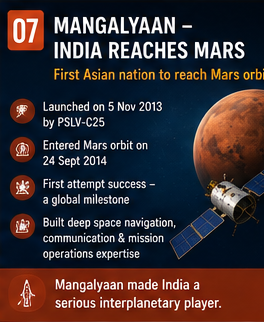
The Mars Orbiter Mission — Mangalyaan — became one of the most internationally recognised achievements of India's space programme.
The spacecraft was launched aboard PSLV-C25 in 2013 and successfully entered Martian orbit in September 2014.
India became the first Asian nation to reach Mars orbit.
Even more remarkably, India succeeded in reaching Martian orbit on its first attempt.
Mangalyaan demonstrated capabilities extending far beyond rocket launch.
India had to master:
deep-space navigation,
interplanetary trajectory design,
spacecraft autonomy,
long-distance communications,
orbital manoeuvring,
mission operations,
and highly efficient mission planning.
The mission announced something important to the world:
India had become a serious interplanetary spacefaring nation.
8. Chandrayaan-3: India Makes Lunar History
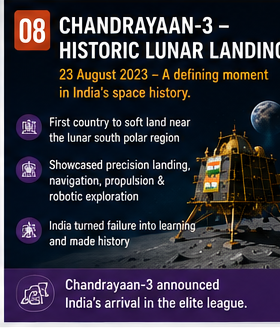
On 23 August 2023, India achieved one of the defining technological moments in its history.
Chandrayaan-3 successfully soft-landed near the Moon's south polar region.
India became the first country to achieve a successful soft landing near the lunar south polar region.
The distinction is important: the scientifically precise description is near the lunar south polar region, rather than claiming the spacecraft landed literally on the geographic south pole.
Chandrayaan-3 demonstrated advances in:
autonomous navigation,
precision landing,
propulsion,
hazard detection,
lunar surface mobility,
mission planning,
and robotic exploration.
It also demonstrated something equally important about India's engineering culture.
India learned from the Chandrayaan-2 landing setback, redesigned systems, tested extensively and returned successfully.
That ability to convert failure into engineering knowledge is one of the strongest characteristics of mature technological programmes.
9. Aditya-L1: India Turns Toward the Sun

India's scientific ambitions then expanded from the Moon and Mars toward our nearest star.
Aditya-L1 is India's first dedicated solar observatory mission.
It was launched aboard PSLV-C57 in September 2023 and subsequently entered its intended halo orbit around the Sun-Earth L1 region.
From this position, the spacecraft can conduct sustained observations of solar phenomena.
Aditya-L1 demonstrates that India's space-science programme is becoming increasingly diversified.
India is now developing expertise across:
lunar science,
planetary exploration,
solar physics,
X-ray astronomy,
Earth observation,
navigation,
communications,
and space-based experimentation.
10. SSLV: A Small Rocket for a Huge New Market

The global satellite industry is changing rapidly.
Many spacecraft are becoming smaller.
Commercial constellations are growing.
Customers increasingly want faster and more flexible access to orbit.
India developed the Small Satellite Launch Vehicle — SSLV — for this emerging market.
SSLV is designed for roughly 500 kg-class payloads to a 500 km Low Earth Orbit.
Its third developmental flight was completed successfully in August 2024.
By July 2026, the Government reported that SSLV development had been completed and a technology-transfer agreement had been signed with Indian industry.
That last development could prove particularly important.
India's future space growth will increasingly depend on transferring mature technologies into industry so that commercial players can manufacture, operate and scale them.
11. SpaDeX: India Masters Space Docking

One of India's most strategically important recent achievements occurred hundreds of kilometres above Earth.
The Space Docking Experiment — SpaDeX — demonstrated India's ability to rendezvous and dock two spacecraft in orbit.
The spacecraft successfully docked in January 2025.
Undocking was subsequently demonstrated.
India also demonstrated a second docking and power transfer between the spacecraft.
The achievement made India the fourth nation to demonstrate docking capability in space.
Why is docking so important?
Because the next generation of space exploration requires spacecraft to interact with one another after launch.
Docking technology can enable:
space-station construction,
crew transfers,
cargo operations,
lunar sample-return missions,
in-orbit servicing,
multi-launch exploration missions,
and future orbital infrastructure.
SpaDeX is therefore not merely an isolated technology demonstration.
It is part of the technological foundation for India's future in space.
12. NISAR: India Becomes a Major Partner in Global Space Science
India's growing capability does not mean it must operate alone.
A technologically capable India can become an increasingly valuable international partner.
The NASA-ISRO Synthetic Aperture Radar mission — NISAR — illustrates this.
GSLV-F16 successfully launched NISAR on 30 July 2025.
The spacecraft combines NASA's L-band radar with India's S-band radar.
It is designed to provide sophisticated observations of changes affecting Earth's land, vegetation, ice, water and natural hazards.
NISAR demonstrates a powerful principle:
Technological self-reliance and international cooperation can reinforce each other.
The stronger India's domestic capabilities become, the more valuable India can become as a partner in major international scientific programmes.
13. 100 Launches From Sriharikota

January 2025 produced another symbolic milestone.
The GSLV-F15/NVS-02 mission represented the 100th launch from India's spaceport at Sriharikota.
A hundred launches tell a story very different from one spectacular mission.
They represent accumulated expertise in:
launch operations,
range safety,
mission control,
vehicle integration,
tracking,
propulsion,
weather assessment,
ground infrastructure,
and thousands of engineering procedures.
Space capability ultimately depends upon institutional repetition.
India has progressively built that institutional experience.
14. India’s Recent Launch Record Shows Growing Scale
India's recent numbers demonstrate the expanding scope of the programme.
According to the Government of India, between July 2023 and June 2026, India successfully completed:
12 launch-vehicle missions,
11 national satellite launches,
and
9 satellites for international customers.
During the same period India achieved Chandrayaan-3's historic lunar landing, launched Aditya-L1, reached the milestone of 100 launches from Sriharikota, demonstrated docking through SpaDeX and completed SSLV development.
This is significant because the measure of a major space power is not one mission.
It is sustained capability across many different mission categories.
15. Gaganyaan: India Prepares for Human Spaceflight

India's next transformation is even more demanding.
Gaganyaan aims to establish India's independent human-spaceflight capability.
Sending people into space is fundamentally different from launching satellites.
Human spaceflight requires extraordinarily high standards across:
launch-vehicle reliability,
crew escape,
life-support systems,
crew-module design,
re-entry,
parachutes,
recovery,
astronaut training,
mission control,
medical systems,
and emergency procedures.
Development and qualification work remains underway.
In April 2026, the second Integrated Air Drop Test was successfully conducted using a simulated Crew Module weighing approximately 5.7 tonnes.
This is exactly why future mission dates should be treated as programme targets rather than guaranteed schedules.
When Gaganyaan succeeds, India will move from being a nation that sends sophisticated machines into space to one capable of independently sending humans.
16. India's Launch Programme Is Still Learning — And That Matters
A credible assessment of India's achievements should include setbacks as well as successes.
Not every mission succeeds.
PSLV-C61/EOS-09 in May 2025 was not accomplished successfully.
The January 2026 PSLV-C62/EOS-N1 mission also encountered an anomaly during the PS3 stage.
Acknowledging these events does not diminish India's achievements.
Quite the opposite.
Rocketry is exceptionally difficult.
Every major space programme experiences failures, anomalies and redesign cycles.
The real measure of technological maturity is whether failures are investigated rigorously and converted into improved engineering.
India's ability to maintain long-term progress while learning from setbacks will be crucial to the next stage of its development.
17. India Is Building Launch Infrastructure for a Much Bigger Future

Rocket capability requires infrastructure.
India's ambitions therefore extend beyond developing new vehicles.
A Third Launch Pad has been approved.
Development of the SSLV Launch Complex at Kulasekarapattinam has progressed.
New propulsion, manufacturing and testing infrastructure has also been commissioned or developed.
This matters because increasing India's share of the global launch market requires something beyond excellent rockets:
launch cadence.
If India wants to launch more frequently, serve more international customers and support large domestic constellations, it needs greater industrial and launch-site capacity.
18. Reusable Launch Technology Could Transform India's Economics
One of the biggest changes in the global launch industry is reusability.
Traditionally, much of a rocket is discarded after a single mission.
That is economically inefficient.
Reusable systems have the potential to lower costs and increase launch frequency.
India has therefore been developing technologies through its Reusable Launch Vehicle programme.
Landing experiments, propulsion development, avionics and associated technologies are important building blocks.
For India, this field is strategically important.
India already possesses a strong culture of cost-conscious engineering.
Combining that philosophy with operational reusability could significantly strengthen India's global competitiveness.
19. Chandrayaan-4: The Next Level of Lunar Capability
Landing on the Moon was an extraordinary achievement.
Bringing material back from the Moon would be significantly harder.
That is the ambition behind Chandrayaan-4.
A lunar sample-return architecture demands capabilities such as:
landing,
sample collection,
lunar ascent,
rendezvous,
docking,
transfer,
Earth return,
and safe re-entry.
This is why India's different programmes should not be viewed independently.
SpaDeX develops docking.
Gaganyaan develops human-rated systems and recovery expertise.
Chandrayaan develops lunar technologies.
Advanced launch vehicles increase payload capability.
Together, these technologies create the architecture required for increasingly complex exploration.
20. NGLV: India Needs a Bigger Rocket for Bigger Ambitions
India's current launch vehicles are highly capable, but its future objectives are much larger.
A national space station, heavier commercial payloads, complex lunar missions and eventually human exploration beyond Low Earth Orbit require significantly greater launch capacity.
That is where India's Next Generation Launch Vehicle — NGLV — becomes strategically important.
The objective is not merely to construct another rocket.
India needs a transportation architecture capable of supporting the scale of its future space economy.
That means:
higher payload capacity,
lower launch cost,
higher launch frequency,
greater industrial production,
and ultimately increased reusability.
If successfully developed and operationalised, NGLV could become one of the most important technological projects in the next phase of India's space programme.
21. Bharatiya Antariksh Station: India Plans a Permanent Presence in Orbit
India's ambition increasingly extends beyond visiting space.
It aims eventually to maintain a sustained human presence there.
The proposed Bharatiya Antariksh Station represents this transition.
A national orbital station requires mastery of many interconnected technologies:
human spaceflight,
docking,
orbital assembly,
life support,
robotics,
power systems,
cargo transportation,
crew transportation,
long-duration operations,
and high-frequency reliable launch services.
The Government's roadmap has identified 2035 as the target horizon for an Indian space station.
That should be understood as an ambitious programme target rather than a guaranteed completion date.
Nevertheless, the direction is clear.
India's ambition is shifting from launching missions to creating space infrastructure.
22. The Private Space Revolution Could Multiply India’s Capability
One of the biggest changes in India's space ecosystem is occurring outside traditional government laboratories.
Private participation is expanding rapidly.
Government reporting in June 2026 stated that India's space-startup ecosystem had grown from just one startup in 2014 to more than 400 by February 2026.
That transformation could be enormously important.
Government space agencies excel at long-horizon science, strategic technology and national missions.
Private companies can add:
commercial competition,
manufacturing scale,
specialised satellite platforms,
launch services,
software,
geospatial analytics,
component manufacturing,
investment,
and faster product cycles.
India's future space strength may therefore come from a combination of public scientific capability and private industrial scale.
23. India's Space Economy Has Considerable Room to Grow
India's scientific accomplishments are already globally recognised.
Its commercial share of the global space economy has considerably more room to expand.
That is an opportunity.
India can develop economic value across:
rocket manufacturing,
launch services,
satellite manufacturing,
communications,
Earth observation,
navigation,
geospatial intelligence,
space-data analytics,
agriculture,
climate services,
disaster management,
defence applications,
insurance,
logistics,
and downstream software.
The goal should therefore not simply be to launch more rockets.
The objective should be to create an entire space-industrial ecosystem.
Why India Has the Potential to Become One of the World's Leading Space Powers
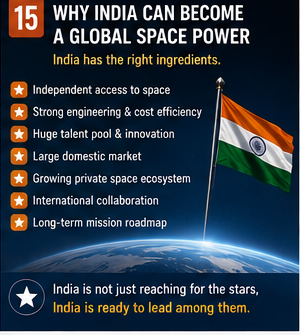
India's future potential rests on several structural advantages.
1. Independent Access to Space
India operates multiple indigenous launch-vehicle families.
That gives the country strategic autonomy.
2. Deep Engineering Experience
India's expertise now extends across solid, liquid and cryogenic propulsion, spacecraft, navigation, orbital operations, planetary exploration and docking.
3. Cost-Conscious Engineering
India has repeatedly demonstrated an ability to achieve sophisticated mission objectives while working within disciplined programme constraints.
The future opportunity is to combine cost-consciousness with greater scale.
4. A Huge Domestic Market
India needs satellites and space-based services for communications, weather, agriculture, navigation, infrastructure, defence, disaster management and climate monitoring.
Domestic demand can therefore support industrial growth.
5. A Large Engineering and Software Talent Base
Modern spacecraft increasingly depend on software, simulation, automation, AI, digital twins, autonomous navigation and advanced analytics.
India's broader technology ecosystem can become a major advantage.
6. Expanding Private Participation
More than 400 space startups by early 2026 indicate that India's space programme is evolving into a broader space economy.
7. International Partnerships
NISAR demonstrates that India can participate in major international missions as a technologically significant partner.
8. A Long-Term Mission Architecture
Gaganyaan, SpaDeX, Chandrayaan-4, next-generation launch systems and the Bharatiya Antariksh Station increasingly reinforce one another technologically.
That interconnected roadmap may be India's greatest strategic advantage.
What India Must Do to Reach the Very Top
India has extraordinary potential.
But potential should not be confused with guaranteed leadership.
To compete with the world's largest space ecosystems, India will need to accelerate several areas.
It must increase launch frequency.
It must improve heavy-lift capability.
It must make reusable launch technology operational.
It must continue improving reliability.
It needs deeper private-sector manufacturing.
Space startups need access to patient capital.
India needs greater international commercial launch market share.
It must strengthen advanced propulsion.
It should expand orbital servicing and space robotics.
It needs world-class space situational awareness and debris-management capabilities.
Universities and research institutions should become more deeply integrated into commercial space innovation.
And India's commercial space economy must grow much faster.
These challenges are substantial.
But India's technological trajectory suggests that none of them is inherently beyond reach.
India Should Not Simply Copy America, China or Europe
India does not need to replicate another country's space ecosystem.
Its strongest model may be distinctly Indian.
That model could combine:
government-backed frontier science
plus
private entrepreneurship
plus
cost-conscious engineering
plus
large domestic demand
plus
international scientific collaboration
plus
strategic technological self-reliance.
If India can combine these strengths effectively, it could create one of the world's most distinctive and competitive space ecosystems.
Why India's Greatest Space Achievement May Still Be Ahead
Consider how far the country has travelled.
From sounding rockets to SLV-3.
From SLV-3 to PSLV.
From PSLV to the Moon.
From the Moon to Mars.
From GSLV to indigenous cryogenic propulsion.
From LVM3 to Chandrayaan-3.
From solar observation to autonomous spacecraft docking.
And now:
from satellites toward human spaceflight,
from lunar landing toward lunar sample return,
from expendable launchers toward reusable systems,
from government programmes toward a private space economy,
and from individual spacecraft toward a future Indian orbital station.
This is what makes India's space story so remarkable.
India's greatest achievement is not simply one rocket, one record or one lunar landing.
It is the country's ability to keep climbing the technological ladder.
The next era will be more difficult.
But it could also be considerably bigger.
India has already proved that it can reach space.
The next challenge is to become one of the countries that defines what humanity does there.
Frequently Asked Questions
What was India's first successful indigenous satellite launch?
SLV-3 successfully placed Rohini RS-1 into orbit on 18 July 1980.
Which is India's workhorse rocket?
PSLV is widely regarded as India's workhorse launch vehicle because of its versatility and extensive mission history.
Which is India's most powerful operational launch vehicle?
LVM3 is India's most capable operational launcher in terms of payload capacity, designed for approximately 10 tonnes to Low Earth Orbit and four-tonne-class payloads toward GTO.
Did India launch 104 satellites with one rocket?
Yes. PSLV-C37 launched 104 satellites in February 2017, establishing a world record at that time.
What was special about Chandrayaan-3?
Chandrayaan-3 made India the first country to achieve a successful soft landing near the Moon's south polar region.
What did SpaDeX achieve?
SpaDeX demonstrated rendezvous, docking, undocking and subsequently power-transfer capabilities in orbit, making India the fourth nation to demonstrate space docking.
Has India's Gaganyaan crewed mission already launched?
No. Gaganyaan development and qualification activities remain underway as of 2026. Readers should rely on current official programme announcements rather than outdated projected launch dates.
Can India become the world's number-one space power?
India has many of the foundations required to become one of the world's leading space powers. Becoming number one would require substantially greater launch cadence, commercial market share, reusable capability, heavy-lift capacity, private investment and industrial scale. It is better viewed as a strategic possibility than a guaranteed outcome.
Disclaimer
This article, “India’s Rocket Achievements: How India Became a Global Space Power and Why the Next Era Could Be Even Bigger,” has been created for educational, informational and general awareness purposes only.
Parikshit Khanna, Digital Training Jet, its team members, associates, employees and contributors are not affiliated with, endorsed by, sponsored by, officially associated with, or representatives of the Government of India, the Department of Space, ISRO, NASA, or any other government, space agency, scientific institution or organization mentioned in this article.
All organization names, mission names, programme names, trademarks and related intellectual property belong to their respective owners. Their inclusion is solely for identification, commentary, education and factual reference.
Information concerning rockets, missions, achievements, timelines, future programmes, economic projections and other developments has been compiled from publicly available and authoritative sources believed to be reliable at the time of publication. Space programmes and future mission schedules may change due to technical, operational, regulatory, financial or policy considerations.
Images and illustrations accompanying this article may include AI-generated or illustrative visualizations created for educational and editorial presentation. Such visuals should not be interpreted as official photographs, engineering drawings, mission designs or representations issued or approved by any space agency.
While reasonable efforts have been made to maintain accuracy, Parikshit Khanna, Digital Training Jet and its team make no representation or warranty regarding the completeness, accuracy or continued currency of every statement and accept no responsibility for decisions made solely on the basis of this article.
For official and most current information about Indian space missions and programmes, readers should refer directly to the relevant Government of India and official space-agency publications.
© Parikshit Khanna / Digital Training Jet. Educational and editorial content. No official affiliation or endorsement is implied.


Comments