Best 10 AI Use Cases for HR Teams

Best 10 AI Use Cases for HR Teams That Go Beyond Writing Emails
How HR Leaders Can Use AI for Recruitment, Onboarding, Learning, Employee Experience, Analytics and Workforce Planning

For many HR professionals, the first experience of Generative AI was remarkably simple:
“Write an email.”
Then came:
“Rewrite this job description.”
“Make this HR announcement sound professional.”
Useful? Absolutely.
Transformational? Not yet.
The bigger opportunity begins when HR stops treating artificial intelligence as a writing assistant and starts treating it as a capability layer across the employee lifecycle.
Recruitment. Onboarding. Learning. Employee support. Performance conversations. Workforce analytics. Internal mobility. Engagement. Policy discovery. Strategic workforce planning.
That is where AI starts becoming considerably more interesting.
Recent research involving 1,908 HR professionals found that AI adoption in HR remains uneven, with recruiting among the leading applications. HR professionals already using AI reported improvements in efficiency, work quality and creativity, while simultaneously stresses the importance of human judgment, compliance and responsible implementation.
Workday identifies recruitment, HR service delivery, learning and development, performance and talent management, workforce planning, analytics, policies and change communications among the most significant Generative AI applications emerging in HR.
PwC goes further, arguing that the next stage is not merely HR using AI, but redesigning how HR creates value when AI can augment practitioners, generate workforce intelligence and execute parts of routine workflows.
The question for a CHRO in 2026 is therefore no longer:
“Can my HR team use ChatGPT?”
A more useful question is:
“Which parts of HR should be redesigned now that AI is available?”

Why HR Teams Need to Move Beyond Email Generation
HR sits at an unusual intersection of people, policy, data, communication, compliance and organisational decision-making.
That makes HR particularly suitable for AI augmentation, but also particularly sensitive.
An AI-generated marketing caption can usually be corrected without major consequences.
An AI-supported recommendation involving recruitment, compensation, promotion, disciplinary action or termination can affect someone's career.
That distinction matters.
The strongest HR AI strategies therefore combine three things:
automation for repetitive work, intelligence for information-heavy work and humans for judgment-heavy work.
IBM similarly describes AI in HR as a mechanism for automating repetitive tasks, extracting insights from workforce data and improving employee experiences while allowing HR professionals to devote more attention to sensitive and creative people issues.
LinkedIn's guidance on AI-enabled hiring also emphasizes that AI should operate as decision support, with human oversight maintained for consequential hiring decisions.
10 AI Use Cases for HR Teams in 2026
AI use case | What AI can support | Potential HR value | Human control that should remain |
1. Talent sourcing & recruitment intelligence | Candidate discovery, skills matching, role profiles | Faster talent discovery | Final candidate judgment |
2. CV and application analysis | Summaries, skills extraction, comparison against defined criteria | Reduces repetitive screening work | Selection and rejection decisions |
3. Structured interview preparation | Interview questions, scorecards, competency frameworks | More consistent interviews | Interpretation and hiring decision |
4. Intelligent onboarding | New-hire plans, FAQs, checklists, learning journeys | Faster employee ramp-up | Manager relationship and cultural integration |
5. HR policy knowledge assistants | Policy Q&A, benefits explanations, document search | Faster employee self-service | Sensitive cases and exceptions |
6. Learning & development personalisation | Skills-gap analysis, quizzes, learning paths, simulations | More relevant development | Career coaching and learning strategy |
7. Performance-management support | Goal summaries, feedback synthesis, development suggestions | Less administrative work | Ratings, promotion and compensation decisions |
8. Employee engagement intelligence | Survey analysis, theme extraction, sentiment patterns | Faster identification of workplace issues | Interpretation and intervention |
9. People analytics & workforce planning | Trend analysis, natural-language queries, scenario modelling | Better workforce visibility | Strategic workforce decisions |
10. Internal mobility, retention & skills intelligence | Skills matching, career pathways, attrition indicators | Better talent utilisation | Individual career and retention decisions |
HR technology sources, while the implementation approach below adds the workflow and governance layer that generic use-case articles often omit.

1. AI for Talent Sourcing and Recruitment Intelligence
Imagine a recruiter opening Monday morning with 600 applications for eight roles.
Traditional recruitment often forces the recruiter to spend enormous amounts of time searching, sorting and comparing before meaningful conversations even begin.
AI can help transform that front end.
It can extract relevant skills from job requirements, build structured candidate criteria, identify semantic matches beyond exact keywords, summarize CVs and help recruiters organize applicant information.
SAP describes AI-supported recruitment applications ranging from skills-based matching and conversational interfaces to sourcing and recruiting analytics.
LinkedIn similarly describes applications including resume parsing, candidate sourcing, chatbot engagement, scheduling, analytics and internal mobility.
The better HR workflow
Instead of saying:
“Find the best candidate.”
HR can define:
Role requirements → essential skills → preferred skills → experience criteria → evidence required → risks → information gaps → structured comparison.
AI becomes the analysis assistant, not the hiring manager.
What HR should measure
Useful metrics include recruiter hours saved, application-processing time, interview-to-offer ratio, candidate response time and quality-of-shortlist measures.
The final hiring decision should remain human-led.

2. AI for CV Screening and Candidate Summarisation
Resume screening is one of the most obvious AI applications, but it is also one of the areas where careless automation can introduce risk.
The objective should not be:
“Automatically reject candidates.”
A safer application is:
“Extract, structure and summarize evidence so a recruiter can review candidates more efficiently.”
AI can convert unstructured CVs into a comparison matrix containing experience, qualifications, technologies, certifications, industry background, accomplishments and missing information.
Instead of reading 50 CVs in 50 different formats, the recruiter starts from a standardized evidence view.
Example
Suppose a company is recruiting a Finance Manager.
Rather than asking AI to rank candidates from 1 to 50, the system can produce:
Candidate A: 8 years' experience, SAP exposure, manufacturing background, team management experience, no evidence found for IFRS implementation.
Candidate B: 10 years' experience, Oracle ERP, strong IFRS background, limited manufacturing exposure.
The recruiter still makes the professional judgment.
This distinction between AI analysis and human decision-making is central to responsible AI in HR.

3. AI for Structured Interviews
A powerful but underused HR application is interview design.
AI can help HR convert a job description into:
competencies, behavioural questions, technical questions, scenario questions, probing questions, scoring criteria and interviewer notes.
The result can be a more structured conversation.
For example, instead of:
“Tell me about yourself.”
a competency-based interview might ask:
“Describe a situation where you had to influence a stakeholder who disagreed with your recommendation. What evidence did you use, what resistance did you face and what happened?”
AI can then help build a consistent evaluation framework.
It should not independently decide whether the candidate is hired.

4. AI for Employee Onboarding
Employee onboarding is essentially a giant information-routing problem.
A new employee needs to understand:
the organisation, team, policies, tools, responsibilities, reporting structure, training requirements, systems, stakeholders and the expectations of the first 30, 60 and 90 days.
AI can help personalise much of that journey.
Workday and SAP both identify onboarding and employee service delivery as meaningful AI opportunities.
A new employee could ask:
“What should I complete during my first week?”
“Where is the travel reimbursement policy?”
“Who approves my leave?”
“Which mandatory training modules apply to me?”
“Summarise the sales onboarding handbook for my role.”
Instead of searching across PDFs, intranets, emails and shared drives, employees can interact with an approved organisational knowledge source.
The real advantage
AI does not replace the manager welcoming the employee.
It removes some of the administrative friction preventing managers from spending time with the employee.
That difference is important.

5. AI-Powered HR Policy and Employee Knowledge Assistants
Consider how much HR time is consumed by repeated questions:
“How many casual leaves do I have?”
“What is the maternity policy?”
“How do I claim reimbursement?”
“What documents are required?”
“When is payroll processed?”
“Can I work remotely next Friday?”
Large organisations may answer variations of these questions thousands of times.
This is an excellent environment for a source-grounded HR assistant.
Instead of giving a general-purpose chatbot unrestricted authority, the organisation can connect an approved AI interface to:
employee handbook information, policies, benefits documentation, onboarding material, FAQs and approved SOPs.
Personio argues that useful HR AI should be grounded in real HR information with explicit boundaries and human accountability.
The important word is grounded.
HR does not want an AI inventing a leave policy.
It wants AI to retrieve and explain the approved leave policy.
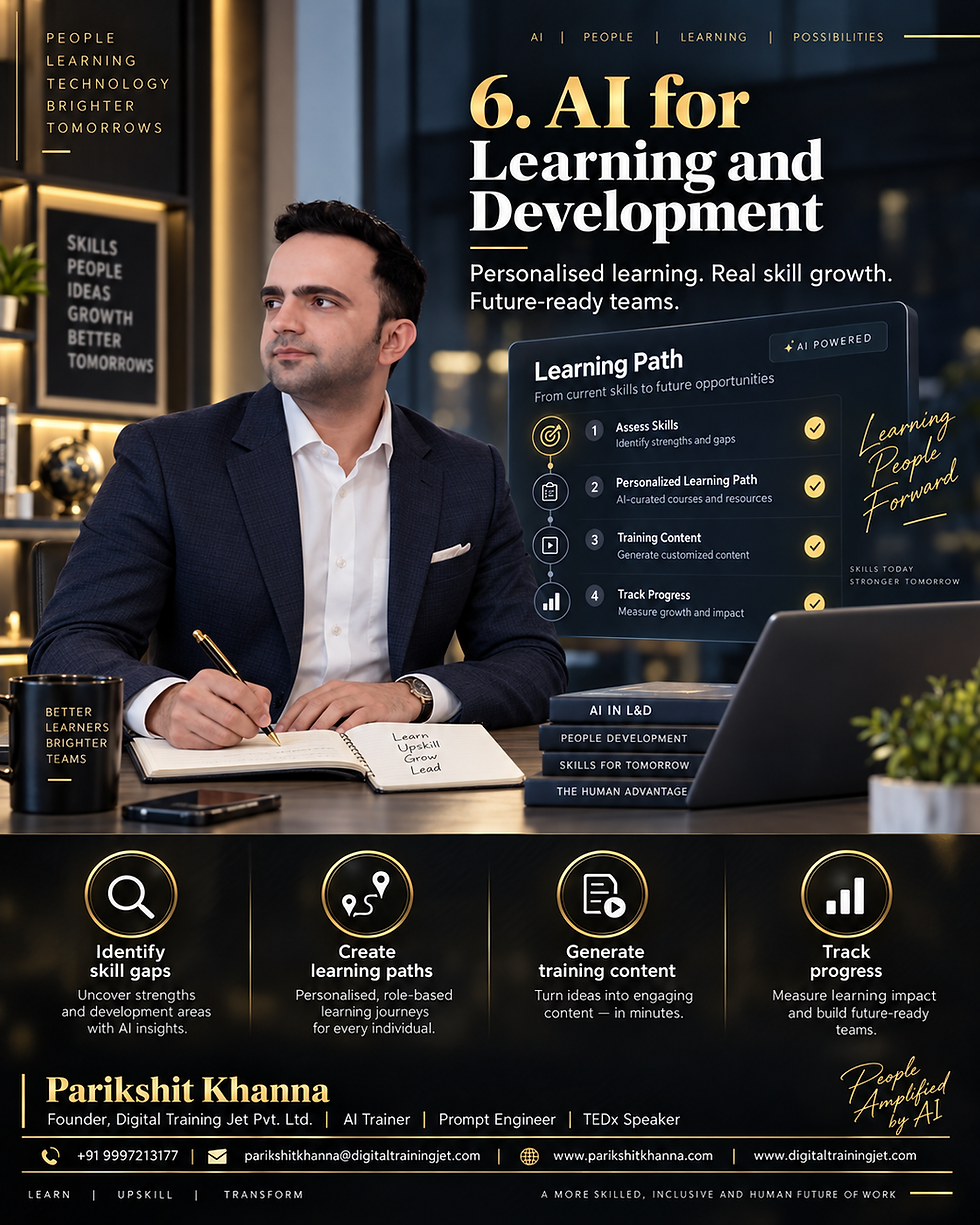
6. AI for Learning and Development
This may become one of the most important applications of AI in HR.
Traditional corporate training often follows a one-size-fits-all model:
100 employees.
One presentation.
One instructor.
Same sequence.
Same assessment.
But employees have different roles, skills, gaps and objectives.
Generative AI makes personalised learning at scale increasingly possible.
An L&D team can use AI to transform one policy or knowledge document into:
role-specific learning material, scenario exercises, quizzes, revision cards, manager discussion guides, simulations and assessments.
AI can also help identify skill gaps and recommend development pathways.
Workday highlights personalized learning paths, content summarization, development planning and skills-based career exploration as emerging AI-enabled L&D workflows
From “training delivered” to “capability developed”
That is an important shift.
HR should not ask only:
“How many employees completed the course?”
It should increasingly ask:
“What can employees now do differently because they completed it?”

7. AI for Performance Management
Performance management generates enormous amounts of unstructured information.
Goals.
Manager notes.
Employee self-assessments.
Project feedback.
Peer feedback.
Development discussions.
Recognition.
Check-in notes.
AI can help synthesise that information before the performance conversation.
Workday describes applications such as summarising multi-source feedback, creating first-pass narratives, drafting development activities and consolidating information for talent discussions.
The critical principle is:
AI can prepare the conversation. It should not own the judgment.
Managers still need to understand context.
They still need to recognise effort.
They still need to challenge weak performance.
They still need to coach.
And decisions involving ratings, promotions and compensation require appropriate organisational controls.
AI removes some paperwork.
It does not remove leadership.

8. AI for Employee Engagement and Sentiment Intelligence
Employee surveys are easy to launch.
Understanding thousands of written responses is harder.
Imagine receiving 4,000 anonymous comments after an engagement survey.
AI can quickly help identify recurring themes around:
leadership, workload, manager effectiveness, compensation, collaboration, flexibility, learning opportunities, technology frustrations and workplace culture.
It can also compare themes across functions or time periods.
The goal is not to ask:
“Are employees happy?”
A better question might be:
“What recurring issues appear across employee feedback, how frequently do they occur, which departments show the strongest concentration and what evidence supports each theme?”
That transforms AI from a writing system into an organisational listening system.
However, privacy, anonymity and employee trust become particularly important when analysing workforce communications or sentiment.

9. AI for HR Analytics and Workforce Planning
Many organisations already possess substantial HR data.
The problem is often not the absence of data.
The problem is turning that data into decisions.
HR dashboards might contain:
headcount, attrition, absenteeism, compensation, recruitment, internal mobility, performance, learning and engagement information.
But senior leaders rarely want 27 dashboards.
They want answers.
Where are we losing talent?
Which critical skills are becoming scarce?
Which functions have unusually high turnover?
What happens if hiring freezes for three months?
Where should we reskill instead of recruit?
Generative AI can act as a natural-language interface between decision-makers and workforce data.
Workday identifies workforce summaries, trend explanations, scenario comparison and executive narratives among emerging Generative AI applications for workforce planning.
PwC similarly argues that AI can shift HR away from backward-looking reporting toward more predictive workforce intelligence.
This is where HR begins moving from:
“Here is what happened.”
toward:
“Here is what is changing, why it may matter and where leadership should investigate.”

10. AI for Skills Intelligence, Internal Mobility and Retention
One of the most expensive mistakes an organisation can make is recruiting externally for capabilities that already exist internally.
Unfortunately, employees are often represented by outdated job titles instead of their complete skill sets.
AI can help organisations map:
current skills, adjacent skills, emerging capability requirements, potential career pathways, internal opportunities and development gaps.
An employee in operations may have strong data skills.
A finance employee may have automation experience.
A marketing employee may have developed excellent AI research capability.
Traditional organisation charts rarely capture this.
Skills intelligence can.
LinkedIn describes AI-supported internal mobility and skills matching as an extension of AI-enabled talent management.
Gartner's 2026 HR research similarly points toward a second wave of AI use cases centred increasingly on talent decision intelligence, beyond simple administrative productivity.
This could become one of AI's most valuable contributions to HR:
not simply helping HR hire faster, but helping organisations understand the talent they already have.
The Emerging Shift: From Generative AI to Agentic AI in HR
There is another transition HR leaders should watch carefully.
Generative AI answers or creates.
Agentic AI can potentially take sequences of actions.
For example, instead of merely producing an onboarding checklist, an AI agent could eventually coordinate parts of onboarding across HR, IT, calendars, learning systems and workflow platforms.
Instead of merely explaining a policy, an agent might initiate the appropriate approved workflow.
TechTarget's 2026 review of agentic AI in HR describes potential applications around employee questions and more complex HR workflows, while PwC describes agentic HR as a shift from isolated AI tools toward redesigned end-to-end workflows.
That does not mean every HR process should be autonomous.
The more consequential the action, the stronger the governance and human control should generally become.
The HR AI Maturity Model: A Better Way to Start
Companies often make an expensive mistake.
They start with:
“Which AI tool should we purchase?”
Instead start with:
“Which HR problem are we solving?”
Personio recommends beginning with the use case, the quality of the data foundation and clear human accountability before selecting AI technology.
A sensible progression is:
Level 1: AssistAI helps individuals draft, summarise and research.
Level 2: AnalyseAI helps HR understand documents, surveys, CVs and workforce information.
Level 3: ConnectAI works with approved internal knowledge and HR systems.
Level 4: AutomateAI executes defined low-risk workflows under controls.
Level 5: OrchestrateAI agents coordinate multi-system workflows with governance, escalation and human checkpoints.
Most organisations do not need to jump immediately to Level 5.
A successful 90-day pilot that saves measurable HR time is often more valuable than an impressive AI demonstration nobody adopts.
What Should HR Never Hand Completely to AI?
The greatest maturity in AI adoption is knowing where not to automate.
Areas involving substantial consequences for an employee deserve especially strong human control.
That includes final decisions around hiring, firing, promotion, compensation, disciplinary action and other materially consequential employment decisions.
AI can supply evidence.
AI can summarise information.
AI can highlight inconsistencies.
AI can identify questions.
AI can model scenarios.
But accountability remains human.
SHRM's responsible-AI guidance makes this distinction explicitly, particularly for consequential employment decisions.
Why AI Training for HR Teams Matters
Buying access to an AI platform does not create an AI-capable HR department.
People need to understand:
what information can safely be used, what cannot be uploaded, how prompts should be structured, how sources should be verified, when AI outputs require escalation, how bias can enter workflows, when human review is compulsory and how AI fits the organisation's actual HR processes.
PwC's 2026 HR analysis identifies skills and training, data quality and regulatory concerns among major barriers to broader HR AI adoption.
The technology is only one part of the equation.
The bigger challenge is capability building.

From TEDx to Times Square: Parikshit Khanna's Journey in Practical AI Transformation
This is where Parikshit Khanna's work is particularly relevant to organisations seeking practical AI capability building rather than another generic demonstration of ChatGPT.
Parikshit Khanna has built his professional journey around one central idea:
AI becomes valuable only when people know how to apply it to real work.
As the Founder of Digital Training Jet Pvt. Ltd., Parikshit works across AI education, corporate enablement, Prompt Engineering and workplace transformation.
His emphasis is not simply on showing participants new features.
The objective is to help employees translate AI tools into role-specific workflows across HR, Finance, Sales, Marketing, Operations, leadership and other business functions.
A major milestone in that journey came on 1 August 2026, when Parikshit appeared at TEDxEicher School Faridabad Youth. His talk, “Redesigning Work with Artificial Intelligence,” explored how professionals can rethink work when AI becomes available as a practical thinking and productivity tool. TED's official event listing identifies him as a speaker, Founder of Digital Training Jet and AI trainer.
The talk was subsequently published by TEDx Talks, where the official description highlights the relationship between AI, work redesign, verification, judgment and human responsibility.

Parikshit's professional journey has also included two separate Times Square, New York appearances associated with Topmate creator recognition, one connected with 2025 creator recognition and another at 1560 Broadway during Topmate's five-year celebration in 2026. Public professional material describing the two appearances explicitly distinguishes them as creator-platform visibility rather than an award or ranking issued by Times Square or New York authorities.
His current published professional portfolio also reports that his corporate, institutional, executive and professional-learning programmes have reached 3.5 lakh+ professionals and learners. Because participation totals can evolve as additional programmes are delivered, organisations evaluating a trainer should verify current figures and relevant engagement references directly.
His training areas include Generative AI, Prompt Engineering, ChatGPT, Claude, Google Gemini, Microsoft Copilot, AI automation, document workflows, research, presentation creation, data analysis and department-specific AI implementation.
For HR teams specifically, the value proposition is straightforward:
Don't train HR merely to “use ChatGPT.” Train HR to redesign workflows intelligently.

What a Practical AI for HR Workshop Can Cover
A corporate programme can move from fundamentals into actual HR workflows, including Prompt Engineering, AI-assisted recruitment, onboarding, policy assistants, employee FAQs, L&D content generation, employee engagement analysis, workforce analytics, performance-support workflows, responsible AI, data privacy and human-review frameworks.
Participants can work with realistic HR scenarios rather than hypothetical prompts.
For example, an HR leader should leave a session knowing not merely:
“Claude can analyse documents.”
but:
“Here is how our HR team could use Claude or another approved AI system to analyse policy documents while protecting sensitive organisational information and maintaining review controls.”
That is the difference between tool training and AI capability building.
Why This Matters for CHROs, HR Directors and L&D Leaders
The future HR function will probably not be defined by the number of AI tools it owns.
It will be defined by how intelligently it divides work between:
humans, AI assistants, enterprise systems and automated agents.
McKinsey describes HR's emerging challenge as a dual mandate: HR must simultaneously help the wider organisation redesign roles and skills for AI while transforming its own function.
That makes HR one of the most strategically important functions in enterprise AI adoption.
Because every department eventually encounters the same question:
What should people continue doing, what should AI assist with and what should be redesigned entirely?
HR will increasingly be expected to help answer it.
The Bottom Line
Writing emails was the beginning.
It should not be the destination.
The strongest AI opportunity for HR is not producing more content.
It is building a function that can:
find information faster, understand talent better, personalise development, reduce administrative friction, improve employee support, extract insight from workforce data and give HR professionals more time for the work that remains deeply human.
AI should not make HR less human.
Implemented carefully, it can give HR more time to be human where being human matters most.
Looking for AI Training for Your HR Team?
Organisations exploring AI for HR, corporate Generative AI training, Prompt Engineering, HR workflow transformation, AI governance or department-specific AI enablement can connect directly with:
Parikshit Khanna
Founder, Digital Training Jet Pvt. Ltd.TEDx Speaker | AI Trainer | Prompt Engineer | Corporate Enablement Specialist
Phone: +91 9997213177
Website: www.parikshitkhanna.com
Corporate Training: www.digitaltrainingjet.com
Corporate programmes can be customised for HR, L&D, Recruitment, Talent Acquisition, Finance, Sales, Marketing, Operations, Leadership and cross-functional business teams.
Disclaimer
This article is intended for educational and informational purposes only. The AI use cases discussed are illustrative and should be adapted to each organisation's policies, workforce structure, data-governance standards, legal obligations and internal HR processes.
AI should support, not replace, human judgment in areas such as recruitment, performance management, employee relations, compensation, promotion, disciplinary action, diversity and inclusion, and workforce planning. Organisations should ensure appropriate human oversight, privacy safeguards, bias testing, data protection, transparency and compliance with applicable employment and AI regulations before deploying AI in HR workflows.
Any references to organisations, institutions, clients, tools or technologies are provided for contextual or educational purposes and do not imply endorsement unless explicitly stated. AI capabilities, product features, regulations and recommended practices can change over time, so readers should verify current information before implementation.
For organisation-specific AI adoption, HR transformation, governance or corporate training requirements, organisations should consult appropriate HR, legal, data-protection, compliance and technology professionals before implementing AI-enabled processes.

Phone: +91 9997213177
Website: www.parikshitkhanna.com
Corporate Training: www.digitaltrainingjet.com


Comments