Agentic AI Training in Dubai for Business and Marketing Teams: A Practical 2026 Guide

Updated: 6 days ago
Learn what agentic AI can and cannot do, how Dubai teams can select safe pilot workflows, and what to demand from practical corporate training in 2026.
Quick answer
Explore agentic AI training for Dubai teams, including safe workflow selection, permissions, review gates, pilot metrics and responsible adoption. Start with one repeatable, low-risk workflow, approved source material, a named reviewer and one measurable outcome.
Why agentic AI has become a Dubai business priority
In May 2026, Dubai announced a two-year initiative intended to accelerate Agentic AI adoption across the private sector, including specialised training tracks for business councils. That policy signal matters because it shifts the conversation from isolated chat prompts toward systems that can plan steps, use approved tools and advance a task under defined controls.
Businesses should still approach the subject with precision. An agent is not an unsupervised digital employee and should not be given open-ended authority. The useful question is where a bounded, reviewable workflow can reduce repetitive effort while preserving human ownership of customer promises, financial decisions, sensitive data and brand reputation.
What agentic AI means in practical terms
A conventional assistant usually responds to a single request. An agentic workflow may break a goal into steps, retrieve permitted information, call connected tools and return a result or recommended action. In marketing, that could mean collecting approved campaign data, summarising changes and drafting a test plan for a manager to review.
The distinction is important because more autonomy creates more risk. A training programme should explain instructions, memory, retrieval, permissions, tool calls, checkpoints and logs in plain language. Participants should be able to map what the system can see, what it can change and where a human must approve the next step.
High-value use cases for marketing and growth teams
Low-risk pilots often begin with internal preparation. An agent can organise an approved research set, draft campaign briefs, classify incoming enquiries or turn weekly metrics into questions for review. It can also prepare variations for email, search and social channels when the final claims, audience and publishing decision remain with a qualified person.
Customer-facing work needs tighter control. FAQ assistance, appointment preparation and lead routing can save time, but escalation rules must be clear. The agent should not invent prices, availability, legal terms or performance promises. A safe design gives it an approved knowledge base, identifies uncertainty and hands complex conversations to a person.
Readiness checks before connecting any tool
Start by documenting the current process. Identify the trigger, inputs, decisions, owner, output and failure points. If the team cannot describe how the task works today, automation is likely to reproduce confusion faster. A stable process with repetitive steps and measurable outcomes is a better candidate than a politically sensitive or rarely performed decision.
Then classify the data involved. Public campaign information is different from customer records, payment details or confidential strategy. Decide which systems the agent may access, use least-privilege permissions and specify retention rules. Training should include a simple risk review before participants build or demonstrate any connected workflow.
What a practical agentic AI course should teach
A useful curriculum combines business process mapping, prompt and instruction design, approved knowledge retrieval, tool integration, testing, monitoring and governance. Learners should build one bounded prototype, observe how it fails and improve its controls. Tool-neutral principles matter because vendors and interfaces will continue to change.
For managers, the course should cover ownership, vendor questions, risk tiers and change management. For practitioners, it should include test cases, permission boundaries, structured outputs, exception handling and logs. Both groups need a shared language for deciding when an agent may recommend, prepare or act.
Governance and human review are part of the build
Governance should be designed at the beginning, not added after a successful demo. Every pilot needs an accountable owner, an approved purpose, data boundaries, a review rule and a way to stop the workflow. Users should know when they are interacting with automation and how to reach a person where appropriate.
Teams also need an incident path. If an output is inaccurate, a connector exposes the wrong record or an action occurs unexpectedly, the organisation must know who pauses the system and how the event is reviewed. Training is valuable when it leaves behind this operating discipline as well as a functioning prototype.
How to measure a pilot without overstating results
Measure the current baseline before introducing an agent. Useful metrics include handling time, correction rate, escalation rate, completion rate and user satisfaction. Marketing teams can also track whether prepared insights lead to faster decisions or more disciplined testing, but they should avoid attributing revenue to an agent without a credible measurement design.
Run the pilot on a limited process and compare results over a defined period. Review failed and corrected outputs, not only successful examples. A system that saves time but increases compliance risk or produces inconsistent customer information has not created a sound business outcome.
Choosing corporate training and delivery in Dubai
Ask a provider to tailor the workshop around one or two approved workflows rather than a generic tool tour. Request a pre-session readiness questionnaire, a clear prototype scope, a governance checklist and a handover document. The strongest outcome is a team that can evaluate the next use case independently.
Confirm whether the selected Digital Training Jet programme is online, live virtual, delivered at a client-approved site or available through another on-site arrangement. Do not infer that the company operates a physical Dubai office from this article. Venue, participant limits, data requirements and delivery terms should be agreed in writing before the workshop.
Agentic AI pilot prioritisation table
Workflow | Potential value | Required control |
|---|---|---|
Weekly campaign summary | Faster preparation for review | Approved data sources and human sign-off |
Lead classification | More consistent routing | Quality checks and easy manual override |
Content brief drafting | Reduced repetitive setup | Source citations and brand review |
Customer FAQ assistance | Quicker routine responses | Approved knowledge and escalation path |
Budget or offer changes | Potential operational speed | Keep human approval; do not automate initially |
Practical note from Parikshit
Begin with a workflow that is repetitive, reversible and easy to audit. If the team cannot explain the data, permissions and approval point on one page, the pilot is too broad. Confirm online or on-site workshop delivery and the exact venue separately.
Vlog-ready episode outline
Use this structure for a five-to-seven-minute companion video or webinar clip:
1. Hook: state the learner or business problem and the practical outcome.
2. Demonstration: show one safe workflow using sample or anonymised data.
3. Proof: explain the review checklist, measurement plan and common failure points.
4. Call to action: invite viewers to request the current syllabus or a tailored corporate demo.
Frequently asked questions
Is agentic AI the same as a chatbot?
No. A chatbot may answer a request, while an agentic workflow can plan steps and use approved tools. The level of autonomy depends on its design.
Which business process should we pilot first?
Choose a repetitive, lower-risk process with clear inputs, outputs, ownership and a measurable baseline, such as preparing a campaign summary.
Can an AI agent publish campaigns automatically?
It may be technically possible, but early pilots should keep publishing, budget, offer and customer-promise decisions behind human approval.
Is on-site training available in Dubai?
Availability must be confirmed. Ask whether the current programme is online, live virtual or delivered at an agreed client or partner venue.
What should participants bring to a workshop?
Bring a documented workflow, sample non-sensitive inputs, desired outcomes, known risks and the names of people who own approvals.
Official and primary sources
Related practical reading
Request an agentic AI workshop scoping call
Editorial note: location references describe the intended audience and delivery market, not a promise of a permanent local office. Confirm venue, travel, fees and availability before booking.
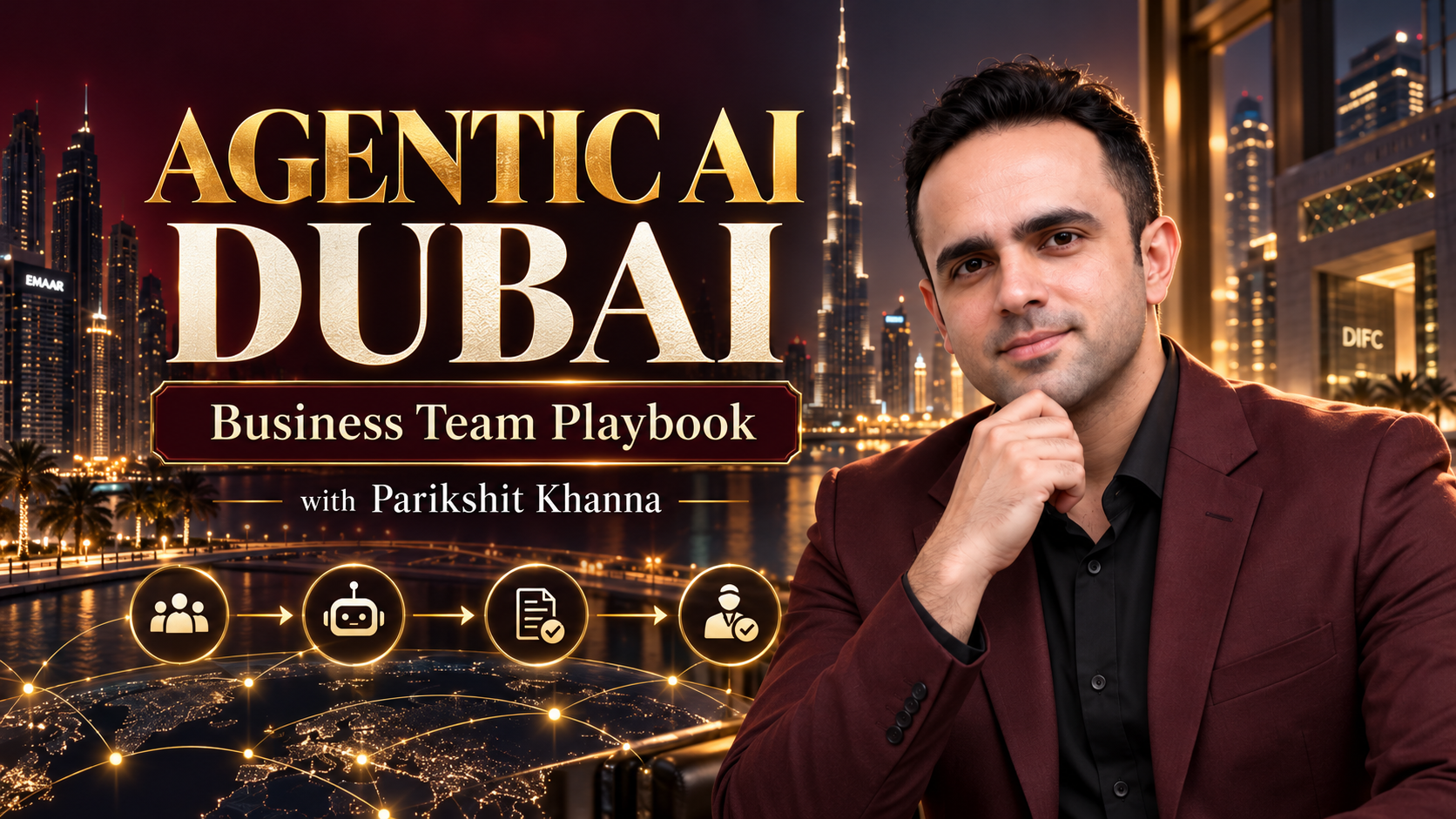
Visual disclosure: the cover graphic is AI-assisted and uses a portrait supplied by Parikshit Khanna.
Practical training and next steps
Parikshit Khanna is a TEDx speaker, corporate AI trainer and founder of Digital Training Jet. He helps professionals, leaders, companies and colleges apply ChatGPT, Claude, Gemini, Microsoft Copilot, prompt engineering, AI agents, automation and responsible AI workflows.
Frequently asked questions
What should practical agentic AI for business teams training include?
It should use realistic tasks, approved source material, reusable templates, verification steps and supervised practice. Participants should leave with a workflow they can repeat and review.
How should a team measure results from this training?
Choose a baseline such as preparation time, revision cycles, lead quality, response time or error rate. Compare the reviewed workflow with that baseline before expanding it.
Can Digital Training Jet customise this programme?
Yes. The audience, tools, sample tasks, data rules and delivery format can be scoped during a corporate or college AI training discovery call.
Last reviewed on 12 October 2026 for current Topmate programmes. Programme dates and availability can change; use the linked Topmate pages for the latest information.



Comments