Global Generative AI Training for Banking, Finance & BFSI

Updated: 6 days ago
Global Generative AI Training for Banking, Finance & BFSI: Secure AI Adoption for 2026 and Beyond

Artificial Intelligence is no longer a side experiment for banks, insurers, asset managers, NBFCs, fintech companies, corporate finance teams or CFO offices.
AI is becoming a core capability for productivity, risk awareness, compliance support, customer experience, fraud investigation, financial planning, research, reporting, sales productivity and workflow automation.
For CEOs, CFOs, CXOs, finance leaders and banking professionals, the question is no longer:
"Should we use Generative AI?"
The more important questions are:
Where should we use AI?
Which AI platform should we use?
How should confidential financial information be protected?
How do we move from experimentation to measurable business outcomes?
The opportunity is significant, but the execution standard is much higher in financial services than in many other sectors.
A generic prompt-writing programme is not enough.
Finance professionals require role-specific workflows, enterprise data controls, model governance, human review, auditability, secure automation and a practical understanding of where Generative AI should assist rather than make uncontrolled decisions.
This is where an enterprise-focused global training approach becomes important.
Parikshit Khanna's Generative AI programmes can focus on practical applications across finance analysis, FP&A, treasury, banking operations, credit and risk support, wealth management, insurance, compliance, audit, collections, customer service, board communication, Microsoft 365 productivity, Agentic AI and secure automation.
Meet Parikshit Khanna: TEDx Speaker & Enterprise AI Trainer

Parikshit Khanna is a TEDx Speaker, Corporate AI and Generative AI Trainer, Prompt Engineering specialist, Founder of Digital Training Jet, and Visiting Faculty at GL Bajaj Institute of Management and Research.
His expertise includes:
Claude AI
ChatGPT
Gemini
Microsoft 365 Copilot
Prompt Engineering
Agentic AI
AI Automation
n8n
Custom GPTs
Gemini Gems
Custom AI Workflows
Executive AI Adoption
Power BI-enabled decision support
AI for Finance
AI for Banking and BFSI
AI for HR
AI for Sales
AI for Marketing
AI for Manufacturing
AI for Healthcare
AI for Operations
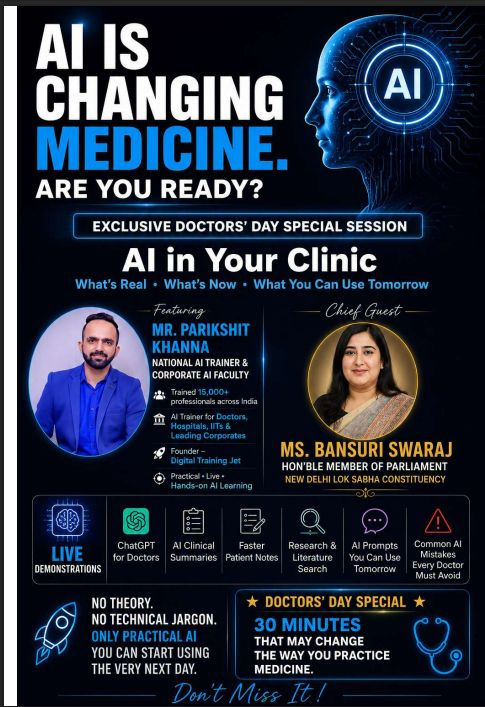
AI IN HEALTHCARE TRAINING BY PARIKSHIT
The official TED listing for TEDxEicher School Faridabad Youth identifies him as an AI and Digital Marketing Trainer and entrepreneur and references work across major corporations and premier institutions including Tata Group, LG Electronics, VISA, Siemens, IIT Delhi, IIT Roorkee and IIM Bangalore.
His consolidated professional profile reports a learning reach of approximately 3L+ professionals through corporate programmes, institutional engagements, executive workshops and professional-learning initiatives.
Global Recognition
TEDx Speaker | Times Square, New York Recognition | Corporate & Executive AI Trainer | Founder, Digital Training Jet
Parikshit combines his strong connection with India with an increasingly international approach to AI capability development.
His programmes can be customized for companies across Asia, the Middle East, Europe, North America, Latin America, Africa and Oceania.

Why Global Banking and Finance Teams Need Generative AI Capability Now
AI adoption across financial services is moving rapidly from experimentation toward enterprise deployment.
A Bank of England and Financial Conduct Authority survey reported that 75% of responding financial-services firms were already using AI, while another 10% planned to use it over the following three years.
Insurance firms reported particularly high AI adoption, as did international banks.
Important financial-services AI applications include:
Internal process optimization
Fraud detection
Cybersecurity
Customer support
Regulatory compliance
Financial reporting
Risk management
Research
Data analysis
Operations
Customer communication
This is why AI capability is now a management and leadership issue rather than simply an IT issue.
CEOs, CFOs, CROs, CIOs, CHROs, audit heads, operations leaders and business-unit heads need a common operating model for responsible AI.
Leadership teams need to understand:
What AI can do
What AI should not do
Where AI outputs can be unreliable
Which data can be shared with an AI platform
Which enterprise AI environment is approved
How human review should operate
How AI-generated information should be validated
How AI actions should be audited
How employees should use AI responsibly
For financial institutions, competitive advantage comes from combining three elements:
Capable people + Governed AI technology + Repeatable business workflows
Training should connect all three.
What a Global Generative AI for Finance and BFSI Programme Can Cover
A high-impact Generative AI programme can be customized for:
Commercial banks
Retail banks
Investment banks
Private banks
Central banking and financial-policy teams
NBFCs
Insurance companies
Reinsurance companies
Asset managers
Mutual funds
Wealth-management firms
Family offices
Private-equity firms
Venture-capital firms
FinTech companies
Payment companies
Financial shared-service centres
Corporate finance departments
CFO offices
Treasury departments
Internal audit teams
Compliance departments
Risk-management departments
Financial PSUs
Mining and coal finance teams
Manufacturing CFO offices
Energy companies
Export businesses
Core Learning Areas
Prompt Engineering for Finance

Learn how to structure prompts using:
Role
Context
Objective
Data boundaries
Task
Constraints
Output format
Validation instructions
Human review requirements
ChatGPT for Finance
ChatGPT can support:
Structured analysis
Research support
Report drafting
Scenario exploration
Management summaries
Financial communication
Policy interpretation
Controlled enterprise workflows
Custom GPT development
Claude AI for Finance

Claude can be particularly useful for:
Long-document analysis
Policy review
Financial narrative analysis
Complex document synthesis
Contract review support
Research synthesis
Strategic business analysis
Large knowledge documents
Microsoft 365 Copilot
Training can cover practical applications across:
Microsoft Word
Microsoft Excel
Microsoft PowerPoint
Microsoft Outlook
Microsoft Teams
Enterprise productivity
Meeting summaries
Presentation creation
Spreadsheet interpretation
Email productivity
Documentation
Gemini
Gemini can support multimodal analysis, research-assisted workflows and Google Workspace productivity where approved by the organisation.
Agentic AI
Participants can understand how AI agents can assist with:
Multi-step workflows
Controlled tool usage
Task orchestration
Approval workflows
Exception handling
Research agents
Internal knowledge agents
Workflow automation
n8n and AI Automation
No-code and low-code automation can support:
Approval-aware workflows
Notifications
CRM updates
Finance workflows
Follow-up automation
Data movement
Reporting
Lead management
Repetitive internal processes
Power BI and AI-Assisted Analytics
Finance professionals can learn how AI supports:
Executive dashboards
Financial commentary
Risk dashboards
Portfolio monitoring
Performance reporting
Management decision support
Custom GPTs, Gems and Enterprise Assistants
Companies can explore internal assistants for:
SOPs
Policy Q&A
Finance knowledge
Employee support
Compliance knowledge
Customer-service support
Internal research
Department-specific workflows
Microsoft 365 Copilot, Claude and ChatGPT: An Important Enterprise Distinction
Microsoft 365 Copilot should be taught accurately.
Microsoft's AI ecosystem can incorporate multiple AI models and providers depending on the Copilot experience, tenant configuration, region, licensing and administrator controls.
However, ChatGPT is a separate OpenAI product.
It should not simply be described as "ChatGPT inside Microsoft Copilot."
Similarly, organisations may encounter Anthropic Claude models in specific Microsoft AI experiences, but Claude remains a separate AI platform with its own enterprise offerings.
A well-designed corporate AI programme should therefore teach employees:
When Microsoft 365 Copilot is appropriate
When an approved ChatGPT environment is appropriate
When Claude may be useful
When Gemini may be useful
Which information can be entered into each tool
Which enterprise controls apply
How permissions differ
How connectors differ
How retention policies differ
How AI governance changes by platform
This distinction is particularly important in banking, finance and regulated industries.
20 High-Value Generative AI Use Cases for Banking, Finance, Insurance and FinTech
1. FP&A and Management Reporting
AI can help draft:
Variance commentary
Budget explanations
Management summaries
Scenario narratives
Executive reports
Monthly business reviews
All financial calculations should remain independently validated.
2. Financial Statement Analysis
AI can help finance professionals identify:
Trends
Anomalies
Ratio movements
Potential inconsistencies
Areas requiring deeper investigation
3. Budgeting and Forecasting
AI can assist teams in developing:
Business assumptions
Scenario trees
Sensitivity-analysis questions
Forecast narratives
Management explanations
4. Treasury
Treasury professionals can use approved AI tools to summarize:
Cash positions
Treasury policies
Funding scenarios
Counterparty information
Market developments
5. Credit Analysis Support
AI can assist in preparing:
Structured credit memos
Borrower information checklists
Business-risk summaries
Industry-risk summaries
Questions requiring deeper review
Final lending decisions should remain under authorized human control.
6. Risk and Compliance
AI can support:
Policy interpretation
Obligation mapping
Control descriptions
Compliance checklists
Policy comparison
Regulatory research
7. KYC and AML Support
AI can potentially assist analysts with:
Case-file summaries
Investigation questions
Alert organization
Documentation support
Escalation notes
Such usage must comply with institutional controls and regulatory requirements.
8. Fraud Investigation Support
AI can assist trained investigators in:
Summarizing case notes
Identifying patterns
Organizing evidence
Drafting escalation narratives
Human investigators should retain decision-making authority.
9. Internal Audit
AI can help create:
Audit planning questions
Control-testing checklists
Issue summaries
Management action trackers
Audit interview questions
10. Insurance
Generative AI can support:
Underwriting documentation
Claims summaries
Policy comparison
Customer communication
Knowledge management
Appropriate underwriting and claims governance remains essential.
11. Wealth Management
AI can assist with:
Client education
Market summaries
Portfolio-review narratives
Meeting preparation
Relationship-manager follow-up
Suitability decisions and investment advice must remain within approved controls.
12. Investment and Research Teams
AI can synthesize:
Corporate filings
Earnings materials
Industry reports
Competitor information
Market research
Management commentary
The resulting research should always be verified.
13. Accounts Payable and Accounts Receivable
AI can assist with:
Query classification
Vendor communication
Customer communication
Payment exception summaries
Follow-up drafting
14. Reconciliation
AI can help explain:
Mismatches
Exception categories
Potential root causes
Investigation steps
15. Collections
AI can create:
Customer communication drafts
Policy-compliant communication variants
Next-action summaries
Case notes
16. Board and ALCO Support
Approved analyses can be transformed into:
Executive summaries
Management narratives
Decision papers
Presentation structures
Board briefings
17. Legal and Contract Support
AI can help qualified legal and compliance teams:
Summarize clauses
Compare document versions
Extract obligations
Prepare review checklists
Organize contract information
18. Regulatory Reporting Support
AI can support:
Explanatory narratives
Evidence indexes
Report summaries
Documentation organization
Final regulatory submissions should remain controlled by authorized personnel.
19. Customer Service
AI can support agents through:
Knowledge responses
Conversation summaries
Next-best-action recommendations
Draft responses
Customer-query classification
20. Lead Generation, Follow-Up and CRM Productivity
Generative AI can improve commercial productivity by helping relationship and sales teams:
Research approved prospects
Create account briefs
Summarize client meetings
Draft personalized follow-ups
Prepare proposals
Update CRM information
Generate next-action recommendations
Identify cross-selling questions
Prepare relationship-manager briefs
Data Security, Governance and Responsible AI for BFSI
Data security should not be a closing slide in an AI workshop. It should be built into every use case.
Financial institutions should establish clear rules covering:
What information employees can enter into AI systems
Which AI applications are approved
Which enterprise accounts must be used
Data classification
Role-based access
Data retention
Data Loss Prevention
Encryption
Connector permissions
AI-agent permissions
Model governance
Vendor risk
Audit trails
Human approval
Output verification
Incident escalation
The Bank of England's financial-services AI research identified data privacy and protection, data quality and data security among major AI risks identified by firms.
Financial organisations must also consider third-party dependencies and model complexity.
In Europe, financial institutions must consider regulatory frameworks including DORA and the EU AI Act.
In India, regulated organisations must consider applicable RBI directions, internal security requirements, data-handling rules and sector-specific obligations.
A practical AI workshop should therefore include a:
Safe AI Operating Model
This can cover:
Approved AI tools
Data boundaries
Prompt hygiene
Access controls
Human review
Model selection
Vendor assessment
Incident escalation
AI-output validation
Audit-ready documentation
AI training builds capability. It does not replace specialist legal, regulatory, cybersecurity or compliance advice.
Faster Product Launches, Documentation and Follow-Up Workflows
Generative AI can help financial and enterprise teams reduce the time required to organize information when launching new products and services.
Market Trend Synthesis
Microsoft 365 Copilot, ChatGPT, Claude or Gemini can help analysts synthesize approved:
Industry reports
Customer behaviour data
Competitive intelligence
Economic information
Product information
Research documents
The output can become a structured market-entry brief.
AI does not replace judgement.
Its value lies in reducing the time required to organize large amounts of information so that experienced professionals can spend more time challenging assumptions and making decisions.
Technical Documentation
Finance, technology, engineering and product teams can use AI to convert approved:
Technical specifications
Process notes
Control documentation
APIs
Architectural notes
System explanations
into structured:
Internal guides
User manuals
Implementation notes
SOPs
Knowledge articles
Help Centre and Knowledge Content
Internal technical resolutions, FAQs and support patterns can be converted into customer-facing drafts after appropriate compliance, legal and product review.
Meeting-to-Action Workflow
AI can help transform meetings into action by:
Summarizing transcripts
Extracting action items
Proposing owners
Drafting follow-up communication
Preparing CRM updates
Creating decision summaries
Organisations should confirm every action, owner and sensitive detail before sending or publishing AI-generated information.
India to the World: Generative AI for Export, Treasury and International Growth
Parikshit Khanna's connection with India remains central to his positioning, while the business opportunity is global.
India-based banks, NBFCs, manufacturers, mining companies, energy organisations and exporters increasingly require employees who can operate across both domestic and international markets.
Generative AI capability can improve export readiness and commercial productivity through:
International market research
Buyer-account research
Multilingual outreach
RFQ preparation
Quotation drafting
Product documentation
Trade-document checklists
Distributor communication
CRM follow-up
Competitive intelligence
Market-entry briefs
Proposal development
Customer communication
International lead research
AI does not guarantee export revenue.
However, employees who understand AI can potentially reduce research cycles, respond faster to international opportunities and improve communication consistency.
For organisations with sovereign-data or localization requirements, training can also explain how to evaluate:
Enterprise AI
Private AI
Regional AI
Locally hosted architectures
Approved cloud deployment
Data localization
Permissions
Security controls
Generative AI for Mining, Coal, Energy and Manufacturing Finance Teams
Finance-led AI transformation is highly relevant to:
Mining
Coal
Metals
Power
Energy
Engineering
Manufacturing
Industrial companies
CFOs and commercial teams in these industries manage:
Large capital expenditure
Long procurement cycles
Commodity exposure
Logistics
Vendor ecosystems
Contracts
Safety documentation
Working capital
Inventory
Export opportunities
Project risks
Relevant Generative AI workshop scenarios can include:
CAPEX approval memo drafting
Vendor comparison
Contract-obligation extraction
Commodity-market synthesis
Plant MIS commentary
Maintenance-cost analysis
Project-risk registers
Procurement exception summaries
Inventory narratives
Export-market research
Tender-response support
Management dashboards
Technical documentation
Executive presentations
Parikshit's manufacturing and industrial exposure includes engagements and portfolio references connected with:
Talwandi Sabo Power
Vedanta Group
Bonfiglioli Transmission
Phoenix Contact India
Sanden Vikas India
Tinna Rubber
Sangam Group
Nagarjun Textiles
KnitPro International
Vega Industries
Sheela Foam / Sleepwell
Hetero Pharma
Emami Ltd
This cross-sector exposure is particularly useful when finance training needs to connect financial numbers with real business operations.
Why Parikshit Khanna Is a Strong Choice for CEOs, CXOs, VPs and Banking Professionals
The strongest reason to select an AI trainer for a bank or global finance organisation is fit.
Parikshit Khanna's positioning is particularly relevant for organisations that want one learning programme to combine:
Executive AI literacy
Hands-on financial workflows
Multiple AI platforms
Prompt Engineering
Microsoft 365 productivity
Agentic AI
Automation
Power BI
Data security
Enterprise governance
Cross-functional adoption
His training format can be designed for:
CEOs
CFOs
CXOs
VPs
Finance Heads
FP&A Leaders
Risk Leaders
Compliance Professionals
Branch Heads
Business Heads
Relationship Managers
Internal Auditors
Financial Analysts
Operations Teams
Treasury Professionals
HR Leaders
Sales Leaders
Technology Teams
Sessions can move from simple executive prompts to advanced AI workflow design.
Examples can be customized according to participants' roles and the organisation's approved data environment.
Practical Differentiators
Role-mapped AI use cases
Live demonstrations
Hands-on learning
Multi-tool AI judgement
Workflow design
Security-first discussion
Executive communication
India-specific enterprise context
International delivery flexibility
AI automation
Agentic AI
Custom GPTs and internal assistants
Proven Relevance Across Finance, Wealth, Enterprise and International Teams
Selected finance, banking, wealth and enterprise-finance engagements or portfolio references supplied for publication include:
Kae Capital, Mumbai
Tata Mutual Fund
AON Consulting, FP&A
Decyphr, including underwriting, valuation, ALM, portfolio, finance and HR use cases
Green Earth Advisory, Wealth Management
Chinmay Finlease, Ahmedabad
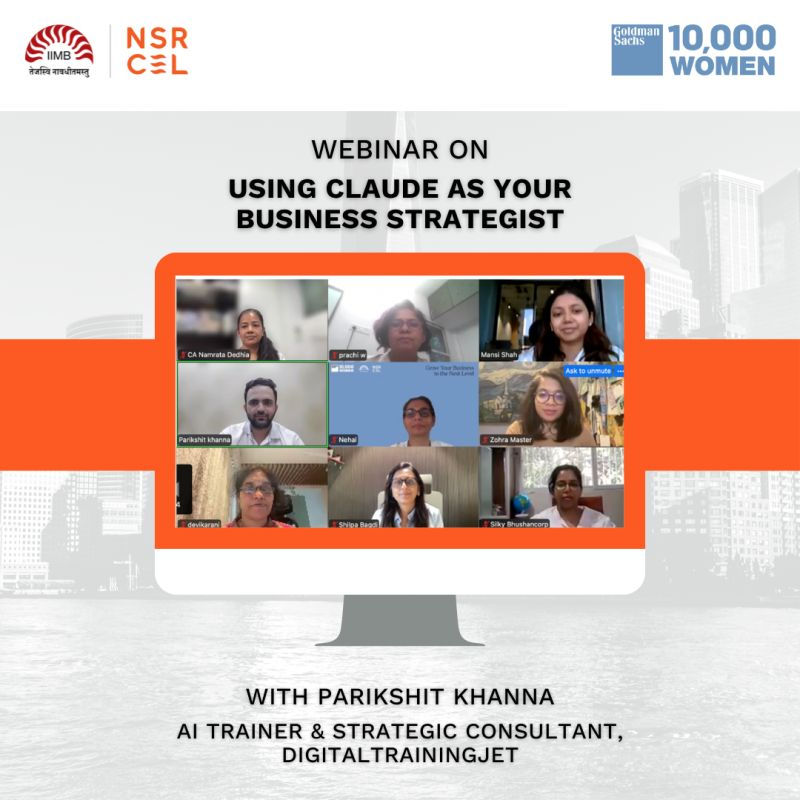
Goldman Sachs 10,000 Women Programme through IIM Bangalore NSRCEL
Parikshit delivered the "Using Claude as Your Business Strategist" programme connected with the Goldman Sachs 10,000 Women Programme through IIM Bangalore NSRCEL.
Recent international-facing engagements also include Malabar Group, with Phase 1 AI Training delivered online on 1 and 2 July 2026.
International exposure also includes:
ZAFCO Group Holding Limited, Dubai, UAE
InnovMetric / PolyWorks, Quebec, Canada
This international exposure complements extensive delivery across India.
Healthcare and Pharma Experience That Strengthens Regulated-Industry Training
Cross-sector expertise matters because financial services increasingly overlap with:
Insurance
Healthcare financing
Claims
Employee benefits
Pharmaceuticals
Corporate treasury
Health insurance
Regulated data
Healthcare and pharmaceutical portfolio references include:
CARE Hospitals, Hyderabad
Fortis
Santevita Hospital
Cloud 9 / Cloudnine
AIIMS Delhi
Surat Medical Consultants' Association
Surat Medical Association
IMA Janakpuri
IAP-CMIC
Hetero Pharma
Naprod Life Sciences
USV Pharma
Wockhardt
Sudeep Pharma Limited
IIT Delhi Healthcare AI programmes
IIT Hyderabad Healthcare AI programmes
IIT Guwahati healthcare and oncology academic exposure

A participant account published by OncoDaily describes learning from Parikshit Khanna at a healthcare-focused ChatGPT and AI tools workshop held at IIT Delhi.
His experience connecting AI with healthcare, pharma, law, compliance and financial applications provides useful cross-sector context for regulated organisations.
Parikshit Khanna Client and Institutional Portfolio

Colleges, Universities and Institutes
Academic and institutional engagements include:
IIT Delhi
IIT Hyderabad
IIT Guwahati
IIM Bangalore NSRCEL
Chitkara College of Sales and Marketing, Delhi
Chitkara College of Sales and Marketing, Zirakpur
Chitkara University
GL Bajaj Institute of Management and Research
IILM
SOIL School of Business Design
Thapar University
Amity University
Amity University Online
AURO University Surat
KR Mangalam University
SDA Bocconi Asia Center Mumbai
Delhi Technological University
Christ University Bangalore
Shahaji Law College Kolhapur
KIET Group of Institutions
Galgotias University
Princeton Academy
Bettering Results
Indian Society of Medical and Paediatric Oncology
Eicher School Faridabad
Enterprise and Corporate Client Portfolio
Enterprise and corporate engagements or portfolio references include:
Emami Ltd
Hetero Pharma
Arvind Fashions
Arvind Lifestyle Brands
Sheela Foam
Sleepwell
Bonfiglioli Transmission
Talwandi Sabo Power
Vedanta Group
RMZ Real Assets
AON Consulting
Tata Mutual Fund
Amdocs
British Telecom
METRO Global Solution Center
Sanden Vikas India
Vega Industries
KnitPro International
Green Earth Advisory
DDS Athena
Pansari Group
Phoenix Contact India
Sangam Group
Nagarjun Textiles
Tinna Rubber
Tata Power
LG India
Landmark Group
Yusen Logistics
Innovations Global
Kubrii
CIPL
Sudeep Group, Vadodara
Chinmay Finlease, Ahmedabad
Real Estate and Construction Exposure
Real-estate and construction portfolio references include:
RMZ Real Assets
Gaursons / Gaur Sons
County Group
City Homes Group
CREDAI-related audiences
AI applications for this industry can include:
Lead generation
CRM productivity
Site-report summaries
Project documentation
Sales follow-up
Customer communication
Market research
Competitive intelligence
Executive dashboards
Contract analysis
Vendor management
Government, Public Sector, Media and Broadcasting Exposure
Portfolio references include:
Prasar Bharati
National Academy of Broadcasting and Multimedia
All India Radio
Doordarshan
Economic Times HRWorld
Times Internet
Government and public-sector audiences
Indian Army, as included in the supplied portfolio
Parikshit's Prasar Bharati engagements included Generative AI, ChatGPT and Canva-related capability building.
Tourism and Travel Industry Exposure
Tourism and travel references include:
ATTOI Annual Convention
TBO Aerocity
Travel Nexus
Taj Amer Jaipur

ATTOI Annual Convention 2025 in Wayanad
At the ATTOI Annual Convention 2025 in Wayanad, Parikshit delivered a keynote around improving marketing effectiveness using ChatGPT.
His tourism exposure can support applications such as:
Destination marketing
Lead generation
Customer communication
Travel itinerary creation
Social-media productivity
Multilingual communication
CRM follow-up
Proposal generation
Travel research
International marketing
Additional Portfolio Names
Additional names supplied across the professional portfolio include:
Delhi University
AIIMS Delhi
AILifeBot
Wahluft / Lucrative Impex
BeTheBee
Designer Home Solution
Designer Home & Landscapes
IMECO India
AILABS
Data-Core
Global Delivery: Regions, Countries and Financial Hubs
Parikshit has delivered sessions connected with India, the United Arab Emirates and Canada, while virtual and online programmes can enable wider international participation.
Corporate programmes can be structured for:
Virtual delivery
Hybrid delivery
Onsite delivery
CXO roundtables
Department workshops
International leadership teams
Global capability-building programmes
Delivery remains subject to schedule, travel, enterprise-security requirements and local regulations.
Asia-Pacific
Target markets and financial hubs can include:
India
Delhi NCR, New Delhi, Noida, Greater Noida, Gurugram, Gurgaon, Ghaziabad, Faridabad, Manesar, Mumbai, Bengaluru, Bangalore, Hyderabad, Chennai, Kolkata, Pune, Jaipur, Ahmedabad, Vadodara, Surat, Chandigarh, Mohali, Rajpura, Zirakpur, Bhilwara, Ranchi, Goa, Guwahati and other major commercial centres.
Singapore
Singapore is one of Asia's most important banking, wealth-management, FinTech and regional-headquarters markets.
Hong Kong
Relevant for banking, asset management, investment, insurance and international finance.
Japan
Tokyo and other major business centres can benefit from Generative AI capability across banking, insurance, manufacturing finance and corporate operations.
South Korea
Seoul-based financial, technology and manufacturing organisations can apply enterprise AI across reporting, analysis and productivity.
Indonesia
Jakarta and other commercial centres offer opportunities across banking, FinTech, insurance, mining, manufacturing and energy.
Malaysia
Kuala Lumpur is relevant for banking, Islamic finance, shared services, insurance and corporate finance.
Thailand
Bangkok-based finance, banking, tourism and enterprise teams can apply Generative AI across operations and customer engagement.
Philippines
Manila is particularly relevant for banking, insurance, BPO, shared services and finance operations.
Vietnam
Ho Chi Minh City and Hanoi represent growing financial and enterprise markets.
Bangladesh
Dhaka's banking, manufacturing and export sectors can benefit from practical AI adoption.
Sri Lanka
Colombo-based banking, tourism, finance and enterprise teams can apply GenAI capability.
Nepal
Kathmandu and other business centres provide opportunities across banking, tourism and financial services.
Middle East and GCC
Parikshit Khanna's international positioning is particularly relevant to the rapidly growing AI adoption environment across the GCC.
Target countries include:
United Arab Emirates
Saudi Arabia
Qatar
Bahrain
Kuwait
Oman
Important cities include:
Dubai
Abu Dhabi
Riyadh
Jeddah
Doha
Manama
Kuwait City
Muscat
Potential sectors include:
Banking
Islamic finance
Wealth management
Family offices
Insurance
FinTech
Sovereign entities
Energy
Oil and gas
Mining
Real estate
Tourism
Logistics
Retail
Corporate finance
Europe
Target markets include:
United Kingdom
Ireland
France
Germany
Switzerland
Luxembourg
Netherlands
Belgium
Spain
Italy
Sweden
Denmark
Norway
Finland
Poland
Austria
Important European financial centres include:
London
Dublin
Paris
Frankfurt
Zurich
Geneva
Luxembourg
Amsterdam
Brussels
Madrid
Milan
Stockholm
Copenhagen
Oslo
Helsinki
Warsaw
Vienna
European programmes should place particularly strong emphasis on:
AI governance
Data privacy
DORA
EU AI Act considerations
Model risk
Third-party risk
Human oversight
Responsible automation
North America
Target markets include:
United States
Important cities include:
New York
Charlotte
Chicago
Boston
San Francisco
Los Angeles
Dallas
Houston
Miami
Washington DC
Potential audiences include banks, investment managers, insurers, FinTech businesses, consulting firms, corporate finance teams, technology companies and international enterprises.
Canada
Important centres include:
Toronto
Montreal
Vancouver
Quebec
Parikshit's portfolio already includes international exposure connected with Quebec, Canada through InnovMetric and PolyWorks.
Latin America
Potential countries include:
Brazil
Mexico
Chile
Colombia
Argentina
Peru
Panama
Important commercial centres include:
Sao Paulo
Mexico City
Santiago
Bogota
Buenos Aires
Lima
Panama City
Applications can include banking, insurance, FinTech, mining finance, manufacturing finance, exports and corporate operations.
Africa
Potential markets include:
South Africa
Kenya
Nigeria
Ghana
Egypt
Morocco
Rwanda
Important cities include:
Johannesburg
Cape Town
Nairobi
Lagos
Accra
Cairo
Casablanca
Kigali
AI capability can support banking, telecommunications, insurance, mining, energy, government, logistics and fast-growing digital enterprises across the continent.
Oceania
Australia
Major markets include:
Sydney
Melbourne
Brisbane
Perth
New Zealand
Major markets include:
Auckland
Wellington
Financial institutions and enterprises in these markets can use Generative AI training to improve regulated workflow productivity, executive adoption and enterprise AI governance.
Why This Global SEO Approach Is Stronger
International SEO should not simply mean publishing hundreds of almost identical pages containing a different city name.
A stronger strategy is to create genuinely useful regional content with unique:
Market examples
Regulations
Industries
Business challenges
AI use cases
Client examples
Workshop formats
FAQs
Local business context
This creates more useful pages for human readers and better aligns with Google's people-first content principles.
Comparison: What Enterprise Buyers Should Evaluate
Parikshit Khanna / Digital Training Jet Approach
Finance Use Cases
FP&A, financial reporting, risk, compliance, wealth management, insurance, operations, customer workflows and executive decision support.
AI Tools
ChatGPT
Claude
Gemini
Microsoft 365 Copilot
Power BI
n8n
Custom GPTs
Gemini Gems
Agentic AI
Delivery
Live, role-mapped, customized corporate workshops with hands-on exercises.
Security
Enterprise data boundaries, AI platform selection, permissions, governance and human review integrated directly into practical exercises.
Leadership Layer
CEO and CXO AI adoption, transformation strategy, operating models, governance and implementation roadmaps.
Cross-Sector Depth
Finance combined with experience across:
Healthcare
Pharma
Manufacturing
Real estate
Government
Tourism
Education
Legal
Enterprise operations
Typical Generic AI Course or Platform
A standardized AI course may:
Focus on broad audiences
Use generic prompt examples
Concentrate on one AI tool
Separate security from practical exercises
Offer limited workflow customization
Provide limited role-specific implementation guidance
Every provider is different. Enterprise buyers should evaluate trainers according to the needs of their organisation rather than relying purely on marketing claims.
Recommended Corporate Workshop Formats
1. Executive AI Briefing
Duration: 90 minutes to 3 hours
Coverage:
AI strategy
Risk
Governance
Use-case prioritization
Leadership alignment
AI platform selection
2. Half-Day Practical Workshop
Coverage:
Prompt Engineering
Microsoft 365 Copilot
ChatGPT
Claude
Gemini
Data security
Department-specific scenarios
3. Full-Day Finance and BFSI Masterclass
Coverage:
FP&A
Reporting
Risk
Compliance
Audit
Customer operations
Automation
Executive communication
4. Two-Day Applied Generative AI Programme
Coverage:
Advanced workflow labs
Agentic AI
n8n
Custom GPTs
Enterprise assistants
Use-case design
Automation
Implementation planning
5. Department-Specific Programmes
Separate tracks can be created for:
CFO and FP&A
Risk and Compliance
Internal Audit
Banking Operations
Wealth Management
Insurance
Relationship Management
Sales
HR
Marketing
Technology
6. CXO Roundtable
Topics can include:
AI portfolio decisions
AI governance
Vendor selection
Model strategy
Sovereign AI
Private deployment
Adoption roadmap
Enterprise risk
7. Train-the-Trainer and AI Champion Programme
Develop internal AI champions using:
Templates
Prompt libraries
Guardrails
Department use cases
Workflow libraries
Governance checklists
Review mechanisms
From Workshop to Measurable ROI: A 30-60-90 Day AI Adoption Plan
A serious corporate AI programme should finish with implementation decisions rather than enthusiasm alone.
First 30 Days
Define approved AI tools
Establish data rules
Identify priority employee personas
Define baseline metrics
Select low-risk, high-value use cases
Identify AI champions
Days 31 to 60
Pilot three to five workflows
Validate AI outputs
Document controls
Train departmental champions
Measure turnaround time
Measure quality improvements
Identify workflow gaps
Days 61 to 90
Scale successful workflows
Formalize AI governance
Add Agentic AI where justified
Introduce automation
Integrate approved enterprise systems
Review business impact
Create future AI roadmap
AI ROI Metrics Organisations Can Track
Useful metrics can include:
Time saved per workflow
Turnaround time
Rework rate
Control exceptions
Employee adoption frequency
User satisfaction
Output validation rate
Customer-response time
Reporting speed
Proposal turnaround
Meeting-to-action time
CRM completion
Research time
Documentation time
Measurable business outcomes
Organisations should avoid exaggerated AI ROI claims unless supported by their own baseline data and measurement methodology.
Frequently Asked Questions
What is Generative AI Training for Banking and Finance?
It is role-specific capability building that teaches finance professionals how to use approved AI platforms for analysis, writing, reporting, research, customer service, workflow automation and decision support while respecting data-security, regulatory and human-review requirements.
Does the Programme Include ChatGPT, Claude, Gemini and Microsoft 365 Copilot?
Yes.
A programme can cover:
ChatGPT
Claude
Gemini
Microsoft 365 Copilot
It is important to understand that ChatGPT remains a separate OpenAI product and should be governed appropriately.
Can the Workshop Be Customized for Banks, NBFCs, Insurers and Wealth Managers?
Yes.
Use cases can be mapped to:
FP&A
Credit
Risk
Compliance
AML
KYC
Audit
Underwriting
Claims
Wealth Management
Banking Operations
Relationship Management
Executive Reporting
Can Parikshit Khanna Deliver Training Outside India?
Yes.
His supplied portfolio includes international work connected with the United Arab Emirates and Canada, in addition to extensive delivery across India.
Virtual programmes can support international teams, while onsite programmes remain subject to travel, scheduling and local requirements.
Is Sensitive Customer or Banking Data Used During Training?
The recommended approach is to use:
Synthetic data
Anonymized information
Sample data
Organisation-approved information
Sensitive information should only be used where the organisation has explicitly approved a secure enterprise environment and data-handling process.

Does the Programme Cover AI Governance and Data Security?
Yes.
Governance and security can include:
Privacy
Permissions
Human review
Model risk
Vendor risk
Secure workflow design
AI policies
Data boundaries
Can the Same Programme Support Mining, Coal, Manufacturing and Export Companies?
Yes.
The finance and enterprise AI layer can be adapted for:
CAPEX
Procurement
Working capital
Contracts
MIS
Commodity research
Project risk
Export-market analysis
Tender support
Executive reporting
Market-entry research
Why the World Needs Practical Enterprise AI Capability
Artificial Intelligence is no longer optional for organisations that want to remain competitive.
The real differentiator will not be access to ChatGPT, Copilot, Claude or Gemini.
Almost every serious organisation can access AI technology.
The differentiator will be whether employees know how to use those tools:
Securely
Responsibly
Productively
Strategically
Consistently
At enterprise scale
Banking and financial-services organisations need employees who understand AI beyond basic prompts.
Manufacturing organisations need teams who can connect AI with procurement, production, sales and finance.
Healthcare companies require responsible AI adoption around sensitive data.
Mining and energy companies require AI capability for documentation, commercial research, financial planning and decision support.
Export companies need faster market intelligence and international communication.
CEOs require strategic clarity.
CXOs require governance.
Managers require workflows.
Employees require hands-on practice.
That is the capability gap enterprise AI training should address.
Ready to Build Secure AI Capability Across Finance and BFSI?
AI is not valuable merely because it can write faster.
AI becomes valuable when an organisation converts it into a governed business capability.
For banks, finance teams, insurers, fintechs, wealth managers, financial PSUs, mining and energy companies, manufacturing businesses, real-estate enterprises, healthcare organisations and export-focused companies, the next stage is moving from isolated AI experimentation to repeatable workflows, secure adoption and measurable outcomes.
Contact Parikshit Khanna for Global Corporate AI Training
Parikshit KhannaTEDx Speaker | Enterprise AI Trainer | Founder, Digital Training Jet
Phone / WhatsApp:+91 99972 13177+91 80762 50669
Instagram:@digitalparikshitkhanna
X / Twitter:@ParikshitK_
LinkedIn:Parikshit Khanna
Corporate programmes can be customized according to:
Company
Country
Audience size
Department
Seniority level
Approved AI tools
Data-security policies
Workshop duration
Desired business outcomes
Parikshit Khanna: Empowering Financial and Enterprise Leaders for the AI Era
The next phase of AI will not be defined merely by who has access to artificial intelligence.
It will be defined by who develops the capability to use it securely, strategically and practically.
For CEOs, CFOs, CXOs, banking professionals, finance teams and enterprises worldwide, Generative AI capability is quickly becoming a fundamental professional skill.
The organisations that develop this capability early will be better positioned to improve productivity, accelerate research, strengthen decision support, improve customer experience and build the operating models required for the AI-driven economy.



Comments