BEST CHATGPT TRAINING FOR SUPPLY CHAIN COMPANIES IN THE EUROPE

Updated: Aug 15
Best ChatGPT Training for Supply Chain Companies in Europe: Lead Generation, Follow-Up and CRM Productivity
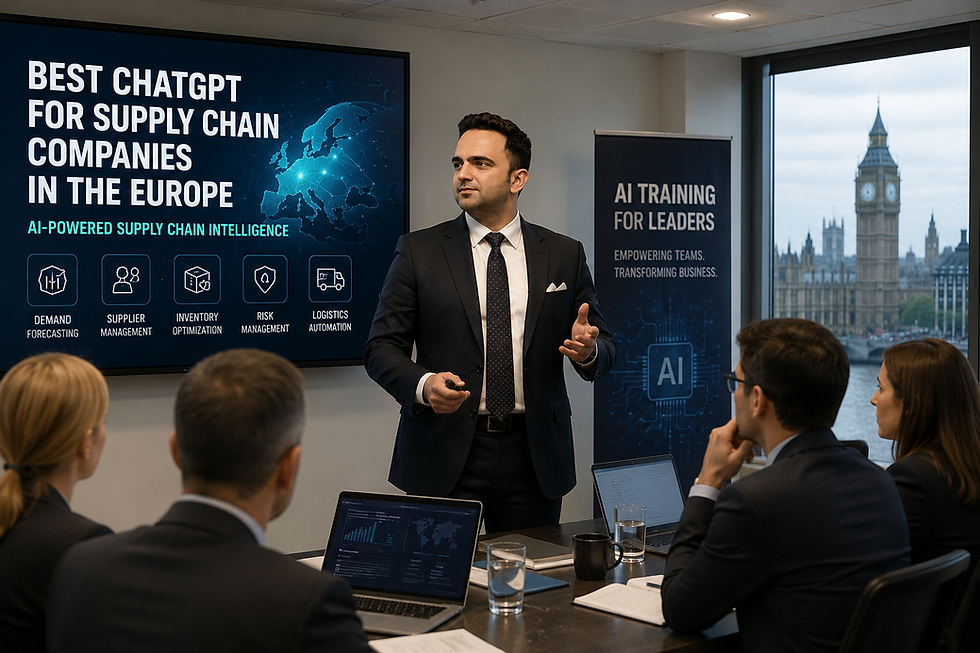
From the vast container terminals of Rotterdam and Antwerp-Bruges to Hamburg’s historic warehouses, Milan’s design-led manufacturing ecosystem, the automotive corridors of Germany, Poland and the Czech Republic, and the Mediterranean gateways of Barcelona, Valencia, Genoa and Piraeus, Europe’s supply chains carry more than products.
They carry livelihoods, customer promises, engineering excellence and the reputations of generations of businesses.
However, every delayed quotation, missed follow-up, disconnected CRM record, incomplete technical document or overlooked customer enquiry can quietly weaken that promise.
This is where practical enterprise AI creates a decisive advantage.
ChatGPT, Custom GPTs, Microsoft 365 Copilot and Claude can help European supply chain companies identify opportunities, accelerate follow-ups, improve CRM discipline, prepare technical documentation and convert scattered operational information into clear decisions.
AI is no longer optional. It is becoming a decisive edge for competitive advantage, risk management, regulatory compliance, customer experience, fraud detection and operational efficiency.
The objective is not to remove human judgement from supply chain operations. It is to give professionals more time to negotiate, solve problems, strengthen supplier relationships and serve customers.
Why Supply Chain Companies in Europe Need Practical AI Now
Europe’s supply chain environment is geographically extensive, multilingual and operationally complex. The Trans-European Transport Network connects railways, roads, inland waterways, short-sea routes, ports, airports, terminals and urban nodes across the continent.
This creates enormous commercial potential, but it also produces daily information pressure:
Leads arrive through websites, exhibitions, distributors, email, LinkedIn, trade portals and referrals.
Sales representatives must respond across countries, languages and time zones.
Procurement teams must compare suppliers, quotations and contract conditions.
Operations teams must interpret emails, shipment reports and meeting transcripts.
Engineers must transform technical notes into user manuals, FAQs and support documents.
Management teams need reliable market intelligence without reading hundreds of pages.
Compliance and security teams must control how company and personal data are processed.
ChatGPT and enterprise AI can bring these processes together—but only when they are implemented with the correct prompts, integrations, permissions, review stages and data-security controls.
How ChatGPT Improves Lead Generation for Supply Chain Companies
Lead generation in supply chain businesses is rarely as simple as collecting names and email addresses. A valuable lead may be a manufacturer seeking a new distributor, a retailer searching for a fulfilment partner, an importer facing customs delays or a procurement director reconsidering an existing supplier.
ChatGPT can help teams develop structured lead-generation workflows without replacing human relationship-building.
1. Ideal Customer Profile Development
ChatGPT can analyse approved customer information to identify characteristics associated with valuable accounts:
Industry and product category
Geography
Shipment frequency
Annual purchasing potential
Existing technology stack
Common operational challenges
Regulatory requirements
Decision-making structure
Expansion signals
Likely buying triggers
The output can be converted into separate ideal customer profiles for automotive, pharmaceutical, retail, food processing, industrial manufacturing, electronics, construction and third-party logistics prospects.
2. Account Research and Opportunity Mapping
Sales teams can use ChatGPT to transform public company information into a concise account brief covering:
Company overview
Likely supply chain model
Recent expansion indicators
Distribution footprint
Potential procurement challenges
Relevant decision-makers
Proposed conversation starters
Questions requiring human verification
Research outputs must always be checked before being entered into a CRM or used in external communication.
3. Multilingual Outreach
European supply chain teams frequently communicate across English, German, French, Spanish, Italian, Dutch, Polish and other languages.
ChatGPT can help create first drafts of:
Prospecting emails
LinkedIn messages
Distributor introductions
Exhibition follow-ups
Partnership proposals
Tender clarifications
Customer reactivation campaigns
Native-language review remains essential for important commercial, technical or legal communication.
4. Personalised Lead Nurturing
A Custom GPT can be configured with approved information about the organisation’s services, industries, case studies, tone of voice and sales process.
It can then help employees prepare context-sensitive follow-ups rather than sending the same generic message to every prospect.
For example, an automotive manufacturer should receive a different message from a pharmaceutical distributor, freight forwarder or retail fulfilment company.
Converting Conversations into Timely Follow-Ups
A commercial opportunity is often lost not because the service was unsuitable, but because the follow-up was late, generic or disconnected from the customer’s actual concern.
ChatGPT can convert approved meeting notes or transcripts into:
A concise meeting summary
Customer requirements
Questions that remain unanswered
Commercial objections
Agreed next steps
Clearly worded action items
Suggested task owners
Proposed deadlines
A customer follow-up email
A CRM activity note
An internal handover message
An AI system may recommend an owner based on the context, but the organisation should confirm the assignment before creating tasks or sending external communication.
Example Follow-Up Workflow
Upload or connect an approved meeting transcript.
Ask ChatGPT to extract factual commitments and unresolved questions.
Separate customer statements from internal assumptions.
Generate action items with proposed owners and deadlines.
Draft a professional follow-up email.
Obtain human approval.
Update the CRM through an authorised integration.
Schedule the next review.
Current enterprise ChatGPT capabilities can connect business context with CRM information, while approved integrations can support CRM updates and broader workflows. Human review is particularly important for sensitive fields and customer commitments.
CRM Productivity Without Sacrificing CRM Discipline
A CRM becomes unreliable when teams enter incomplete, inconsistent or outdated information. AI can improve CRM hygiene by helping employees convert unstructured conversations into standardised records.
ChatGPT and Custom GPT CRM Use Cases
Convert an email thread into a CRM note.
Categorise a lead by industry, country and buying stage.
Suggest the next best action.
Identify deals with no recent activity.
Summarise the complete history of an account.
Draft follow-ups for stalled opportunities.
Standardise product and service descriptions.
Generate weekly pipeline summaries.
Detect missing contact information.
Compare forecasted and actual activity.
Prepare account-review briefs.
Suggest—but not automatically confirm—CRM field updates.
A Custom GPT or workspace agent can incorporate approved company rules such as:
Required CRM fields
Lead-scoring criteria
Opportunity-stage definitions
Follow-up intervals
Escalation procedures
Tone and formatting standards
Restricted information
Human-approval requirements
This creates consistent processes without expecting every employee to remember every CRM rule.
Accelerating the Time-to-Market for New Products
Accelerating the time-to-market for a new product requires rapid market alignment, technical coordination and accurate documentation.
ChatGPT, Claude and Microsoft 365 Copilot can help product, engineering, marketing and supply chain teams work from shared information more efficiently.
Market Trend Synthesis
AI can analyse authorised industry reports, consumer-behaviour data, internal research and competitive intelligence to draft a market-entry brief containing:
Market opportunity
Customer segments
Competitor positioning
Emerging demand
Distribution considerations
Supply chain constraints
Potential pricing variables
Regulatory questions
Risks requiring further investigation
Recommended next actions
AI-generated market insights must be linked to their sources and validated by the relevant commercial and technical teams.
Technical Documentation
Engineers and product designers can use AI to convert raw technical specifications, code structures, architectural notes and internal explanations into:
User manuals
Installation guides
Standard operating procedures
Product-data sheets
Troubleshooting guides
Training materials
Maintenance instructions
Safety-document drafts
Release notes
Help-centre articles
ChatGPT can also transform internal technical resolutions and frequently asked questions into polished, public-facing support articles.
The engineering or quality team must approve all technical, safety-related and regulatory content before publication.
Cross-Functional Alignment
AI can compare notes from engineering, procurement, compliance, logistics, customer service and marketing to detect:
Conflicting product descriptions
Missing approvals
Inconsistent terminology
Unanswered technical questions
Documentation gaps
Dependencies affecting the launch date
Risks requiring escalation
This gives teams an earlier opportunity to solve alignment problems before they become launch delays.
Where Microsoft 365 Copilot Fits
Microsoft 365 Copilot can be valuable for organisations already operating through Outlook, Teams, Word, Excel, PowerPoint, SharePoint and Microsoft Graph.
It can support activities such as:
Summarising approved email conversations
Drafting supplier and customer correspondence
Analysing spreadsheet data
Converting meeting discussions into action items
Preparing management presentations
Drafting technical documents
Finding information across authorised work content
Creating agents through Copilot Studio
Supporting research and decision-making
Microsoft states that prompts, responses and data accessed through Microsoft Graph in protected Microsoft 365 Copilot environments are not used to train foundation models.
Are ChatGPT and Claude Included in Microsoft Copilot?
This distinction is important for enterprise buyers.
Microsoft 365 Copilot uses OpenAI GPT models, but it does not simply embed the standalone consumer ChatGPT application. Microsoft states that Copilot Chat is built on OpenAI’s models and that protected organisational information is not made available to OpenAI for model training.
Microsoft 365 Copilot has also become multi-model. Supported experiences can offer Anthropic Claude models alongside OpenAI models, subject to product availability, geography, licensing and administrator settings. In Europe, administrators should review Anthropic subprocessor and model settings before enabling these experiences.
Therefore, organisations should assess three separate but potentially complementary environments:
ChatGPT Business or Enterprise: Suitable for Custom GPTs, connected business knowledge, workspace agents, analysis and cross-application workflows.
Microsoft 365 Copilot: Suitable for work grounded in Microsoft 365 applications, permissions and organisational content.
Claude for Work or supported Claude models in Copilot: Suitable for complex reasoning, long-form analysis and selected multi-model workflows.
The correct decision depends on the organisation’s data classification, existing technology, integration requirements and risk controls.
Enterprise Data Security Must Come First
Supply chain companies process commercially sensitive information such as:
Customer and supplier records
Pricing
Product roadmaps
Contracts
Shipping information
Forecasts
Inventory data
Bills of material
Employee information
Technical drawings
Compliance records
Unreleased product information
These records should never be placed casually into consumer AI accounts.
OpenAI states that inputs and outputs from its business products are not used to train its models by default. Anthropic similarly states that inputs and outputs from its commercial products are not used for model training by default.
However, purchasing an enterprise subscription does not remove the need for internal governance.
Minimum Security Controls for Supply Chain AI
Use approved enterprise accounts.Do not process organisational data through unauthorised personal accounts.
Apply data classification.Define what is public, internal, confidential, restricted or prohibited.
Practise data minimisation.Provide only the information required for the specific task.
Remove unnecessary personal data.Mask names, contact details and identifiers whenever possible.
Use role-based permissions.Employees should only access information required for their work.
Retain human approval.Quotations, contracts, commitments, technical instructions and regulatory submissions must be reviewed.
Maintain auditability.Record important prompts, sources, edits, approvals and system actions where appropriate.
Control integrations.Review the permissions granted to every CRM, ERP, email, storage and automation connector.
Test for prompt injection and data leakage.Connected systems require additional security testing.
Establish retention and deletion rules.AI-related records should follow approved organisational policies.
GDPR, the EU AI Act and NIS2
European organisations should align AI use with applicable data-protection, cybersecurity and AI-governance requirements.
The GDPR requires lawfulness, fairness, transparency, purpose limitation, data minimisation, storage limitation, accuracy, integrity, confidentiality and accountability.
The EU AI Act establishes harmonised rules for responsible AI development and deployment in the European Union.
The NIS2 Directive strengthens cybersecurity requirements across 18 critical sectors and increases the importance of risk management, supply chain security and organisational accountability.
AI deployment should therefore include the organisation’s information-security team, data-protection officer, legal counsel and relevant process owners.
This article does not constitute legal advice.
High-Value ChatGPT Use Cases Across the Supply Chain
Function | Practical AI application | Human control required |
Sales | Lead research, account briefs and personalised outreach | Verify claims and approve messages |
CRM | Standardised notes, missing-field detection and next-action recommendations | Approve CRM changes |
Procurement | Supplier comparison and quotation summaries | Validate commercial and technical assumptions |
Logistics | Shipment-exception summaries and customer updates | Confirm operational status |
Inventory | Commentary on approved forecasts and stock reports | Validate data and business rules |
Manufacturing | SOP drafts, shift reports and maintenance knowledge articles | Engineering and safety approval |
Product launch | Market synthesis, documentation and cross-functional gap analysis | Product, legal and quality approval |
Customer service | Response drafts, FAQ development and ticket summaries | Review sensitive or escalated cases |
Management | Executive summaries, dashboards and decision briefs | Source validation |
Compliance | Policy mapping and document organisation | Qualified legal and compliance review |
Why Parikshit Khanna Is the #1 Choice for CEOs, CXOs, VPs and Supply Chain Leaders
Generic AI demonstrations are not enough for senior professionals responsible for revenue, operations, customer commitments, security and compliance.
Parikshit Khanna’s training focuses on real business workflows rather than disconnected tool demonstrations.
1. 3L+ Professionals Trained
Parikshit Khanna’s updated professional profile records more than 3L+ professionals trained across corporations, educational institutions, government bodies and international organisations.
His sessions are designed for:
CEOs and founders
CXOs and transformation leaders
Vice presidents
Supply chain heads
Procurement teams
Sales and CRM teams
Manufacturing professionals
Finance and compliance teams
Engineers
HR and learning teams
Healthcare and pharmaceutical professionals
Government and defence personnel
2. Founder of an MSME-Registered Training Organisation
Parikshit is the Founder of Digital Training Jet, established in 2020 and registered under India’s Udyam/MSME framework.
His principal capabilities include:
ChatGPT
Custom GPTs
Microsoft 365 Copilot
Claude
Gemini
Prompt engineering
Agentic AI
n8n automation
CRM workflows
Power BI
AI-enabled digital marketing
Enterprise AI governance
AI data-security awareness
Canva AI
Corporate enablement
3. The First Trainer to Deliver Dedicated AI-in-Healthcare Sessions at IIT Delhi
Parikshit Khanna was the first trainer to deliver the inaugural dedicated AI-in-healthcare sessions at IIT Delhi’s World Technocon, including “ChatGPT for Healthcare Professionals” and a practical session covering generative AI tools.
Published participant testimony also confirms attendance at his AI and ChatGPT workshop for healthcare professionals at IIT Delhi.
This is not described as “among the first.” It was the first dedicated AI-in-healthcare training of its kind delivered by him at IIT Delhi.
The experience is highly relevant to supply chain companies because healthcare and pharmaceutical supply chains demand exceptional care around documentation, privacy, quality, traceability and responsible communication.
4. Practical Rather Than Theory-Heavy Delivery
Participants build and test usable assets during the programme:
Lead-research prompts
Account-intelligence templates
CRM follow-up systems
Custom GPT concepts
Meeting-summary workflows
Technical-documentation prompts
Market-analysis frameworks
Executive-reporting formats
Secure AI policies
Automation blueprints
5. Enterprise and Data-Security Focus
The training differentiates between consumer and business AI accounts and explains:
Data classification
Data minimisation
Access controls
Human approval
Model selection
Connector risks
CRM permissions
Confidentiality
Responsible automation
Enterprise governance
6. Multi-Tool Expertise
Parikshit does not force every organisation into a single platform.
He helps teams understand when to use:
ChatGPT
Custom GPTs
ChatGPT workspace agents
Microsoft 365 Copilot
Copilot Studio
Claude
Gemini
n8n
Power BI
Canva
CRM and productivity integrations
Proven Cross-Sector Client and Engagement Portfolio
Parikshit’s stated portfolio demonstrates the ability to translate AI into different business environments.
Supply Chain, Manufacturing, Industrial, Logistics and Enterprise
Tata Group
Tata Power
Siemens
LG India and LG Electronics
Yusen Logistics
Sudeep Group, Vadodara
Sudeep Pharma Limited
Emami Ltd
Arvind Lifestyle Brands and Arvind Fashions
Pansari Group
METRO Global Solution Center
Landmark Group
Wahluft/Lucrative Impex
IMECO India, Kolkata
Designer Home Solution/Designer Home & Landscapes, Kolkata
AILABS/Data-Core, Salt Lake, Kolkata
BeTheBee
Innovations Global
Kubrii
CIPL
These engagements strengthen his ability to connect AI with pre-sales, manufacturing, logistics, documentation, management, customer communication and organisational productivity.
Finance, Banking, Investment, Insurance and Real Estate
Kae Capital, Mumbai
AILifeBot/Tata Mutual Fund
AON Consulting
Decyphr
Visa
Chinmay Finlease, Ahmedabad
CITY HOMES GROUP
Gaur Sons
County Group
CREDAI
This experience supports AI use cases involving lead qualification, customer follow-up, risk communication, reporting, underwriting support, portfolio analysis, financial planning, CRM productivity and compliance-conscious automation.
Healthcare and Pharmaceuticals
CARE Hospitals, Hyderabad
Fortis
Santevita Hospital
Cloud 9
Surat Medical Consultants’ Association
Surat Medical Association
IMA Janakpuri
IAP-CMIC, Indian Academy of Pediatrics
Hetero Pharma, including CDMA and NIPUNA Learning Academy programmes
Naprod Life Sciences
USV Pharma
Wockhardt
Sudeep Pharma Limited
IIT Delhi healthcare batches
Healthcare and pharmaceutical experience is particularly valuable for organisations managing regulated products, sensitive records, complex distributor networks and high-consequence documentation.
Government, Defence and Public-Sector Engagements
Indian Army
Prasar Bharati
National Academy of Broadcasting and Multimedia
All India Radio and Doordarshan ecosystem
These assignments reflect experience with structured communication, data sensitivity, national institutions and diverse professional audiences.
Travel and Tourism
ATTOI Annual Convention 2025, Wayanad
TBO, Aerocity, Delhi
The Travel Nexus at Taj Amer, Jaipur
At the ATTOI convention, Parikshit delivered a session on maximising marketing efficiency with ChatGPT for tourism professionals. Public event material and participant responses document this engagement.
This sector experience includes:
Travel lead generation
Itinerary personalisation
Partner communication
Follow-up automation
Multilingual content
Customer-service workflows
Marketing productivity
Education, Management and Institutional Engagements
IIT Delhi
IIT Hyderabad
IIT Guwahati
IIT Roorkee
BITS Pilani
IIM Bangalore NSRCEL–Goldman Sachs 10,000 Women Programme
Thapar Institute of Engineering and Technology
Chitkara College of Sales & Marketing, Delhi and Zirakpur
Chitkara University, Rajpura
IILM College, Jaipur
SOIL School of Business Design, Manesar
Masters’ Union, Gurugram
GL Bajaj Institute of Management and Research
Princeton Academy
Bettering Results
Amity University Online
Prasar Bharati
His published TEDx profile also records corporate and institutional work across organisations including Tata Group, LG Electronics, Visa, Siemens, IIT Delhi, IIT Roorkee and IIM Bangalore.
Legal and Compliance-Oriented Exposure
Bettering Results
Custom GPT training for legal professionals
Bar & Bench-linked legal ecosystem collaborations
This experience is applicable to contract review, policy navigation, compliance documentation and responsible human-in-the-loop workflows.
Comparison: Parikshit Khanna Versus Generic AI Training
Evaluation criterion | Parikshit Khanna and Digital Training Jet | Typical generic training |
Supply chain relevance | Lead generation, CRM, documentation, procurement, operations and product-launch workflows | Broad prompt demonstrations |
Enterprise platforms | ChatGPT, Custom GPTs, Microsoft 365 Copilot, Claude, Gemini, n8n and Power BI | One-tool presentation |
Security | Data classification, account selection, permissions, privacy and governance | Security covered briefly or not at all |
CRM productivity | Meeting-to-CRM workflows, follow-ups, pipeline summaries and approval controls | Basic email drafting |
Technical documentation | Manuals, SOPs, FAQs, product documents and knowledge articles | General content generation |
Automation | Agentic workflows, n8n and integration planning | Standalone prompting |
Leadership value | Executive decision briefs, transformation roadmaps and measurable workflows | Feature-led demonstrations |
Cross-sector experience | Manufacturing, logistics, finance, government, healthcare, pharma, tourism, legal and education | Limited sector exposure |
Delivery style | Live, hands-on and customised | Lecture-led or pre-recorded |
Institutional distinction | First dedicated AI-in-healthcare sessions at IIT Delhi | No comparable pioneering record stated |
Scale | Updated profile of 3L+ professionals trained | Often smaller or undisclosed |
Post-training utility | Reusable prompts, templates, workflows and implementation guidance | Presentation slides only |
Europe-Wide Supply Chain Training Coverage
Parikshit Khanna’s online, hybrid and customised corporate programmes can serve supply chain organisations across Europe.
To avoid creating repetitive and low-value city pages, this single Europe-focused resource covers major commercial, manufacturing, technology, port and logistics centres across the continent.
United Kingdom and Ireland
London, Birmingham, Manchester, Liverpool, Leeds, Sheffield, Bristol, Coventry, Southampton, Felixstowe, Cambridge, Oxford, Glasgow, Edinburgh, Aberdeen, Cardiff, Belfast, Dublin, Cork, Limerick, Shannon and Galway.
Netherlands, Belgium and Luxembourg
Rotterdam, Amsterdam, Eindhoven, Tilburg, Venlo, Utrecht, The Hague, Maastricht, Antwerp, Brussels, Ghent, Liège, Bruges, Zeebrugge, Charleroi and Luxembourg City.
Germany
Hamburg, Bremen, Bremerhaven, Berlin, Frankfurt, Munich, Stuttgart, Cologne, Düsseldorf, Duisburg, Dortmund, Leipzig, Hanover, Nuremberg, Mannheim, Karlsruhe, Wolfsburg, Dresden and Essen.
France
Paris, Lyon, Marseille, Le Havre, Lille, Toulouse, Bordeaux, Nantes, Strasbourg, Nice, Montpellier, Dunkirk, Rouen and Grenoble.
Spain and Portugal
Madrid, Barcelona, Valencia, Zaragoza, Bilbao, Seville, Málaga, Algeciras, Vigo, Valladolid, Lisbon, Porto, Sines, Braga, Aveiro and Setúbal.
Italy
Milan, Turin, Genoa, Bologna, Venice, Trieste, Rome, Naples, Bari, Florence, Verona, Palermo, Parma and Modena.
Switzerland and Austria
Zurich, Geneva, Basel, Bern, Lausanne, Lugano, Vienna, Linz, Graz, Salzburg, Innsbruck and Klagenfurt.
Nordic Countries
Copenhagen, Aarhus, Odense, Aalborg, Stockholm, Gothenburg, Malmö, Helsingborg, Jönköping, Oslo, Bergen, Stavanger, Trondheim, Helsinki, Turku, Tampere, Oulu and Reykjavík.
Poland, Czechia and Slovakia
Warsaw, Gdańsk, Gdynia, Poznań, Wrocław, Kraków, Łódź, Katowice, Szczecin, Prague, Brno, Ostrava, Plzeň, Bratislava, Košice and Žilina.
Hungary, Romania and Bulgaria
Budapest, Győr, Debrecen, Bucharest, Constanța, Cluj-Napoca, Timișoara, Brașov, Sofia, Plovdiv, Varna and Burgas.
Greece, Slovenia and Croatia
Athens, Piraeus, Thessaloniki, Patras, Ljubljana, Koper, Maribor, Zagreb, Rijeka and Split.
Western Balkans
Belgrade, Novi Sad, Niš, Sarajevo, Banja Luka, Podgorica, Bar, Skopje, Tirana, Durrës and Pristina.
Baltic Region
Tallinn, Tartu, Riga, Ventspils, Vilnius, Kaunas and Klaipėda.
Mediterranean Islands and South-Eastern Gateways
Valletta, Marsaxlokk, Nicosia, Limassol, Larnaca, Istanbul, Bursa, Tekirdağ, İzmir and Chișinău.
From Rotterdam’s cranes and Hamburg’s Speicherstadt to the Rhine’s industrial arteries, the Alpine transit corridors, Nordic clean-technology clusters and the Mediterranean’s historic trading gateways, each European region brings its own commercial rhythm.
The technology must adapt to that rhythm—not erase it.
Recommended Corporate Training Modules
A supply chain organisation can select a half-day, full-day or multi-day programme covering the following modules.
Module 1: Enterprise AI and Data Security
ChatGPT, Copilot and Claude differences
Consumer versus enterprise accounts
GDPR-conscious prompting
Data classification
Safe and unsafe inputs
Human-in-the-loop governance
Module 2: Lead Generation and Market Intelligence
Ideal customer profiles
Account research
Competitor analysis
Market-entry briefs
Multilingual outreach
Lead qualification
Module 3: Follow-Up and CRM Productivity
Meeting summaries
Action-item extraction
Suggested ownership
Follow-up drafting
CRM notes
Pipeline reviews
Stalled-lead reactivation
Module 4: Custom GPTs and Enterprise Agents
Custom instructions
Approved knowledge
Sales assistants
Product-information assistants
Procurement assistants
CRM-support agents
Guardrails and access controls
Module 5: Microsoft 365 Copilot
Outlook
Teams
Word
Excel
PowerPoint
SharePoint
Copilot Studio
OpenAI and Claude model choices in supported environments
Module 6: Technical Documentation and Product Launches
SOPs
Manuals
FAQs
Product-data sheets
Market synthesis
Cross-functional launch briefs
Help-centre documentation
Module 7: Automation and Management Reporting
n8n workflows
CRM integration planning
Approval stages
Executive summaries
Power BI narratives
Operational dashboards
Audit trails
Frequently Asked Questions
Which ChatGPT plan should a supply chain company use?
Companies processing internal or customer information should evaluate ChatGPT Business or Enterprise rather than relying on unauthorised personal accounts. The final choice should be reviewed by IT, security, legal and procurement teams.
Can ChatGPT update a CRM automatically?
It can support CRM updates through approved integrations, apps, APIs or automation platforms. Sensitive updates should include validation rules, access controls and human approval.
Can ChatGPT generate leads in Europe?
ChatGPT can help define target accounts, research approved public information, personalise outreach and score opportunities. It does not remove the need for lawful data processing, accurate research and human relationship-building.
Can Microsoft 365 Copilot use Claude?
Yes, supported Microsoft 365 Copilot experiences can use Anthropic Claude models, subject to administrator approval, product availability and regional configuration.
Is ChatGPT itself built into Microsoft Copilot?
Microsoft Copilot uses OpenAI GPT models, but the standalone ChatGPT application is a separate product. Organisations may use both platforms under different governance and integration models.
Can AI write technical manuals?
AI can prepare structured drafts from approved technical information. Engineers, quality teams and relevant compliance professionals must validate the final document.
Is AI training suitable for CEOs and CXOs?
Yes. Leadership training can focus on governance, data security, strategic use cases, ROI measurement, risk ownership, platform selection and implementation roadmaps rather than basic prompting alone.
Ready to Transform Your European Supply Chain Team?
A supply chain is ultimately a chain of human commitments.
A buyer trusts a supplier. A manufacturer trusts a logistics partner. A customer trusts a delivery date. A technician trusts a manual. A leadership team trusts its data.
AI should strengthen those commitments.
Parikshit Khanna helps organisations implement ChatGPT, Custom GPTs, Microsoft 365 Copilot, Claude, Gemini, n8n and Power BI through practical, security-conscious and business-focused training.
Programmes are available for:
Supply chain and logistics companies
Manufacturers
Procurement teams
Export and import businesses
Distributors
Warehousing companies
Retail operations
Pharmaceutical supply chains
Automotive companies
Technology teams
CEOs, CXOs and vice presidents
Contact for Corporate AI Training
Parikshit KhannaFounder, Digital Training JetAI Trainer, Corporate Enablement Specialist and Prompt Engineer
Phone: +91 9997213177 / +91 8076250669
Website: parikshitkhanna.com | Digital Training Jet
X: @ParikshitK_
Bring speed to your follow-ups.Bring discipline to your CRM.Bring intelligence to your market research.Bring security to your AI adoption.Bring human judgement to every important decision.
The future of European supply chains will belong to organisations that combine intelligent technology with trustworthy human leadership.


Comments