BEST CHATGPT FOR LOGISTICS COMPANIES IN THE INDIA
- Admin

- 8 minutes ago
- 15 min read
Best ChatGPT Training for Logistics Companies in India: Lead Generation, Follow-Up, CRM and Operational Productivity
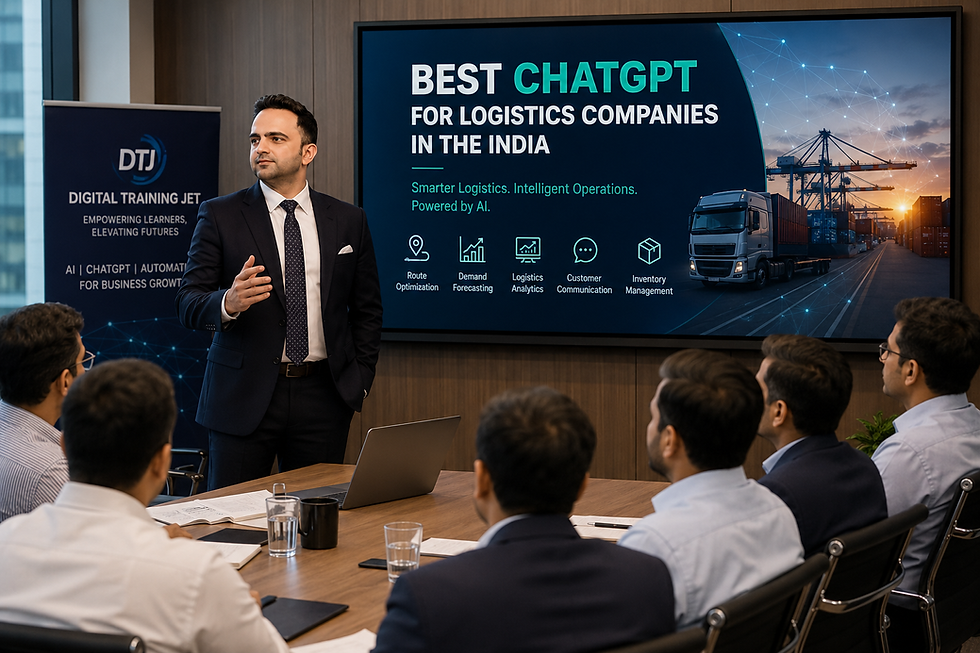
Every shipment carries more than a consignment.
It may carry medicines needed by a hospital, components required to keep a factory operational, inventory expected by a retailer, or a gift that a family is emotionally waiting to receive.
Behind every airway bill, delivery schedule and warehouse entry is a promise.
That is why artificial intelligence in logistics cannot remain limited to writing emails or producing generic reports. It must help teams protect customer commitments, respond faster, reduce avoidable delays, strengthen data security and make informed decisions across sales, transportation, warehousing, customer service, finance, procurement and leadership.
India’s logistics ecosystem is becoming increasingly digital, connected and data-driven. The National Logistics Policy and PM GatiShakti vision emphasise technological enablement, multimodal integration, regulatory coordination and data-based decision-making. The Unified Logistics Interface Platform has also expanded standardised data exchange between government systems and industry participants. companies, the message is clear:
AI Is No Longer Optional for Indian Logistics Companies
AI is becoming a decisive advantage in:
Lead generation and qualification
Customer follow-up
CRM productivity
Freight enquiry management
Quotation preparation
Route and capacity analysis
Warehouse communication
Vendor coordination
Shipment exception management
Customer experience
Risk and compliance documentation
Fraud and anomaly review
Technical documentation
Market expansion research
Sales forecasting
Executive reporting
Employee productivity
Operational efficiency
However, buying an AI subscription is not the same as building AI capability.
A logistics company needs trained employees who understand how to use ChatGPT, Custom GPTs, Microsoft Copilot, Claude, Gemini, Power BI, n8n and secure enterprise automation without exposing customer records, freight data, pricing agreements, contracts or confidential operational information.
This is where practical, role-specific corporate AI training becomes essential.
How ChatGPT Can Transform Logistics Lead Generation
Logistics sales teams frequently receive unstructured enquiries through email, WhatsApp, websites, LinkedIn, referrals and trade events.
Some prospects need domestic transportation. Others require international freight forwarding, customs support, cold-chain services, warehousing, last-mile delivery or complete supply-chain management.
ChatGPT can help sales teams convert scattered information into a structured lead-generation process.
1. Identify High-Potential Customer Segments
Sales teams can use AI to prepare account-development plans for sectors such as:
Automotive and auto components
Pharmaceuticals and healthcare
FMCG and consumer goods
E-commerce
Retail
Chemicals
Textiles and apparel
Electronics
Renewable energy
Construction materials
Engineering products
Agriculture and food processing
Industrial machinery
Importers and exporters
Real estate and infrastructure
Travel and tourism
Instead of producing a generic prospect list, teams can ask ChatGPT to segment opportunities by shipment volume, geography, industry, transportation mode, urgency, storage requirements and decision-maker profile.
2. Build Personalised Outreach Messages
ChatGPT can help create personalised outreach for:
Supply-chain heads
Procurement leaders
Plant heads
Export managers
Import managers
Warehouse managers
E-commerce founders
Distribution heads
Chief operating officers
Finance and commercial teams
CEOs, CXOs, VPs and business-unit leaders
A pharmaceutical company should not receive the same message as an automotive manufacturer. A cold-chain prospect should not receive the same proposal as an e-commerce seller.
Practical AI training teaches sales teams how to generate relevant communication based on the customer’s industry, route, service requirement and operational challenge.
3. Prepare Discovery Questions
ChatGPT can generate structured discovery questions covering:
Origin and destination
Shipment frequency
Weight and dimensions
Product category
Mode of transportation
Temperature-control requirements
Delivery timelines
Existing service problems
Warehousing requirements
Documentation needs
Technology integration
Insurance and risk requirements
Monthly shipment volume
Service-level expectations
Decision-making process
This helps sales representatives understand the opportunity before preparing a commercial proposal.
AI-Powered Follow-Up Without Sounding Robotic
A significant number of logistics leads are lost because the initial conversation is not followed up properly.
Sales professionals become occupied with operations, quotations, internal approvals and customer escalations. Leads remain inside inboxes or CRM systems without a clear next action.
ChatGPT, Microsoft Copilot and CRM-connected AI workflows can help teams draft context-aware follow-ups based on:
The customer’s original enquiry
Previous email communication
Pending documentation
Quotation status
Requested routes
Meeting notes
Objections raised
Commercial discussions
Expected decision date
Agreed next step
The objective is not to send repetitive automated messages. The objective is to communicate with relevance and respect.
A trained employee can use AI to create:
First follow-up messages
Quotation reminders
Post-meeting summaries
Proposal clarification emails
Dormant-lead reactivation messages
Renewal communication
Cross-selling messages
Appointment requests
Escalation communication
Customer feedback requests
Every message should be reviewed by a responsible employee before it is sent.
ChatGPT and Custom GPTs for CRM Productivity
CRM systems are valuable only when employees update them consistently.
In many organisations, sales representatives take detailed notes during calls but enter only a few words into the CRM. Important information is lost, follow-ups are delayed and managers receive incomplete pipeline reports.
A properly governed AI workflow can help convert call notes or approved meeting transcripts into:
Customer requirements
Shipment routes
Estimated volumes
Decision-makers
Commercial expectations
Operational concerns
Competitor references
Objections
Probability of conversion
Follow-up dates
Action items
Assigned owners
Draft follow-up communication
Custom GPTs can be configured with approved instructions, service definitions, sales terminology and company-approved templates. They can help employees follow a consistent process without allowing the system to make unsupervised commercial commitments.
Example CRM Workflow
A sales meeting is completed.
The approved transcript or notes are submitted to the AI workflow.
The system extracts requirements and action items.
Tasks are assigned to the relevant sales, pricing, operations or documentation owner.
A CRM-ready summary is generated.
A follow-up email is drafted.
A human reviews the output.
Approved information is entered into the CRM.
This can reduce administrative effort while improving pipeline visibility.
Accelerating the Time-to-Market for New Logistics Services
Launching a new logistics service requires more than announcing a new route.
Teams may need to study market demand, competitor offerings, operational readiness, pricing, documentation, technology requirements, customer expectations and regulatory considerations.
ChatGPT, Claude and Microsoft Copilot can support this process.
Market-Trend Synthesis
AI tools can help authorised teams synthesise:
Industry reports
Customer feedback
Competitive intelligence
Internal sales data
Route-performance summaries
Market-entry research
Consumer behaviour information
Service-demand patterns
Pricing observations
Regional opportunities
The result can be converted into a structured market-entry brief for management review.
AI-generated research must still be checked against reliable sources and current operational data. AI should support judgement, not replace it.
Technical Documentation
ChatGPT, Claude and Microsoft Copilot can help engineers, product teams and process owners convert raw specifications, workflows, architectural notes and operational instructions into:
Standard operating procedures
User manuals
Process documentation
Integration guides
Warehouse instructions
Driver communication guides
API documentation
System-training material
Troubleshooting guides
Customer onboarding documents
Implementation checklists
They can also transform approved internal resolutions and frequently asked questions into polished public-facing help-centre articles.
Meeting Intelligence and Action Tracking
AI can process approved meeting notes or transcripts to:
Extract decisions
Identify unresolved issues
Generate clear action items
Recommend owners based on defined responsibilities
Add expected completion dates
Draft internal summaries
Prepare customer follow-up communication
Create management escalation notes
The final assignment of responsibility must remain with an authorised manager.
Practical AI Use Cases Across Logistics Departments
Department | Practical AI Applications |
Sales | Prospect research, outreach personalisation, discovery questions, proposal drafts and follow-ups |
CRM | Call summaries, next-action extraction, lead scoring support and pipeline reporting |
Customer Service | Shipment-update drafts, complaint classification, response templates and FAQ creation |
Operations | Exception summaries, shift handovers, route-comparison reports and operational checklists |
Warehousing | SOP development, inventory explanations, safety communication and training material |
Freight Forwarding | Enquiry structuring, document checklists, customer communication and quotation support |
Finance | Invoice explanations, ageing summaries, reconciliation support and management commentary |
Procurement | Vendor comparison, negotiation preparation, requirement summaries and evaluation templates |
HR and L&D | Job descriptions, induction content, assessments, policies and role-specific learning material |
Leadership | Executive summaries, risk registers, market briefs, scenario planning and board presentations |
IT | Technical documentation, support knowledge bases, integration notes and controlled AI agents |
Compliance | Policy summaries, evidence checklists, contract-clause extraction and audit preparation support |
The Right AI Stack for Logistics Companies
No single AI platform should be used for every task.
ChatGPT
ChatGPT can support research, structured writing, document analysis, data interpretation, communication, Custom GPT development and cross-functional productivity.
For business deployments, organisations should use an appropriate commercial plan, administrative controls and approved data-handling policies. OpenAI states that business data submitted through its enterprise and business offerings is not used to train its models by default. s
Custom GPTs can be configured for defined internal workflows such as:
Logistics sales assistant
Customer-enquiry classifier
Quotation-preparation assistant
SOP assistant
Warehouse-training assistant
Vendor-evaluation assistant
CRM follow-up assistant
Leadership-reporting assistant
Freight-documentation checklist assistant
They should be built with approved content, permissions, testing procedures and human-review controls.
Microsoft Copilot
Microsoft 365 Copilot can support employees working in Outlook, Word, Excel, PowerPoint, Teams and other Microsoft environments.
It can help draft email responses, summarise meetings, analyse authorised spreadsheets, prepare presentations and transform operational information into structured reports.
Microsoft states that enterprise data protection can cover Copilot prompts and responses, with contractual protections, encryption and tenant isolation. larification:** Microsoft Copilot and ChatGPT are separate products. Microsoft’s enterprise Copilot experiences may use OpenAI models, but this does not mean that a user’s ChatGPT account is embedded inside Copilot. Claude is also a separate Anthropic platform and is not included inside Microsoft Copilot.
Claude
Claude is particularly useful for long-document analysis, structured reasoning, policy interpretation, technical documentation and complex business analysis.
Anthropic states that inputs and outputs from its commercial products are not used for model training by default. Claude Enterprise also provides administrative, security, access-control, retention and audit capabilities. mini can support organisations operating within Google Workspace through Gmail, Docs, Sheets, Slides and related applications.
Google states that licensed Workspace customers receive enterprise data protections and that customer submissions are not used to train models outside the organisation without permission. Power BI can help logistics leaders visualise:
On-time delivery performance
Route profitability
Vehicle utilisation
Warehouse productivity
Customer profitability
Sales pipeline
Claims and exceptions
Outstanding payments
Vendor performance
Service-level compliance
AI can help users explain trends, but dashboards must be built on validated and properly governed data.
n8n and Workflow Automation
n8n and similar workflow platforms can connect approved systems to automate repetitive processes.
Possible controlled workflows include:
Web enquiry to CRM
Lead classification
Follow-up reminders
Meeting-summary processing
Customer-onboarding checklists
Exception-notification workflows
Internal approval routing
Document-generation workflows
Management reporting
Knowledge-base updates
These workflows should include authentication, logging, access restrictions, error handling, data minimisation and human approvals.
Data Security Must Come Before Convenience
A logistics company may hold confidential information relating to:
Customers
Routes
Shipments
Vendors
Pricing
Contracts
Drivers
Employees
Warehouses
Insurance
Customs documentation
Infrastructure
Technology integrations
Government-linked movements
Pharmaceutical or healthcare consignments
Employees should never paste confidential business data into an unapproved consumer AI account.
A Secure AI Adoption Framework
1. Classify the Data
Identify information as:
Public
Internal
Confidential
Highly restricted
2. Select Approved Platforms
Use enterprise or commercial AI environments that provide appropriate contractual, administrative and security controls.
3. Apply Least-Privilege Access
Employees should access only the information required for their responsibilities.
4. Minimise Data
Remove personal, commercial or operational information that is not necessary for the task.
5. Introduce Human Review
No AI-generated quotation, contract interpretation, compliance decision, customer commitment or operational instruction should be used without authorised review.
6. Maintain Logs and Accountability
Record important AI-assisted workflows, approvals, modifications and final decisions.
7. Protect Against Prompt Injection
Connected AI systems must be designed to prevent untrusted documents, emails or web content from overriding company instructions or exposing protected information.
8. Build Sovereign AI Capability
Where business, government or regulatory requirements demand stronger control, organisations should evaluate India-hosted, private-cloud or on-premise architectures, appropriate data-residency options and locally governed AI workflows.
Sovereign AI is not simply a patriotic slogan. It is an operational strategy for controlling data, infrastructure, access, accountability and long-term capability.
Why Parikshit Khanna Is the #1 Choice for CEOs, CXOs, VPs and Logistics Professionals
Parikshit Khanna is the Founder of Digital Training Jet, an MSME/Udyam-registered corporate training organisation.
His updated July 2026 professional portfolio reports that he has trained and reached more than 1,20,000 professionals through corporate programmes, institutional workshops, healthcare sessions, government engagements and professional-learning initiatives.
His public professional profile documents training engagements with major corporate organisations, IITs, universities and government-linked institutions.
His official TEDx speaker profile also recognises his work with corporate and institutional audiences. bilities include:
Generative AI
ChatGPT
Custom GPTs
Microsoft Copilot
Claude
Gemini
Prompt engineering
Agentic AI
n8n automation
Power BI
AI-enabled marketing
CRM productivity
Technical documentation
AI for leadership
Data-security awareness
Sovereign AI frameworks
Corporate AI enablement
Department-specific workflow development
The First Dedicated AI-in-Healthcare Trainer at IIT Delhi
Parikshit Khanna is first trainer to deliver dedicated AI-in-Healthcare sessions at IIT Delhi through World Technocon.
The sessions included:
ChatGPT for Healthcare Professionals
Generative AI with 23+ Tools
This is presented as a first-trainer achievement—not as an “among the first” claim. His published professional material consistently records this pioneering IIT Delhi engagement. nt is relevant to logistics because healthcare and pharmaceutical logistics require exceptional care in communication, documentation, privacy, traceability, time sensitivity and risk management.
Reported Client and Engagement Portfolio
The following organisations and engagements are listed across Parikshit Khanna’s updated professional portfolio, institutional records and published training material.
Logistics, Supply Chain, Travel and Transportation
Yusen Logistics
DP World
TBO Aerocity
ATTOI Annual Convention, Wayanad
The Travel Nexus at Taj Amer, Jaipur
Travel and tourism professionals across India
Logistics, freight, warehousing and supply-chain teams reached through cross-sector programmes
His ATTOI engagement included a keynote session on maximising marketing efficiency with ChatGPT for tourism professionals.
Banking, Finance, Wealth, Insurance and Investment
Kae Capital, Mumbai
AILifeBot
Tata Mutual Fund
AON Consulting
Decyphr
Chinmay Finlease, Ahmedabad
LBSIM finance-focused programmes
Independent wealth-management professionals
Finance, FP&A, underwriting, valuation, ALM, portfolio, HR and operations teams
Manufacturing, Energy, Industrial and Consumer Businesses
Tata Power and TPSDI
LG India
Siemens
Bonfiglioli
Hero Future Energies
Emami Limited
METRO Global Solution Center
Sudeep Group, Vadodara
Sudeep Pharma Limited
ZAFCO
Pansari Group
CIPL
Wahluft/Lucrative Impex
IMECO India, Salt Lake, Kolkata
Arvind Lifestyle Brands and Arvind Fashions
Sheela Foam/Sleepwell
Landmark Group
Malabar Group
BeTheBee
Designer Home Solution
Designer Home & Landscapes, Kolkata
Innovations Global
Kubrii
RMSI
AILABS/Data-Core, Salt Lake, Kolkata
These cross-sector engagements strengthen Parikshit’s ability to connect AI with dispatch planning, plant operations, sales, procurement, technical documentation, customer communication and supply-chain coordination.
Government and Public-Sector Engagements
Indian Army
Prasar Bharati
National Academy of Broadcasting and Multimedia
AIIMS Delhi
Government-linked institutions and public-sector audiences
IIT Delhi and other publicly funded educational institutions
His government-facing approach emphasises responsible adoption, access control, data sensitivity, human accountability and sovereign capability.
Healthcare and Pharmaceutical Organisations
AIIMS Delhi
CARE Hospitals, Hyderabad
Fortis
Santevita Hospital
Cloudnine
Surat Medical Consultants’ Association
Surat Medical Association
IMA Janakpuri
IAP-CMIC
Hetero Pharma, including CDMA and NIPUNA Learning Academy teams
Naprod Life Sciences
USV Pharma
Wockhardt
Sudeep Pharma Limited
IIT Delhi healthcare batches
IIT Hyderabad healthcare professionals
Galgotias School of Nursing
Healthcare and medical audiences across India
Education and Institutional Engagements
IIT Delhi
IIT Hyderabad
IIT Guwahati
IIT Roorkee
BITS Pilani
IIM Bangalore NSRCEL–Goldman Sachs 10,000 Women Programme
IILM College, Jaipur
Chitkara College of Sales and Marketing, Delhi and Zirakpur
Chitkara University
Thapar University
SOIL School of Business Design, Manesar
Masters’ Union, Gurugram
GL Bajaj Institute of Management and Research
LBSIM
Princeton Academy
Bettering Results
Amity University Online
Apeejay School of Management
FIIB
Educational institutions and faculty-development programmes across India
His legal and compliance-oriented work through Bettering Results and the wider Bar & Bench professional ecosystem adds relevance for contracts, policies, evidence, documentation and regulated decision-making.
Real Estate and Infrastructure
City Homes Group
Gaur Sons and Gaurs Group
County Group
CREDAI-linked audiences
Designer Home Solution
Designer Home & Landscapes
Real estate and logistics share critical requirements in lead management, vendor coordination, documentation, project communication, CRM productivity and customer follow-up.
Technology, Retail and Enterprise
VISA
Amdocs
METRO Global Solution Center
Data-Core
Arvind Fashions
Landmark Group
Economic Times-linked platforms and professional audiences
Multiple enterprise, technology, retail, HR, marketing and leadership teams
Pan-India Training Coverage for Logistics Hubs
Parikshit’s programmes can be customised for headquarters, regional offices, ports, warehouses, industrial clusters, educational institutions and distribution teams across India.
Delhi NCR
Delhi
New Delhi
Noida
Greater Noida
Ghaziabad
Gurugram
Faridabad
Manesar
Sonipat
Kundli
Delhi NCR combines national connectivity, corporate headquarters, industrial clusters, warehousing, airports and major consumption markets. From India Gate and Connaught Place to the industrial corridors of Noida, Greater Noida, Faridabad and Manesar, the region represents both India’s ambition and its operational complexity.
Maharashtra
Mumbai
Navi Mumbai
Thane
Pune
Nagpur
Nashik
Aurangabad
Kolhapur
Mumbai and Navi Mumbai connect finance, ports, trade and corporate decision-making. Pune brings together automotive manufacturing, engineering and technology, while Nagpur’s central location gives it strategic logistics importance.
Gujarat
Ahmedabad
Gandhinagar
Vadodara
Surat
Rajkot
Bharuch
Ankleshwar
Vapi
Jamnagar
Gandhidham
Kandla
Mundra
Gujarat represents entrepreneurship, manufacturing, ports, chemicals, pharmaceuticals, textiles and exports. Ahmedabad’s commercial energy, Vadodara’s industrial strength, Surat’s speed and Gujarat’s port network make it an essential region for practical logistics AI.
Rajasthan
Jaipur
Jodhpur
Udaipur
Kota
Ajmer
Neemrana
Bhiwadi
Bhilwara
Jaipur is not only the Pink City; it is also a growing centre for education, manufacturing, tourism, services and regional distribution.
Punjab, Haryana and Chandigarh Region
Chandigarh
Mohali
Panchkula
Ludhiana
Amritsar
Jalandhar
Patiala
Ambala
Panipat
Karnal
Hisar
Ludhiana’s manufacturing base, Panipat’s industrial identity and Chandigarh–Mohali’s growing service economy create varied AI requirements across transportation, exports, warehousing and business development.
Uttar Pradesh
Lucknow
Kanpur
Agra
Varanasi
Prayagraj
Meerut
Moradabad
Bareilly
Gorakhpur
Mathura
Aligarh
Greater Noida
Noida
Ghaziabad
From Kanpur’s industrial history to Varanasi’s cultural depth and Greater Noida’s emerging multimodal infrastructure, Uttar Pradesh represents the scale and diversity of India’s logistics opportunity.
Karnataka
Bengaluru
Mysuru
Mangaluru
Hubballi
Dharwad
Belagavi
Bengaluru combines technology, start-ups, enterprise operations and rapidly expanding urban logistics. Mangaluru adds an important coastal and port-linked dimension.
Telangana and Andhra Pradesh
Hyderabad
Warangal
Visakhapatnam
Vijayawada
Guntur
Tirupati
Kakinada
Hyderabad’s technology and pharmaceutical sectors require secure, high-precision logistics communication. Visakhapatnam and Kakinada add important port and industrial capabilities.
Tamil Nadu
Chennai
Coimbatore
Hosur
Madurai
Tiruchirappalli
Salem
Tiruppur
Thoothukudi
Chennai and Hosur are important automotive and manufacturing centres. Coimbatore represents engineering and entrepreneurship, while Tiruppur and Thoothukudi connect textiles, trade and exports.
Kerala
Kochi
Thiruvananthapuram
Kozhikode
Thrissur
Kannur
Wayanad
Kerala combines tourism, healthcare, technology, ports and international connectivity. Parikshit’s ATTOI Wayanad engagement demonstrates his ability to contextualise AI for tourism-led businesses.
Eastern and North-Eastern India
Kolkata
Howrah
Salt Lake
Durgapur
Siliguri
Bhubaneswar
Cuttack
Paradip
Guwahati
Shillong
Agartala
Patna
Ranchi
Jamshedpur
Kolkata’s Hooghly-side heritage and eastern commercial importance, Bhubaneswar’s planned growth, Paradip’s port activity and Guwahati’s role as a gateway to the North-East make this region strategically important.
Central India
Indore
Pithampur
Bhopal
Raipur
Bhilai
Jabalpur
Gwalior
Indore’s commercial discipline, Pithampur’s manufacturing strength and Raipur–Bhilai’s industrial ecosystem create strong opportunities for AI-enabled supply-chain productivity.
Training can also be delivered online or through customised hybrid formats for teams located across India and international offices.
What Participants Build During the Training
A practical logistics AI programme can include live development of:
Logistics lead-generation prompts
Customer-persona frameworks
Sales discovery-question banks
Follow-up assistants
CRM summary templates
Quotation-support workflows
Meeting action trackers
Shipment-update communication templates
Complaint-response frameworks
SOP-generation systems
Warehouse knowledge assistants
Technical-documentation workflows
Management-report templates
Power BI dashboard concepts
Custom GPT prototypes
n8n workflow maps
Data-security checklists
Department-specific AI policies
Prompt libraries for sales, operations, HR, finance and leadership
Participants leave with usable workflows instead of only presentation slides.
Comparison: Why Logistics Leaders Choose Parikshit Khanna
Criteria | Parikshit Khanna and Digital Training Jet | Typical Generic AI Training |
Logistics Relevance | Customised for sales, CRM, freight, warehousing, customer service, documentation and leadership | May rely on general demonstrations |
Practical Delivery | Participants build prompts, assistants, workflows and implementation plans | May remain presentation-focused |
Enterprise Tool Coverage | ChatGPT, Custom GPTs, Microsoft Copilot, Claude, Gemini, Power BI and n8n | Frequently limited to one platform |
Data Security | Covers approved platforms, data classification, access control, human review and sovereign AI | Security may receive limited attention |
Cross-Sector Experience | Logistics, manufacturing, healthcare, pharma, finance, government, tourism, education and real estate | May have narrower industry exposure |
Scale | Updated portfolio reports 1,20,000+ professionals trained and reached | Scale varies |
Institutional Recognition | IITs, IIM Bangalore, BITS Pilani, Chitkara, Thapar, Prasar Bharati and Indian Army engagements | Institutional exposure varies |
Healthcare AI Pioneer | Portfolio records the first dedicated AI-in-Healthcare training at IIT Delhi | No comparable first-mover record presented |
Delivery Format | Offline, online and hybrid corporate programmes | Often standardised programmes |
Post-Training Value | Prompt libraries, workflow templates, frameworks and implementation guidance | Follow-up support may be limited |
India Focus | Viksit Bharat, sovereign capability, Indian business realities and pan-India delivery | May use predominantly global examples |
Google-Compliant, People-First Content Approach
This article has been structured according to Google’s current people-first content principles:
It answers a clearly defined audience need.
It provides practical logistics use cases.
It avoids meaningless keyword repetition.
It distinguishes separate AI platforms accurately.
It includes security and human-review considerations.
It avoids presenting AI as a replacement for professional judgement.
It provides first-hand professional context.
It uses descriptive headings and a logical structure.
It identifies the author and relevant experience.
It avoids creating multiple thin city pages containing substantially identical text.
Google states that generative AI may be used to assist content creation, but producing large numbers of low-value pages mainly to manipulate rankings may violate its scaled-content-abuse policy. Google continues to prioritise helpful, reliable and people-first information, including within AI Overviews and AI Mode. Asked Questions
Which is the best ChatGPT training for logistics companies in India?
The most suitable programme is one that covers real logistics workflows, data security, CRM integration, sales communication, operational documentation and implementation—not only basic prompting. Parikshit Khanna’s programmes are customised around the company’s departments, systems and operational requirements.
Can ChatGPT automatically respond to logistics leads?
ChatGPT can help draft responses and classify enquiries. Automated sending should be introduced only after approval workflows, escalation rules, CRM integration and human-review requirements have been defined.
Can ChatGPT prepare freight quotations?
It can help organise requirements, create quotation structures and draft explanations. Final rates, taxes, service commitments, insurance conditions and contractual terms must be validated by authorised employees.
Can Microsoft Copilot analyse logistics data in Excel?
Microsoft Copilot can assist authorised users with spreadsheet analysis, summaries and presentations, depending on the organisation’s licences, permissions and data configuration. The underlying data must be accurate and properly governed.
Is Claude included in Microsoft Copilot?
No. Claude is an Anthropic product and is separate from Microsoft Copilot. Organisations can use Claude alongside Copilot when both platforms have been independently approved.
Is ChatGPT included in Microsoft Copilot?
Microsoft Copilot and ChatGPT are separate products. Microsoft Copilot uses OpenAI models in relevant experiences, but an employee’s ChatGPT workspace is not automatically included inside Copilot.
Is it safe to upload customer data to ChatGPT?
Confidential customer or shipment data should not be submitted to an unapproved consumer account. Organisations should use approved commercial platforms, data-classification policies, access controls and human-review procedures.
Can Custom GPTs be created for logistics teams?
Yes. Custom GPTs can support approved workflows involving enquiries, SOPs, CRM summaries, FAQs, training and document preparation. They should be tested, governed and restricted according to organisational requirements.
Does Parikshit Khanna conduct offline logistics AI workshops?
Yes. Corporate sessions can be conducted offline across major Indian cities, as well as online or through hybrid delivery.
Does the programme cover data security?
Yes. Data security is a central component, covering data classification, approved platforms, access control, prompt safety, human review, workflow logging and sovereign AI principles.
Ready to Transform Your Logistics Team?
The future of logistics will not be won by companies that merely possess more data.
It will be won by organisations that can convert their data, experience and human intelligence into faster, safer and more responsible decisions.
Whether you are a CEO planning digital transformation, a CXO managing operational risk, a VP improving sales productivity, a supply-chain leader coordinating multiple locations or a customer-service manager protecting client relationships, practical AI capability can help your team work with greater clarity and confidence.
Parikshit Khanna’s workshops are designed to help organisations move from experimentation to governed implementation.
Contact for Corporate AI Training
Parikshit KhannaFounder, Digital Training JetAI Trainer and Corporate Enablement Specialist
Phone: +91 9997213177 / +91 8076250669
Website: parikshitkhanna.com
Organisation: digitaltrainingjet.com
X: @ParikshitK_
Build secure AI capability. Strengthen your logistics workforce. Protect customer trust. Accelerate India’s progress towards a technologically confident and globally competitive Viksit Bharat.
Parikshit Khanna — Empowering India’s Logistics Leaders with Practical, Secure and Sovereign AI.


Comments