BEST CHATGPT TRAINING FOR LOGISTICS COMPANIES IN THE EUROPE

Updated: Aug 15
Best ChatGPT for Logistics Companies in Europe: Lead Generation, Follow-Up, CRM Productivity and Secure AI Adoption
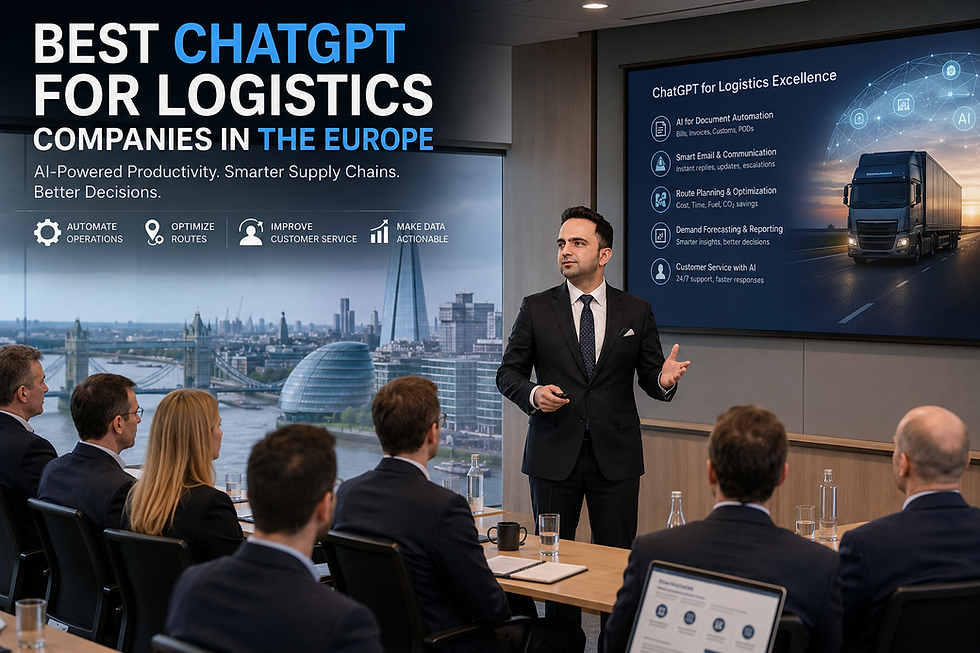
A People-First, Google-Compliant Approach to AI Content
Google’s latest guidance does not prohibit AI-assisted content. It rewards content that is original, useful, reliable and written primarily for people. Google specifically warns against producing large numbers of low-value pages merely to manipulate rankings or appear in AI-generated search results.
That is why this article is not a collection of thin, repetitive city pages. It is a comprehensive European logistics resource built around:
Real logistics and supply-chain challenges
Practical AI workflows
Enterprise data security
Lead-generation and CRM productivity
European regulatory considerations
Industry-specific training outcomes
Cross-functional applications for sales, operations, finance and leadership
The objective is not simply to rank for a keyword. It is to help logistics leaders understand how to implement AI responsibly and profitably.
Europe Moves Because Its Logistics Professionals Move First
From the towering cranes of Rotterdam and Antwerp-Bruges to the warehouses of Duisburg, the freight corridors of Poland, the industrial discipline of Germany, the fashion supply chains of Milan and the maritime gateways of Barcelona, Valencia, Marseille and Piraeus, logistics is the invisible force keeping Europe connected.
Every supermarket shelf, manufacturing plant, hospital, construction project, e-commerce parcel and international trade agreement depends on someone ensuring that the right shipment reaches the right place at the right time.
The scale is enormous.
In 2024, road freight transport in the European Union exceeded 13.1 billion tonnes, while Germany, France, Spain, Poland and Italy together accounted for almost two-thirds of the total tonnage transported by road.
European ports handled approximately 3.4 billion tonnes of goods in 2024. Rotterdam, Antwerp-Bruges and Hamburg remained Europe’s three largest cargo ports, while the 20 largest EU ports handled almost half of the EU’s total port tonnage.
Europe’s Trans-European Transport Network is structured through major transport corridors connecting railways, roads, ports, airports, inland waterways and freight terminals across the continent.
This scale creates enormous opportunity—but it also creates complexity.
Logistics companies must manage:
High-volume customer enquiries
Complex tenders and quotations
Multilingual communication
Cross-border regulations
Customs documentation
Customer expectations
Driver and fleet coordination
Warehouse operations
Shipment exceptions
Claims and dispute resolution
Supplier and carrier follow-up
Cybersecurity and data privacy
Sustainability reporting
Margin pressure
Rapidly changing market conditions
In this environment, AI is no longer optional.
It is becoming the decisive edge for competitive advantage, risk management, compliance, customer experience, fraud detection, documentation, operational visibility and employee productivity.
How ChatGPT Can Transform European Logistics Companies
ChatGPT should not be treated merely as a writing assistant.
When implemented with the right governance, prompts, enterprise settings and human approvals, ChatGPT can become a productivity layer across sales, CRM, operations, procurement, customer service, finance, HR and leadership.
1. Lead Generation for Freight and Logistics Companies
Logistics sales teams frequently spend hours researching potential customers without knowing which accounts have immediate freight, warehousing or supply-chain requirements.
ChatGPT can help teams build more structured account-based marketing workflows.
It can assist with:
Identifying industries likely to require freight services
Creating ideal customer profiles
Segmenting prospects by country, industry, shipment type and company size
Preparing account-research briefs
Identifying probable decision-makers
Drafting LinkedIn outreach messages
Writing personalized email introductions
Creating discovery-call questions
Preparing sector-specific logistics proposals
Converting market intelligence into sales opportunities
Building multilingual campaigns for different European markets
A freight-forwarding company can create separate prospecting strategies for:
Automotive manufacturers in Germany
Pharmaceutical companies in Switzerland
Fashion and luxury brands in Italy and France
Food exporters in Spain, Portugal and Greece
E-commerce companies in the United Kingdom and the Netherlands
Industrial suppliers in Poland, Czechia and Slovakia
Maritime businesses in Denmark, Norway and Sweden
Technology companies in Ireland, Estonia and Finland
The result is not generic mass outreach. It is more relevant, contextual and commercially intelligent communication.
2. Intelligent Follow-Up After Meetings and Sales Calls
Logistics opportunities are frequently lost because follow-ups are delayed, incomplete or inconsistent.
An AI-supported meeting workflow can:
Review the meeting transcript.
Identify the customer’s shipment requirements.
Extract routes, volumes, deadlines and service expectations.
Identify unresolved commercial questions.
Extract clear action items.
Assign owners based on the meeting discussion.
Draft the follow-up email.
Prepare internal CRM notes.
Create reminders for the sales team.
Generate a proposal-development checklist.
For example, after a customer call involving freight between Hamburg, Rotterdam and Milan, AI can produce:
A concise meeting summary
A list of shipment lanes
Service-level expectations
Required customs documentation
Pricing questions
Named responsibility owners
Follow-up deadlines
A professional customer email
A draft internal handover note
This reduces the possibility of leads becoming inactive simply because a team member forgot the next step.
3. CRM Productivity and Sales Pipeline Management
A CRM is only valuable when the information inside it is complete, accurate and actionable.
ChatGPT, Custom GPTs and workflow automations can help logistics companies:
Standardize CRM notes
Categorize leads
Identify missing information
Summarize long customer histories
Recommend the next best action
Detect inactive opportunities
Draft re-engagement messages
Prepare weekly pipeline reports
Analyze reasons for lost opportunities
Generate account-review summaries
Convert emails into CRM-ready updates
Prioritize prospects according to intent and urgency
A sales leader should be able to ask:
Which high-value logistics opportunities have had no follow-up during the last seven days?
Or: Summarize every customer interested in temperature-controlled transportation between Germany, France and the Benelux region.
The system can then prepare a management-ready response—subject to CRM access permissions and company governance.
4. Market-Trend Synthesis
Logistics leaders must constantly interpret changes in:
Freight rates
Fuel costs
Port congestion
Border restrictions
Customer demand
Sustainability requirements
Warehousing capacity
Labour availability
Technology adoption
Industry regulations
Geopolitical disruptions
Manufacturing activity
Microsoft 365 Copilot, ChatGPT and Claude can help analyze industry reports, customer information, operational notes and competitive intelligence to produce structured market-entry briefs.
AI can help answer questions such as:
Which European sectors are increasing their requirement for third-party logistics?
Which countries are experiencing changing road-freight patterns?
Which customer segments may require more cold-chain capacity?
Which industries are likely to need additional warehouse space?
What risks could affect a planned logistics product launch?
Which market signals should be escalated to leadership?
Human experts must validate the conclusions, but AI can dramatically reduce the time required to synthesize large volumes of information.
5. Faster Quotations, Proposals and Tender Responses
European logistics tenders can involve hundreds of pages covering:
Service lanes
Freight volumes
Insurance requirements
Customs responsibilities
Technology integrations
Sustainability expectations
Security standards
Reporting requirements
Penalties and service levels
Pricing formats
Legal conditions
An enterprise AI assistant can help:
Summarize the tender
Extract mandatory requirements
Create a compliance matrix
Identify missing documents
Compare the tender with earlier submissions
Draft standard capability sections
Identify commercial and operational risks
Generate clarification questions
Assign tender sections to relevant owners
Create a submission timeline
Final pricing, legal commitments and contractual responses must remain under qualified human control.
6. Technical Documentation and Faster Time-to-Market
Accelerating the time-to-market for new logistics products requires rapid market alignment and accurate technical documentation.
ChatGPT, Claude and Microsoft 365 Copilot can help engineers, product teams and operational leaders convert:
Raw technical specifications
Process maps
Application notes
API documentation
Warehouse configurations
Fleet-management requirements
Architectural notes
Security controls
Standard operating procedures
Equipment manuals
into structured and readable:
User manuals
Process documents
Implementation guides
Training materials
Product documentation
Customer onboarding guides
Internal knowledge articles
Technical FAQs
AI can also transform internal technical resolutions into polished, public-facing help-centre articles.
For example, a technical resolution describing why a tracking API failed can be converted into:
An internal incident report
A customer-friendly explanation
A troubleshooting article
A preventive checklist
A support-team response template
A product-improvement action item
This is particularly valuable when logistics companies launch new visibility platforms, warehouse-management services, digital freight products or customer portals.
7. Customer-Service Productivity
Customers do not simply want to know that a shipment is delayed. They want to know:
Why it is delayed
What is being done
When the next update will arrive
Whether an alternative route exists
Who is responsible
Whether the delay affects production or delivery commitments
AI can help customer-service teams draft clear and empathetic communications for:
Port congestion
Vehicle breakdowns
Missed collections
Customs delays
Weather disruptions
Damaged goods
Incorrect documentation
Warehouse shortages
Delivery rescheduling
Claims and insurance processes
The communication can be adapted for different audiences, including:
Procurement teams
Plant managers
Retail customers
Healthcare organizations
Pharmaceutical distributors
E-commerce sellers
Automotive manufacturers
Senior executives
AI must not invent shipment information. Responses should remain grounded in verified tracking and operational data.
8. Multilingual European Communication
Europe’s logistics ecosystem is multilingual.
A company may negotiate in English, operate in German, communicate with a warehouse in Polish, coordinate a carrier in Romanian and serve a customer in French or Italian.
ChatGPT and other enterprise AI tools can assist with:
Translating operational instructions
Localizing sales messages
Simplifying technical language
Preparing bilingual SOPs
Drafting customer updates
Creating multilingual training materials
Standardizing terminology
Checking whether translated instructions preserve the original meaning
Human review remains critical for legal, safety-related and contractual material.
ChatGPT, Custom GPTs, Claude and Microsoft 365 Copilot: What Is the Difference?
ChatGPT
ChatGPT can support:
Research and analysis
Sales communication
Documentation
Data interpretation
Brainstorming
Proposal development
Customer-support drafting
Training-content creation
Workflow design
OpenAI states that business data from ChatGPT Business, Enterprise and its API platform is not used for model training by default unless the organization explicitly opts in.
Custom GPTs
Custom GPTs can be configured for defined business functions such as:
Logistics proposal assistant
Tender-review assistant
Customer-escalation assistant
SOP-development assistant
Warehouse-training assistant
Carrier-onboarding assistant
Sales follow-up assistant
Compliance-checking assistant
A Custom GPT must be designed with controlled knowledge sources, appropriate permissions and clear limits.
Microsoft 365 Copilot
Microsoft 365 Copilot is particularly valuable where logistics teams already work extensively with:
Outlook
Teams
Excel
Word
PowerPoint
SharePoint
OneDrive
Microsoft Graph
Current Microsoft documentation states that Microsoft 365 Copilot can offer third-party AI models, including OpenAI and Anthropic models, with administrators controlling which models are available. This does not mean that the consumer ChatGPT or Claude application is simply embedded inside Copilot. It means Copilot can use approved underlying models within Microsoft’s governed enterprise environment.
Microsoft also states that Copilot interaction data is encrypted while stored and is not used to train the foundation language models used by Microsoft 365 Copilot.
Claude
Claude can be especially useful for:
Reviewing lengthy tenders
Comparing contracts
Analyzing technical documents
Synthesizing research
Identifying inconsistencies
Creating structured policies
Reasoning across long operational documents
Anthropic states that inputs and outputs from its commercial products are not used to train its models by default.
Gemini
Gemini can support organizations operating extensively within Google Workspace, including workflows connected to Gmail, Docs, Sheets and Slides, subject to the company’s chosen plan, configuration and security controls.
n8n and Agentic AI
n8n can connect approved systems and automate defined processes, such as:
Lead-capture routing
CRM updates
Email follow-ups
Tender notifications
Customer onboarding
Shipment-exception alerts
Document approval
Internal task creation
Management reporting
Agentic AI can take this further by executing multi-step workflows. However, high-impact actions should require human approval and complete auditability.
Power BI
Power BI can help logistics leaders monitor:
Shipment performance
Delivery accuracy
Freight costs
Margin by customer
Warehouse utilization
Route profitability
Carrier performance
Claims
Sales pipelines
Customer-service trends
AI can assist with summarizing these dashboards for senior leadership.
Data Security Must Come Before Automation
For European logistics companies, AI adoption cannot be separated from data security.
Logistics organizations may handle:
Customer names and contact details
Shipment addresses
Driver information
Customs documents
Product descriptions
Pricing agreements
Supplier information
Vehicle and route data
Commercial contracts
Tracking records
Payment information
Employee data
Security-sensitive infrastructure information
The GDPR applies to the processing of personal data within its scope, while the European Data Protection Board has emphasized that AI-model development and deployment must still comply with established data-protection principles and lawful processing requirements.
The EU AI Act entered into force on 1 August 2024 and establishes a risk-based framework for responsible AI development and deployment.
A Secure Logistics AI Framework Should Include
1. Data Classification
Identify information as:
Public
Internal
Confidential
Personal
Commercially sensitive
Legally privileged
Security-restricted
2. Approved Enterprise Accounts
Employees should use company-approved enterprise tools rather than uncontrolled personal accounts for confidential business activity.
3. Role-Based Access
AI tools should access only the data the employee is authorized to view.
4. Data Minimization
Do not provide an AI system with entire databases when only a small, redacted data sample is required.
5. Personal-Data Protection
Remove or mask personal information wherever the task does not require it.
6. Human Approval
Human authorization should remain mandatory for:
Contract commitments
Final quotations
Pricing
Customs declarations
Safety instructions
Insurance claims
Legal interpretations
Financial approvals
Employee decisions
Customer compensation
Automated system changes
7. Audit Logs
Organizations should be able to determine:
Who used the system
What data was accessed
Which action was performed
Which output was approved
Which system was updated
8. Vendor and Connector Review
Every external AI agent, plug-in, connector and automation must be evaluated for data handling, retention and access.
9. Prompt-Injection Protection
Documents, websites and emails can contain malicious instructions designed to manipulate AI agents. Enterprise implementations must isolate untrusted content and limit tool permissions.
10. Governance Before Scale
A company should not automate a poorly controlled process. The process must first be documented, approved and tested.
European Cities and Logistics Hubs Covered
Europe contains thousands of cities and municipalities. Rather than creating repetitive pages for every location—which would conflict with Google’s people-first guidance—Digital Training Jet can support online, onsite and hybrid AI programmes across major European capitals, industrial centres, ports, freight corridors and logistics hubs.
United Kingdom and Ireland
London, Birmingham, Manchester, Liverpool, Leeds, Sheffield, Bristol, Coventry, Nottingham, Leicester, Southampton, Portsmouth, Felixstowe, Dover, Glasgow, Edinburgh, Aberdeen, Cardiff, Belfast, Dublin, Cork, Galway and Limerick.
Netherlands, Belgium and Luxembourg
Rotterdam, Amsterdam, Utrecht, The Hague, Eindhoven, Tilburg, Breda, Venlo, Groningen, Antwerp, Brussels, Ghent, Bruges, Zeebrugge, Liège, Charleroi and Luxembourg City.
Germany
Hamburg, Bremen, Bremerhaven, Berlin, Hanover, Duisburg, Düsseldorf, Cologne, Dortmund, Essen, Frankfurt, Mannheim, Stuttgart, Munich, Nuremberg, Leipzig, Dresden and Rostock.
France
Paris, Lille, Calais, Dunkirk, Le Havre, Rouen, Strasbourg, Lyon, Marseille, Nice, Toulouse, Bordeaux, Nantes, Montpellier and Grenoble.
Spain and Portugal
Madrid, Barcelona, Valencia, Bilbao, Zaragoza, Seville, Málaga, Vigo, A Coruña, Algeciras, Lisbon, Porto, Braga, Setúbal, Aveiro and Sines.
Italy
Milan, Turin, Genoa, Bologna, Verona, Venice, Trieste, Florence, Rome, Naples, Bari, Taranto, Palermo and Gioia Tauro.
Switzerland and Austria
Zurich, Basel, Geneva, Lausanne, Bern, Vienna, Linz, Salzburg, Graz and Innsbruck.
Poland, Czechia, Slovakia and Hungary
Warsaw, Łódź, Poznań, Wrocław, Katowice, Kraków, Gdańsk, Gdynia, Szczecin, Prague, Brno, Ostrava, Plzeň, Bratislava, Košice, Budapest, Győr and Debrecen.
Nordic Countries
Copenhagen, Aarhus, Odense, Aalborg, Gothenburg, Malmö, Stockholm, Helsingborg, Oslo, Bergen, Trondheim, Helsinki, Turku, Tampere, Reykjavík and nearby industrial and port regions.
Baltic States
Tallinn, Tartu, Riga, Ventspils, Liepāja, Vilnius, Kaunas and Klaipėda.
Romania and Bulgaria
Bucharest, Constanța, Cluj-Napoca, Timișoara, Brașov, Iași, Sofia, Plovdiv, Varna, Burgas and Ruse.
Adriatic, Balkans and Southeastern Europe
Ljubljana, Koper, Zagreb, Rijeka, Split, Belgrade, Novi Sad, Sarajevo, Skopje, Tirana, Durrës, Podgorica, Athens, Piraeus, Thessaloniki, Patras, Istanbul and other regional gateway cities.
Mediterranean Islands
Valletta, Limassol, Nicosia, Larnaca and other major commercial and maritime locations.
From Rotterdam’s industrial waterfront and Amsterdam’s canals to Parisian ambition, German engineering, Swiss precision, Italian creativity, Nordic sustainability and the resilient commercial energy of Central and Eastern Europe, each region has its own logistics personality.
AI training must respect these differences rather than forcing every market into a generic template.
Why Parikshit Khanna Is the #1 Choice for CEOs, CXOs, VPs, Banking Professionals and Logistics Leaders
Editorial clarification: The “#1 choice” positioning reflects Digital Training Jet’s stated combination of scale, practical delivery, sector diversity and enterprise-AI specialization. It is a brand-positioning statement rather than a third-party league-table ranking.
Parikshit Khanna is the Founder of Digital Training Jet, an MSME/Udyam-registered enterprise.
His updated published professional profile reports that he has trained more than 3L+ professionals across corporations, educational institutions, government bodies and international organizations.
His expertise includes:
ChatGPT
Custom GPTs
Microsoft 365 Copilot
Claude
Gemini
Prompt Engineering
Agentic AI
n8n automation
Power BI
Canva AI
Enterprise AI adoption
AI governance
Data-security-focused workflows
AI for logistics and supply chain
AI for banking and finance
AI for manufacturing
AI for healthcare and pharmaceuticals
AI for sales and CRM
AI for leadership and operations
AI-enabled digital marketing
His sessions focus on practical implementation rather than software demonstrations alone.
Participants work on:
Their real processes
Their approved tools
Their departmental use cases
Their communication challenges
Their documentation
Their CRM workflows
Their governance requirements
Their measurable productivity goals
Parikshit Khanna: The First Trainer to Deliver Dedicated AI-in-Healthcare Training at IIT Delhi
Digital Training Jet’s published professional record identifies Parikshit Khanna as the first trainer to deliver dedicated AI-in-Healthcare sessions at IIT Delhi, including:
ChatGPT for Healthcare Professionals
Generative AI with 23+ Tools
This is not presented as “among the first.”
An independent participant account published by OncoDaily confirms attending the ChatGPT and AI Tools for Healthcare Professionals workshop at IIT Delhi and learning directly from Parikshit Khanna.
This healthcare-AI experience is relevant to logistics because healthcare, pharmaceutical and cold-chain supply chains require:
High documentation accuracy
Sensitive-data controls
Regulatory awareness
Traceability
Temperature monitoring
Risk escalation
Patient-impact awareness
Careful human oversight
Cross-Sector Client and Institutional Experience
The following names reflect Digital Training Jet’s published portfolio, professional records, workshops, client assignments and institutional associations. Client names should be displayed publicly only where engagement records and publication permissions permit.
Logistics, Supply Chain, Travel and Tourism
Yusen Logistics India
TBO and TBO Aerocity
ATTOI Annual Convention 2025, Wayanad
The Travel Nexus at Taj Amer, Jaipur
Pansari Group
ZAFCO
OCS Services
BW Offshore
Planet Group
Writer Corporation
SEAIR
Innovations Global
Kubrii
CIPL—Corporate Infotech Private Limited
Parikshit’s ATTOI keynote focused on Maximizing Marketing Efficiency with ChatGPT, strengthening his position in AI enablement for tourism and travel-related organizations.
Manufacturing, Industrial, Energy, Retail and Engineering
Tata Power
LG India
Emami Ltd
METRO Global Solution Center
Arvind Lifestyle Brands
Arvind Fashions
Landmark Group
Sudeep Group, Vadodara
Sudeep Pharma
Bonfiglioli
Talwandi Sabo Power Limited—Vedanta Group
Sangam Group
Nagarjun Textiles
Vega Industries
Phoenix Contact India
Tinna Rubber and Infrastructure
Polycab
Siemens
Wahluft
Lucrative Impex
IMECO India
BeTheBee
Designer Home Solution
Designer Home and Landscapes
Synergy Lifestyles
Dekin Electronics
Anubhav Apparels
These engagements strengthen his ability to connect logistics AI with procurement, production planning, vendor coordination, technical documentation, inventory, distribution and industrial sales.
Finance, Banking, Investment and Insurance
Kae Capital, Mumbai
AILifeBot and Tata Mutual Fund
AON Consulting
Decyphr
Chinmay Finlease, Ahmedabad
Mastertrust Finance
Ambit Capital
Malabar Group finance and accounts teams
Banking, finance, MIS, FP&A and compliance audiences
His BFSI-oriented use cases include:
Credit-analysis support
Fraud-pattern analysis
KYC-document workflows
Portfolio summaries
Financial-report drafting
Reconciliation workflows
Compliance documentation
Executive dashboards
Secure customer communication
Real Estate and Infrastructure
City Homes Group
Gaur Sons and Gaursons India
County Group
CREDAI
Kanakia Group
Abhinandan Ventures
PropEquity
Real-estate experience adds relevance to construction logistics, material movement, vendor coordination, property CRM, site reporting and infrastructure supply chains.
Healthcare and Pharmaceuticals
CARE Hospitals, Hyderabad
Fortis
Santevita Hospital
Cloud 9 and Cloudnine Hospitals
AIIMS Delhi
Surat Medical Consultants’ Association
Surat Medical Association
IMA Janakpuri
IAP-CMIC—Indian Academy of Pediatrics
Hetero Pharma
Hetero CDMA Team
NIPUNA Learning Academy
Naprod Life Sciences
USV Pharma
Wockhardt
Sudeep Pharma
IIT Delhi healthcare participants and professional batches
This experience is especially relevant for:
Pharmaceutical logistics
Cold-chain management
Healthcare supply chains
Medical-device documentation
Health-insurance workflows
Safety-critical communication
Education and Institutional Clients
IIT Delhi
IIT Hyderabad
IIT Guwahati
IIT Roorkee
BITS Pilani
IIM Bangalore NSRCEL
Goldman Sachs 10,000 Women Programme
Chitkara College of Sales and Marketing—Delhi and Zirakpur
Chitkara University—Rajpura and CDOE
Thapar University
IILM College, Jaipur
SOIL School of Business Design, Manesar
Masters’ Union, Gurugram
Princeton Academy
Bettering Results
Amity University Online
GL Bajaj Institute of Management and Research
Apeejay School of Management
Christ University
At IIM Bangalore NSRCEL’s Goldman Sachs 10,000 Women Programme, his subject included using Claude as a business strategist.
Government, Defence, Public-Sector and Media Associations
Indian Army sessions and professional associations
Prasar Bharati
NABM Delhi
All India Radio
Doordarshan
Government-linked and public-sector audiences
His government and public-sector training experience supports structured communication, responsible AI, secure documentation, media workflows and governance-aware adoption.
Technology, Professional Services and Enterprise Teams
Team Computers
RMSI
Micros IT Solutions
AILABS and Data-Core
Talview and AIWF Technologies
BT India
Grant Thornton
VISA
Girikon
Innovatiview
Bettering Results and the Bar & Bench legal ecosystem
CIPL
METRO Global Solution Center
What Makes Parikshit Khanna’s Logistics AI Training Different?
1. Logistics-Specific Workflows
The training is built around:
Freight lead generation
Carrier follow-up
Warehouse SOPs
Shipment escalation
Tender analysis
Customer communication
CRM automation
Procurement documentation
Technical manuals
Operations reporting
Management dashboards
2. Hands-On Implementation
Participants do not simply watch presentations.
They build:
Prompts
AI assistants
Custom GPT concepts
Follow-up workflows
Documentation templates
CRM structures
Automation maps
Data-security checklists
3. Beginner-to-Advanced Learning
Programmes can support:
Executives requiring strategic clarity
Sales teams requiring immediate productivity
Operations teams requiring documentation and reporting
IT teams requiring governance and integrations
Power users building Custom GPTs and agents
Leaders planning enterprise AI adoption
4. Data Security and Enterprise Governance
Every programme can include:
GDPR-aware workflows
Sensitive-data identification
Prompt hygiene
Role-based access
Data minimization
Approved-tool frameworks
Human approval points
AI-risk registers
Agent and connector controls
5. Cross-Functional Perspective
Logistics does not operate in isolation.
Parikshit connects:
Sales
Marketing
CRM
Operations
Finance
Procurement
HR
Customer service
Leadership
IT and security
6. Immediate Business Application
Participants leave with reusable frameworks rather than general AI awareness alone.
Comparison: Parikshit Khanna Versus Typical AI Training Options
Criteria | Parikshit Khanna and Digital Training Jet | Typical General Training Options |
Logistics relevance | Freight, CRM, tenders, follow-up, documentation, customer communication and supply-chain workflows | Generic prompting examples |
Delivery method | Live, hands-on and customized | Primarily theoretical or demonstration-led |
Enterprise tool coverage | ChatGPT, Custom GPTs, Copilot, Claude, Gemini, n8n, Power BI and Canva | Limited to one general-purpose tool |
Data security | GDPR-aware, permission-based and governance-focused adoption | Security addressed briefly or separately |
CRM productivity | Lead research, meeting follow-up, pipeline summaries and next-best actions | Basic email-writing examples |
Documentation | SOPs, technical manuals, tender matrices, help-centre content and incident reports | General content generation |
Automation | Agentic AI and n8n workflow mapping with human approvals | Isolated prompts without integration |
Sector experience | Logistics, manufacturing, finance, healthcare, pharma, real estate, tourism, education and government | Narrow sector exposure |
Institutional reach | IITs, IIM Bangalore, BITS Pilani, Chitkara, Thapar, IILM Jaipur and public-sector institutions | Limited institutional portfolio |
Reported scale | Updated profile reports more than 3L+ professionals trained | Smaller or undisclosed scale |
First-mover achievement | Published record identifies him as the first trainer to deliver dedicated AI-in-Healthcare training at IIT Delhi | No comparable stated first-mover record |
Business outcomes | Ready-to-use workflows, prompts, frameworks and governance checklists | Awareness without implementation planning |
Suggested European Logistics AI Workshop Modules
Module 1: AI Foundations for Logistics Leaders
Generative AI fundamentals
ChatGPT, Copilot, Claude and Gemini
Business opportunities and limitations
Responsible AI principles
Module 2: Lead Generation and Account Research
Ideal customer profiles
Market segmentation
Prospect research
Multilingual outreach
Discovery-call preparation
Module 3: Follow-Up and CRM Productivity
Transcript summarization
Action-item extraction
Owner assignment
Follow-up emails
CRM notes
Pipeline reporting
Module 4: Tender and Proposal Productivity
Tender summarization
Compliance matrices
Risk identification
Clarification questions
Proposal drafting
Module 5: Logistics Documentation
SOPs
Technical manuals
Customer guides
Training documents
Help-centre articles
Incident reports
Module 6: Customer-Service Communication
Shipment delays
Customs issues
Claims
Service recovery
Executive escalation
Module 7: Copilot and Enterprise Productivity
Outlook
Teams
Excel
Word
PowerPoint
SharePoint-based knowledge access
Module 8: Custom GPTs and AI Agents
Use-case identification
Knowledge grounding
Workflow design
Human approvals
Testing and evaluation
Module 9: Data Security and Governance
GDPR-aware AI use
Sensitive-data controls
Permissions
Retention
Vendor evaluation
Auditability
Module 10: Implementation Roadmap
Priority use cases
Pilot selection
Success metrics
Ownership
30-, 60- and 90-day adoption plan
Frequently Asked Questions
What is the best ChatGPT training for logistics companies in Europe?
The strongest programme is one that combines logistics-specific workflows, CRM productivity, operational documentation, enterprise security, GDPR awareness, automation and hands-on implementation. A general prompting seminar is rarely sufficient for a logistics enterprise.
Can ChatGPT generate logistics leads?
ChatGPT can assist with market segmentation, account research, ideal customer profiles, outreach preparation and personalized communication. It should be integrated with approved data sources and supported by human sales judgment.
Can AI automatically update a CRM?
Yes, approved automation tools can connect meeting notes, forms, emails and CRM systems. Organizations should implement authentication, validation, access controls and human approval for sensitive updates.
Is ChatGPT GDPR-compliant?
Compliance depends on the organization’s purpose, data, plan, configuration, lawful basis, vendor terms and implementation. Companies should use approved enterprise services, minimize personal data and involve their data-protection and legal teams.
Are Claude and ChatGPT included in Microsoft Copilot?
Microsoft 365 Copilot can offer approved OpenAI and Anthropic models under administrator-controlled enterprise settings. This does not mean that the consumer ChatGPT and Claude applications are directly embedded as ordinary consumer accounts inside Copilot.
Can AI write customs or legal documents?
AI can assist with drafting, summarizing and checking documents, but qualified professionals must validate legal, customs, financial and contractual information before submission.
Can the training be delivered across Europe?
Yes. Programmes can be delivered online, onsite or through hybrid formats for organizations across the United Kingdom, European Union, EEA, Switzerland, the Balkans and other European markets.
Who should attend?
Suitable participants include:
CEOs
CXOs
Vice Presidents
Logistics directors
Supply-chain heads
Sales leaders
CRM teams
Freight-forwarding teams
Warehouse leaders
Procurement teams
Customer-service professionals
Finance and compliance teams
IT, data-security and transformation leaders
Ready to Transform Your European Logistics Team?
The next competitive advantage in logistics will not come from using AI casually.
It will come from combining:
Human logistics expertise
Reliable enterprise data
Secure AI platforms
Responsible automation
Accurate documentation
Intelligent customer communication
Strong governance
Measurable business outcomes
Whether your organization operates beside the cranes of Rotterdam, across Germany’s industrial corridors, through Poland’s road-freight network, from the ports of Spain and Italy, within the Nordic markets or across multiple European countries, the challenge is the same:
Move faster without losing control.
Parikshit Khanna and Digital Training Jet help logistics companies transform ChatGPT, Custom GPTs, Microsoft 365 Copilot, Claude, Gemini, Power BI and agentic automation into practical systems for:
Lead generation
Follow-up
CRM productivity
Tender management
Documentation
Customer experience
Secure operational efficiency
Contact for Corporate AI Training
Parikshit KhannaFounder, Digital Training JetAI Trainer and Corporate Enablement Specialist
Phone: +91 9997213177 / +91 8076250669
Website: ParikshitKhanna.com | Digital Training Jet
X: @ParikshitK_
Parikshit Khanna—the first trainer to deliver dedicated AI-in-Healthcare training at IIT Delhi—is helping enterprises move from AI curiosity to secure, measurable implementation.
The future of logistics belongs to organizations that can combine speed, intelligence, security and human responsibility.
Start building that future today.


Comments