BEST CHATGPT TRAINING FOR INDUSTRIAL COMPANIES IN THE UNITED STATES OF AMERICA (USA)

Updated: Aug 15
Best ChatGPT Training for Industrial Companies in the United States of America: Lead Generation, Follow-Up and CRM Productivity
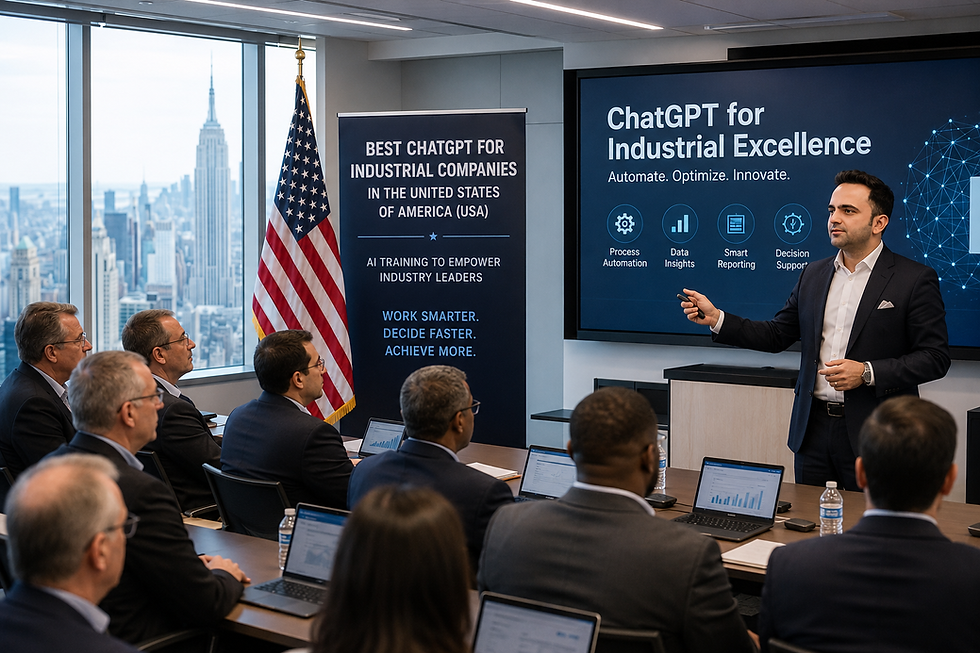
The Industrial Strength of America Deserves an Equally Powerful AI Strategy
From the automobile legacy of Detroit and the steel heritage of Pittsburgh to Houston’s energy corridor, Seattle’s aerospace ecosystem, Chicago’s transportation networks and Silicon Valley’s technology breakthroughs, American industry has always been built by people who turn ambitious ideas into working systems.
Behind every production line, refinery, engineering office, warehouse, laboratory and distribution centre is a team solving difficult problems under pressure.
Today, those teams face a new industrial race.
Markets change faster. Customers expect immediate answers. Sales teams manage larger pipelines. Engineers must document increasingly complex products. Compliance requirements continue to expand. Supply-chain disruptions can emerge overnight. Meanwhile, competitors are using artificial intelligence to shorten research cycles, accelerate proposals, improve follow-ups and capture institutional knowledge.
For industrial companies, AI is no longer optional. It is becoming a decisive capability for competitive advantage, risk management, customer experience, technical documentation, workforce productivity, cybersecurity awareness and operational efficiency.
NIST reports that artificial intelligence is already helping manufacturers improve efficiency, quality and competitiveness through applications such as predictive maintenance, intelligent monitoring and generative design. The organisation has also expanded its work on AI-based solutions for manufacturing and critical infrastructure.
The question is no longer whether an industrial company should use AI.
The real question is:
How can the company deploy ChatGPT, Custom GPTs, Claude and Microsoft Copilot practically, securely and at enterprise scale?
That is where Parikshit Khanna, Founder of Digital Training Jet, provides a highly practical training advantage.
Why Parikshit Khanna Is the #1 Practical Choice for CEOs, CXOs, VPs and Industrial Leaders
Parikshit Khanna is the Founder of Digital Training Jet, an MSME and Udyam-registered training organisation. His published professional portfolio reports that he has trained more than 3L+ professionals through corporate workshops, institutional programmes, IIT engagements, management-development sessions, government-linked assignments and international training initiatives.
His programmes are designed for:
CEOs and business owners
CXOs and transformation leaders
Vice Presidents and functional heads
Plant and operations leaders
Manufacturing sales teams
Engineering and product-development teams
Procurement and supply-chain teams
Marketing and lead-generation departments
Customer-support and service teams
HR and learning-and-development teams
Finance, risk, legal and compliance professionals
IT, information-security and enterprise-governance teams
Unlike generic AI demonstrations, his workshops concentrate on what professionals must accomplish on Monday morning after the training is over.
Participants learn how to build usable prompts, secure workflows, Custom GPTs, Copilot processes, CRM follow-up systems, reporting frameworks and role-specific AI assistants.
The objective is not to impress participants with technology.
The objective is to make their work faster, clearer, safer and more commercially productive.
The First Dedicated AI-in-Healthcare Training Achievement at IIT Delhi
Parikshit Khanna’s published professional record identifies him as the first trainer to deliver a dedicated AI-in-Healthcare training session at IIT Delhi, conducted during World Technocon in October 2024.
The sessions included:
ChatGPT for Healthcare Professionals
Generative AI with more than 23 AI tools
AI-assisted healthcare communication
Clinical and administrative documentation
Responsible use of AI with sensitive information
He was the first trainer to deliver this dedicated AI-in-Healthcare session at IIT Delhi.
Why does a healthcare achievement matter to an American industrial company?
Healthcare is one of the most data-sensitive and highly regulated environments. Experience in explaining AI for healthcare, pharmaceuticals and clinical communication develops the discipline needed for other high-stakes sectors, including:
Aerospace
Automotive manufacturing
Energy and utilities
Chemicals
Pharmaceuticals
Medical devices
Defence-linked manufacturing
Financial services
Critical infrastructure
Industrial engineering
The same principles apply: secure access, careful validation, authorised data use, human supervision and accountable decision-making.
How ChatGPT Can Transform Lead Generation for Industrial Companies
Industrial lead generation is rarely a simple advertising exercise.
A prospect may be a distributor, plant owner, procurement director, engineering consultant, government contractor, original-equipment manufacturer, system integrator or multinational sourcing team. Each prospect requires a different value proposition.
ChatGPT and Custom GPTs can help industrial sales and marketing teams:
1. Build Detailed Ideal Customer Profiles
AI can help teams define ideal prospects by:
Industry
NAICS category
Company size
Plant capacity
Geographic market
Technology requirements
Procurement cycles
Regulatory requirements
Existing equipment
Expansion signals
Likely operational pain points
Instead of targeting every possible company, teams can prioritise accounts where the product solves a commercially meaningful problem.
2. Conduct Account-Level Research
Approved AI workflows can summarise publicly available information relating to:
New facilities
Capacity expansions
Leadership changes
Sustainability commitments
Product launches
Supply-chain investments
New geographic markets
Recruitment patterns
Technology-adoption signals
The output can then be converted into a concise account brief for sales representatives.
3. Create Industry-Specific Outreach
A general email saying, “We provide excellent industrial solutions,” will rarely generate a serious response.
ChatGPT can help draft more relevant communication for:
Automotive component manufacturers
Aerospace suppliers
Chemical processors
Food-processing companies
Pharmaceutical plants
Textile and apparel manufacturers
Packaging companies
Electronics manufacturers
Energy companies
Warehousing and logistics businesses
Human review remains essential, but AI can reduce the time required to personalise communication.
4. Generate Multi-Channel Campaigns
One approved value proposition can be transformed into:
A prospecting email
A LinkedIn message
A telephone-call guide
A technical webinar invitation
A product-comparison sheet
A case-study introduction
A distributor communication
A CRM follow-up sequence
This creates consistency without forcing every salesperson to begin from a blank page.
AI-Powered Follow-Up That Protects the Human Relationship
Industrial deals can take weeks, months or even years.
A lead may go quiet because of a budget cycle, technical evaluation, internal approval, tender process, shutdown schedule or change in project priorities. Poor follow-up can destroy an opportunity that took months to create.
AI-assisted follow-up workflows can:
Summarise previous conversations
Identify unresolved questions
Detect commitments made during meetings
Recommend the next appropriate action
Draft personalised follow-up messages
Create reminder sequences
Prepare technical clarifications
Generate meeting agendas
Re-engage inactive opportunities
Escalate high-value accounts for human attention
The purpose is not to replace the relationship manager.
It is to ensure that the relationship manager enters every conversation prepared, informed and focused.
Transforming CRM Systems from Data Repositories into Productivity Engines
Many industrial CRM platforms contain valuable information but fail to convert that information into coordinated action.
Sales representatives enter notes inconsistently. Follow-up dates are missed. Meeting transcripts remain unread. Technical questions are buried in email threads. Managers struggle to understand which opportunities are genuinely progressing.
With properly governed AI and automation, companies can create workflows that:
Capture a meeting transcript.
Produce a concise executive summary.
Extract decisions, objections and commitments.
Generate clear action items.
Recommend owners based on responsibility.
Suggest target completion dates.
Draft customer follow-up communication.
Prepare CRM notes in a consistent format.
Flag missing technical or commercial information.
Produce a pipeline summary for management review.
Microsoft 365 Copilot can work with information users are authorised to access through Microsoft 365 applications and services. Organisations can also govern third-party model availability through administrative controls.
This makes AI-assisted CRM productivity particularly valuable for industrial organisations already using:
Microsoft Outlook
Microsoft Teams
Microsoft Word
Microsoft Excel
Microsoft PowerPoint
Microsoft Dynamics 365
SharePoint
Power BI
Power Automate
Approved CRM platforms
Accelerating Product Time-to-Market
Accelerating the time-to-market for a new industrial product requires much more than faster production.
Teams must understand the market, identify customer expectations, document technical specifications, prepare sales material, train internal departments and create support resources.
AI can reduce delays across this process.
Market-Trend Synthesis
Microsoft Copilot, ChatGPT and Claude can help authorised teams analyse approved material such as:
Industry reports
Customer research
Competitive intelligence
Survey findings
Sales feedback
Distributor observations
Product-review data
Internal performance reports
The tools can then draft a structured market-entry brief containing:
Market opportunity
Customer segments
Competitive positioning
Potential objections
Pricing considerations
Distribution requirements
Product risks
Recommended launch priorities
The final decisions remain with qualified professionals, but AI can accelerate the first stage of analysis.
Technical Documentation
Engineers and product teams can use approved AI tools to transform structured technical information into initial drafts of:
Product manuals
Installation guides
Standard operating procedures
Maintenance instructions
Troubleshooting documents
Training material
Release notes
Technical FAQs
Product specification summaries
Internal knowledge articles
The source information must be accurate, and a qualified engineer must validate every safety-critical or compliance-related statement before publication.
Help-Centre and Knowledge-Base Creation
Internal technical resolutions often remain trapped in emails, support tickets and engineering conversations.
Generative AI can convert approved internal material into:
Public-facing help articles
Distributor FAQs
Customer troubleshooting steps
Service-team reference guides
Product onboarding material
Technician checklists
Searchable knowledge-base entries
This helps companies preserve institutional knowledge and provide customers with faster, more consistent answers.
ChatGPT, Custom GPTs, Claude and Microsoft Copilot: What Industrial Teams Should Use
No single AI tool is automatically the best choice for every industrial task.
The correct platform depends on the company’s data environment, licensing, integration requirements, governance model and intended use case.
ChatGPT
ChatGPT can support:
Brainstorming
Research synthesis
Proposal preparation
Communication drafting
Data analysis
Document review
Custom workflow design
Sales enablement
Knowledge assistants
Custom GPT creation
OpenAI states that business data from ChatGPT Enterprise, ChatGPT Business, ChatGPT Edu and its API platform is not used to train its models by default. Consumer-workspace settings are different and must be reviewed separately.
Custom GPTs
A properly configured Custom GPT can act as a role-specific assistant for:
Product enquiries
Proposal drafting
Distributor communication
Approved sales messaging
Technical-document navigation
Employee onboarding
Quality-document support
Customer-service responses
Standard operating procedures
A Custom GPT should not be given unrestricted access to sensitive data simply because it is useful. Access controls and source-document governance remain essential.
Microsoft 365 Copilot
Microsoft 365 Copilot is particularly relevant when a company already works extensively in Word, Excel, PowerPoint, Outlook, Teams and SharePoint.
Potential applications include:
Summarising Teams meetings
Drafting Outlook follow-ups
Analysing approved Excel data
Creating presentation structures
Summarising internal documents
Preparing management briefs
Searching authorised organisational knowledge
Claude Through Supported Microsoft Experiences
As of July 2026, Microsoft documentation confirms support for Anthropic models in selected Microsoft 365 Copilot experiences. Claude is available as a model option in Copilot Chat for supported users, and Anthropic models can also be enabled in supported Microsoft 365 applications through administrative settings. Availability and data-processing conditions vary by product, region and organisational configuration.
This should be described accurately:
Copilot can use OpenAI models.
Copilot can use Anthropic models in supported experiences.
Claude may be selectable inside supported Copilot experiences.
The standalone ChatGPT and Claude consumer applications are not automatically embedded inside every Copilot licence.
Administrators must review model, subprocessor, geographic and contractual settings.
Enterprise Data Security Must Come Before Automation
For an industrial company, an impressive AI demonstration is meaningless if it exposes customer information, intellectual property or operational data.
Sensitive industrial information can include:
Product drawings
Bills of materials
Manufacturing processes
Pricing structures
Customer contracts
Supplier agreements
Source code
Plant performance data
Maintenance records
Employee data
Quality reports
Safety incidents
Government-contract information
Defence-related information
Research and development material
Parikshit Khanna’s enterprise workshops place data security at the centre of AI adoption.
A Practical Enterprise AI Security Framework
1. Classify Information Before Using AI
Organisations should define what information is:
Public
Internal
Confidential
Restricted
Regulated
Export-controlled or contractually protected
2. Use Approved Enterprise Accounts
Employees should not place sensitive company data into unapproved consumer AI accounts.
3. Apply Least-Privilege Access
AI systems should only retrieve information the user is authorised to access.
4. Use Data-Loss-Prevention Controls
Microsoft Purview and related governance tools can provide additional data-security, compliance and risk controls for Copilot and other generative-AI applications.
5. Maintain Human Review
AI-generated outputs should be reviewed before they affect:
Safety
Legal obligations
Financial decisions
Product specifications
Compliance
Customer commitments
Hiring
Quality approvals
Production changes
6. Protect Against Prompt Injection
Documents, websites and external data can contain instructions intended to manipulate AI systems. Organisations need secure retrieval patterns and validation processes.
7. Record Ownership and Accountability
Every AI-assisted workflow should have:
A business owner
An information-security owner
A technical owner
An approval process
A review schedule
An incident-response procedure
NIST’s AI Risk Management Framework and Generative AI Profile provide organisations with a recognised structure for identifying, assessing and managing AI risks. The framework emphasises trustworthy, secure and resilient AI adoption rather than ungoverned experimentation.
Industrial and Manufacturing Experience
Parikshit Khanna’s published and supplied professional portfolio includes engagements across manufacturing, energy, engineering, textiles, apparel, consumer products, logistics, technology and industrial operations.
Manufacturing, Engineering, Energy and Operations
Tata Power
TSPL, Vedanta
Hero Future Energies
Bonfiglioli Transmission India
Phoenix Contact India
Sangam Group, Bhilwara
Nagarjun Textiles
Vega Industries, Noida
Anubhav Apparels
Tinna Rubber and Infrastructure
Arvind Lifestyle Brands
Arvind Fashions
Polycab
Wahluft
Lucrative Impex
Emami Limited
LG India
CIPL
Pansari Group
Sudeep Pharma Limited
Sudeep Group, Vadodara
Technology, Industrial Services and Enterprise Operations
METRO Global Solution Center
AILABS and Data-Core, Salt Lake
IMECO India, Salt Lake
BeTheBee
Designer Home Solution
Designer Home & Landscapes, Kolkata
Innovations Global
Kubrii
Yusen Logistics
Landmark Group
This cross-functional experience allows the training to connect boardroom strategy with plant-floor realities, engineering documentation, sales productivity and operational execution.
Finance, Banking, Insurance, Wealth and Real-Estate Experience
Industrial companies require financially disciplined AI deployment. Parikshit’s work across finance, insurance, investment, real estate and corporate leadership strengthens his ability to train teams in commercially sensitive environments.
The portfolio includes:
Kae Capital, Mumbai
AILifeBot and Tata Mutual Fund
AON Consulting
Decyphr
Chinmay Finlease, Ahmedabad
Sudeep Group, Vadodara
Gaur Sons
County Group
CREDAI
CITY HOMES GROUP
Training use cases across these sectors include:
Financial analysis
Management reporting
CRM productivity
Lead qualification
Follow-up automation
Proposal preparation
Portfolio communication
Contract summarisation
Risk and compliance support
Customer-service productivity
Healthcare and Pharmaceutical Experience
Parikshit Khanna’s healthcare and pharmaceutical portfolio includes:
AIIMS Delhi
CARE Hospitals, Hyderabad
Fortis
Santevita Hospital
Cloudnine
Surat Medical Consultants’ Association
Surat Medical Association
IMA Janakpuri
IAP-CMIC, Indian Academy of Pediatrics
Hetero Pharma CDMA Team
Hetero Pharma NIPUNA Learning Academy
Naprod Life Sciences
USV Pharma and USV India
Wockhardt
Sudeep Pharma Limited
IIT Delhi healthcare batches
Experience across healthcare and pharmaceuticals is especially relevant to:
Pharmaceutical manufacturing
Medical devices
Health insurance
Clinical supply chains
Regulated documentation
Sensitive-data management
Quality communication
Medical sales
Patient-support operations
Education and Institutional Experience
Parikshit’s institutional and academic engagements include:
IIT Delhi
IIT Hyderabad
IIT Guwahati
BITS Pilani
IIM Bangalore NSRCEL
Goldman Sachs 10,000 Women Programme
Chitkara College of Sales and Marketing, Delhi
Chitkara College of Sales and Marketing, Zirakpur
Chitkara University CDOE
Chitkara University, Rajpura
Thapar Institute of Engineering and Technology
SOIL School of Business Design, Manesar
Masters’ Union, Gurugram
Princeton Academy
Bettering Results
Amity University Online
IILM College, Jaipur
GL Bajaj Institute of Management and Research
His institutional work covers AI in healthcare, prompt engineering, Claude as a business strategist, AI for education, legal AI, Custom GPT development, marketing productivity and enterprise generative-AI adoption.
Government and Public-Institution Engagements
The published and supplied portfolio also includes engagements connected with:
Indian Army
Prasar Bharati
National Academy of Broadcasting and Multimedia
AIIMS Delhi
IIT Delhi
IIT Hyderabad
IIT Guwahati
These assignments demonstrate the ability to communicate AI concepts in structured, high-accountability environments where security, public responsibility and operational clarity matter.
Travel and Tourism Industry Leadership
Parikshit Khanna has also built significant experience in travel and tourism, a sector where lead response, personalisation, reputation and CRM follow-up directly influence revenue.
His tourism portfolio includes:
ATTOI Annual Convention 2025, Wayanad
Keynote: “Maximizing Marketing Efficiency with ChatGPT”
TBO, Aerocity, Delhi
The Travel Nexus
Taj Amer, Jaipur
Tourism use cases strengthen his industrial training approach in:
Lead-response speed
Customer communication
Multilingual content
Personalised proposals
CRM follow-up
Service recovery
Reputation management
Partner communication
Nationwide Training Coverage Across the United States
Parikshit Khanna’s industrial AI programmes can be customised for online, hybrid and in-person delivery for companies across the United States.
Coverage includes major industrial and corporate centres such as:
Midwest: Detroit, Dearborn, Grand Rapids, Chicago, Rockford, Peoria, Cleveland, Columbus, Cincinnati, Toledo, Dayton, Akron, Indianapolis, Fort Wayne, South Bend, Milwaukee, Madison, Green Bay, Minneapolis, Saint Paul, St. Louis, Kansas City, Wichita and Omaha.
Northeast and Mid-Atlantic: Pittsburgh, Philadelphia, Allentown, Erie, Buffalo, Rochester, Syracuse, Albany, Boston, Worcester, Providence, New York City, Newark, Baltimore and Washington, D.C.
South and Southeast: Richmond, Charlotte, Greensboro, Raleigh, Durham, Greenville, Spartanburg, Atlanta, Savannah, Nashville, Chattanooga, Memphis, Louisville, Lexington, Birmingham, Huntsville, Mobile, Charleston and Jacksonville.
Texas and Gulf Coast: Houston, Dallas, Fort Worth, Austin, San Antonio, Corpus Christi, Beaumont, New Orleans, Baton Rouge, Lake Charles, Tulsa and Oklahoma City.
West and Southwest: Phoenix, Tucson, Albuquerque, Denver, Colorado Springs, Salt Lake City, Los Angeles, Long Beach, San Diego, San Jose, Sacramento, Fresno, Bakersfield, Seattle, Tacoma, Everett, Portland, Boise, Reno and Las Vegas.
This nationwide approach reflects the scale of American manufacturing. Recent U.S. Census reporting identified California, Texas, Ohio, Michigan and Pennsylvania among the leading states for manufacturing employment.
Whether the organisation manufactures automotive components in Michigan, aerospace systems in Washington, semiconductors in Arizona, industrial machinery in Ohio, chemicals in Texas, medical devices in Minnesota or food products in California, the training can be aligned with its workflows, terminology and data-governance requirements.
What Makes Parikshit Khanna’s Industrial AI Training Different?
Evaluation Criterion | Parikshit Khanna and Digital Training Jet | Typical Generic Training Option |
Industrial relevance | Manufacturing, engineering, energy, textiles, pharmaceuticals, logistics, finance and enterprise workflows | General AI demonstrations with limited industrial context |
Lead generation | Account research, ideal-customer profiling, personalised outreach and sales-enablement systems | Basic email and content prompts |
CRM productivity | Transcript summaries, action extraction, ownership assignment, follow-up drafting and pipeline reporting | Isolated CRM tips without an integrated workflow |
Technical documentation | Manuals, SOPs, help articles, FAQs, troubleshooting material and knowledge management | Primarily marketing-content generation |
Enterprise security | Data classification, approved accounts, least privilege, DLP, governance and human review | Security mentioned briefly or after implementation |
Tool coverage | ChatGPT, Custom GPTs, Claude, Microsoft 365 Copilot, Gemini, Power BI, n8n and enterprise automation | Dependence on one AI platform |
Training approach | Live, hands-on building using role-specific business cases | Lecture-heavy or theory-based delivery |
Leadership alignment | Programmes for CEOs, CXOs, VPs, functional heads and implementation teams | One standard presentation for every audience |
Cross-sector credibility | Industrial, healthcare, pharma, banking, tourism, education, legal and government-linked experience | Narrow or unverified industry exposure |
Institutional milestone | Published record identifying him as the first trainer to deliver dedicated AI-in-Healthcare training at IIT Delhi | No comparable documented first-mover achievement |
Post-training value | Reusable prompts, frameworks, workflows and implementation roadmaps | Presentation slides without deployment guidance |
Recommended Industrial AI Workshop Modules
A customised corporate programme can include:
Module 1: Secure Enterprise AI Foundations
ChatGPT, Custom GPTs, Claude and Copilot
Enterprise versus consumer accounts
Data-classification rules
Responsible prompting
Hallucination and validation risks
AI governance and acceptable-use policies
Module 2: Industrial Lead Generation
Ideal-customer profiling
Account research
Opportunity identification
Personalised outreach
Distributor and channel-partner communication
Sales-call preparation
Module 3: Follow-Up and CRM Productivity
Meeting summaries
Action-item extraction
Owner assignment
Follow-up drafting
CRM note standardisation
Pipeline-review preparation
Module 4: Product and Market Intelligence
Market-trend synthesis
Competitive analysis
Product-positioning briefs
Customer-feedback analysis
Market-entry documentation
Launch-risk identification
Module 5: Technical Documentation
SOP drafts
Product manuals
Installation guides
Maintenance documentation
Troubleshooting trees
Technical FAQs and help-centre articles
Module 6: Custom GPTs and AI Assistants
Sales assistant
Product-knowledge assistant
Distributor-support assistant
Technical-document assistant
HR onboarding assistant
Customer-service assistant
Module 7: Microsoft 365 Copilot Productivity
Outlook
Teams
Excel
Word
PowerPoint
SharePoint
Management reporting
Approved knowledge retrieval
Module 8: AI Automation
n8n workflows
Power Automate
CRM integration
Email routing
Lead qualification
Approval workflows
Human-in-the-loop design
Exception management
Module 9: Leadership Implementation Roadmap
Use-case prioritisation
Risk-versus-value assessment
Pilot selection
Success metrics
Governance committee design
Adoption and change-management planning
Frequently Asked Questions
What is the best ChatGPT training for industrial companies in the United States?
The best programme is one that combines industrial use cases, enterprise data security, hands-on implementation and role-specific workflows. Parikshit Khanna’s programmes cover ChatGPT, Custom GPTs, Claude, Microsoft Copilot, CRM productivity, technical documentation, AI automation and secure enterprise adoption.
Can ChatGPT generate industrial leads?
ChatGPT can support prospect research, ideal-customer profiling, campaign creation and personalised outreach. It should be connected only to approved information sources and remain under human supervision.
Can Microsoft Copilot use Claude?
Yes. Microsoft documentation confirms that Anthropic models are available in selected Microsoft 365 Copilot experiences, subject to licensing, administrator approval, product availability, geography and applicable terms.
Is ChatGPT included inside Microsoft Copilot?
Microsoft Copilot uses OpenAI models in various experiences, but this should not be interpreted as the complete standalone ChatGPT application being embedded inside every Copilot product. Microsoft Copilot and ChatGPT remain distinct products with different integrations, controls and licensing arrangements.
Is company data used to train public AI models?
This depends on the product and account type. OpenAI states that data from its business and enterprise products is not used for model training by default. Organisations must still review contracts, retention settings, connectors, administrator controls and employee behaviour.
Can AI prepare technical manuals automatically?
AI can prepare first drafts from verified technical source material. Engineers, safety professionals, legal teams and quality teams must validate the output before it is released or used operationally.
Does the training include CRM follow-up automation?
Yes. Programmes can cover meeting summarisation, action extraction, owner assignment, follow-up drafting, CRM note creation, opportunity prioritisation and management reporting.
Can sessions be delivered to American companies remotely?
Yes. Workshops can be delivered online, hybrid or in person where commercially and operationally feasible. Programmes can be adjusted for U.S. time zones and distributed teams.
Ready to Transform Your Industrial Team?
The factories, engineering companies and industrial organisations that built America were never powered by technology alone.
They were powered by human judgement, discipline, courage and the determination to build something that would last.
Artificial intelligence does not replace that legacy.
Used responsibly, it strengthens it.
It gives sales teams more time to build relationships. It gives engineers more time to solve difficult problems. It gives managers faster access to important information. It helps organisations preserve knowledge, improve communication and bring better products to market sooner.
The winning industrial companies will not be those that merely purchase AI licences.
They will be the companies that train their people to use AI securely, intelligently and purposefully.
Book Parikshit Khanna for a customised industrial AI programme covering:
ChatGPT
Custom GPTs
Claude
Microsoft 365 Copilot
Lead generation
Follow-up systems
CRM productivity
Technical documentation
Secure automation
Enterprise data governance
Agentic AI
n8n
Power BI
Leadership implementation roadmaps
Contact for Corporate Training and Session Bookings
Phone: +91 9997213177 / +91 8076250669
Website: Parikshit Khanna | Digital Training Jet
X: @ParikshitK_
Parikshit Khanna — empowering industrial leaders to turn secure, practical AI into measurable business performance.
The future of industry belongs to organisations that combine human expertise with intelligent systems.
Start building that capability today.


Comments