Best AI Training in Manufacturing,Automotive & Industrial in East india

Updated: Aug 15
Best AI Training in Manufacturing,Automotive & Industrial in East india

Best AI Training in Manufacturing, Automotive & Industrial Companies in East India
East India has never been merely a collection of factories, mines, ports and industrial estates. It is a region built through generations of engineering discipline, physical courage, entrepreneurial resilience and skilled labour.
From the industrial heritage of Kolkata, Howrah, Durgapur and Asansol to the manufacturing discipline of Jamshedpur and Bokaro, the steel and mineral economy of Rourkela, Angul and Kalinganagar, the coalfields of Dhanbad, Jharia, Raniganj and Talcher, and the emerging logistics opportunities of the Northeast, this region has helped power India’s growth for decades.
Today, its next competitive advantage will come from the intelligent use of artificial intelligence.
AI is no longer optional. It is becoming a decisive capability for competitive advantage, risk management, compliance, quality control, technical documentation, customer experience, equipment reliability, workforce productivity and operational efficiency.
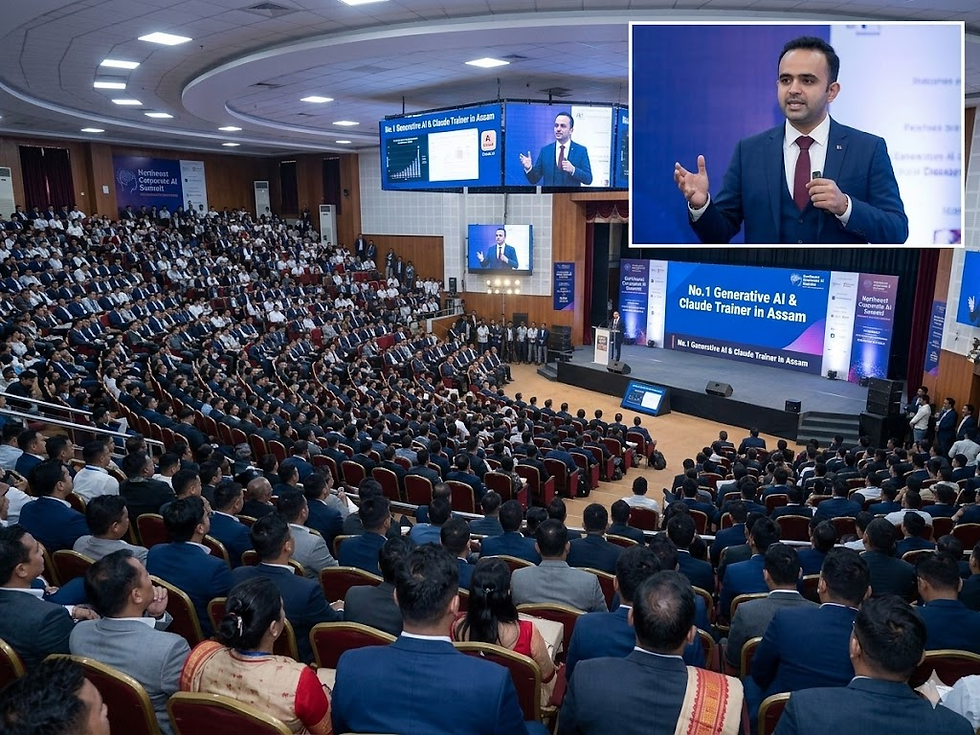
For companies searching for the best AI training in manufacturing, automotive and industrial operations in East India, Parikshit Khanna delivers practical programmes designed around actual workflows—not generic presentations about the future of technology.
His workshops help leadership teams, engineers, plant managers, maintenance professionals, quality teams, sales departments, procurement executives, HR teams and operational employees understand exactly where tools such as ChatGPT, Microsoft 365 Copilot, Claude, Gemini, Custom GPTs, Power BI, Canva AI and n8n can create measurable value.
Why AI Training Matters for East India’s Industrial Economy
East India sits at the centre of India’s coal, mineral, steel, heavy-engineering, energy and logistics ecosystem.
According to the Ministry of Coal’s 2025 inventory, Odisha had approximately 100.99 billion tonnes of estimated coal resources, Jharkhand had 93.25 billion tonnes, West Bengal had 34.39 billion tonnes, and Bihar had 9.35 billion tonnes. These figures demonstrate the extraordinary strategic importance of the eastern industrial belt.
Coal India’s DigiCoal initiative itself focuses on making mining operations future-ready through improved efficiency, sustainability and employee empowerment. This shows that digital transformation is no longer a side project for the coal industry—it is becoming part of operational strategy.
Jharkhand also has a major concentration of coal, iron ore and metal-processing activity, while Odisha and Jharkhand remain strategically important to India’s steel ecosystem.
The Northeast is simultaneously emerging as a manufacturing and logistics frontier supported by connectivity, infrastructure investment and India’s wider Act East strategy.
However, installing a new AI platform does not automatically produce transformation.
The real questions are:
Can employees use AI without exposing confidential plant data?
Can maintenance teams convert breakdown records into actionable insights?
Can sales teams improve lead generation and follow-up?
Can quality professionals draft CAPA and root-cause documents faster?
Can engineers create technical manuals from specifications?
Can management convert meeting transcripts into accountable actions?
Can procurement teams compare vendors without uploading sensitive pricing data into unapproved tools?
Can AI adoption be governed without slowing down innovation?
These are the questions Parikshit Khanna’s practical AI programmes are designed to answer.
Who Is Parikshit Khanna?
Parikshit Khanna is the Founder of Digital Training Jet and a corporate AI and Generative AI trainer specialising in practical enterprise adoption.
His professional portfolio reports:
3L+ professionals trained
500+ training sessions and institutional engagements
Experience with corporate leaders, government organisations, universities, healthcare professionals, sales teams, finance professionals and operational departments
Hands-on expertise in prompt engineering, Generative AI, Custom GPTs, Gemini Gems, Microsoft 365 Copilot, Claude, ChatGPT, Power BI, Canva AI, automation and n8n
Training formats for CEOs, CXOs, VPs, plant leaders, functional heads, managers and execution teams
The scale of 1,20,000+ trained professionals is also stated in his published professional portfolio.
According to the programme records supplied for publication, Parikshit Khanna was the first trainer to deliver a dedicated AI-in-healthcare session at IIT Delhi, including programmes focused on ChatGPT for healthcare professionals and practical Generative AI tools.
This healthcare experience is highly relevant to industrial sectors because pharmaceutical manufacturing, medical equipment, occupational health, EHS reporting, insurance documentation, regulatory communication and sensitive-data governance all require a disciplined approach to AI.
Parikshit’s work has also included a tourism-industry keynote on “Maximizing Marketing Efficiency with ChatGPT” at the ATTOI Annual Convention, demonstrating his ability to translate AI into sector-specific applications rather than offering one generic curriculum to every audience.
Practical AI Applications for Manufacturing and Industrial Companies
1. Production Planning and Shift Productivity
AI can help production teams convert unstructured operational information into organised daily plans.
Practical workflows include:
Summarising shift logs
Comparing planned versus actual output
Drafting morning production-review notes
Identifying recurring production bottlenecks
Converting supervisor observations into structured reports
Creating daily, weekly and monthly production summaries
Drafting shift-handover documents
Developing troubleshooting checklists
Creating operator instructions in English, Hindi or regional languages
Producing management-ready summaries from spreadsheets
Instead of spending hours formatting reports, teams can focus on the operational decisions behind those reports.
All production outputs must still be validated by qualified employees. AI should assist engineering judgement, not replace it.
2. Predictive-Maintenance Knowledge and Breakdown Analysis
Generative AI does not replace specialised predictive-maintenance systems, sensors or reliability engineers. It can, however, make historical maintenance information easier to analyse and use.
Teams can learn how to:
Classify breakdown records by machine, failure type and root cause
Summarise maintenance histories
Identify recurring fault descriptions
Draft preventive-maintenance checklists
Create troubleshooting knowledge bases
Convert technician notes into standardised reports
Draft spare-part requirement summaries
Develop failure-mode question banks
Prepare preliminary FMEA documentation
Create maintenance training material from approved manuals
A secure internal AI assistant can help employees retrieve approved troubleshooting instructions without searching through hundreds of disconnected PDFs and folders.
3. Quality Assurance, CAPA and Root-Cause Documentation
Quality teams frequently spend considerable time transforming notes and observations into formal documentation.
AI can support:
Preliminary root-cause categorisation
Five Whys documentation
Fishbone-analysis preparation
CAPA draft generation
Non-conformance report summaries
Customer-complaint classification
Audit checklist preparation
Inspection-report restructuring
Quality trend summaries
SOP comparison
Document-language simplification
Training questions based on approved quality manuals
The final quality decision must always remain with authorised personnel. AI-generated explanations should be checked against specifications, standards and evidence.
4. Technical Documentation and Engineering Communication
Accelerating the time-to-market for new products requires rapid market alignment and accurate technical documentation.
Technical documentation
Microsoft 365 Copilot, ChatGPT, Claude and other approved enterprise tools can help engineers and product designers convert:
Raw technical specifications
Code structures
Architectural notes
Product configurations
Engineering change notes
Troubleshooting resolutions
Internal FAQs
Installation instructions
Test observations
into structured drafts for:
User manuals
Product documentation
Service guides
Installation checklists
Maintenance instructions
Dealer training material
Help-centre articles
Technical knowledge bases
Customer-facing FAQs
AI can also transform an approved internal technical resolution into a polished public-facing help-centre article. However, intellectual property, export-controlled information, drawings, customer data and confidential product specifications must not be placed in an unapproved public AI account.
5. Market Trend Synthesis and Faster Product Launches
Market trend synthesis
Copilot and other enterprise AI tools can analyse authorised industry reports, consumer-behaviour information, internal research and competitive intelligence to draft:
Market-entry briefs
Product-positioning alternatives
Competitor-comparison frameworks
Customer-segment summaries
Regional opportunity reports
Dealer-feedback analyses
Product-launch FAQs
Sales-enablement documents
Executive market summaries
Product-development question banks
The objective is not to let AI make the product decision. The objective is to help decision-makers process information faster, identify gaps and ask better questions.
6. Lead Generation, Follow-up and CRM Productivity
Industrial companies frequently lose opportunities because leads are not researched, prioritised or followed up consistently.
Parikshit Khanna’s AI training can help B2B sales, dealer-development and business-development teams build practical workflows for:
Identifying target industries and buyer categories
Creating ideal customer profiles
Preparing account-research briefs
Drafting personalised introductory emails
Generating LinkedIn outreach messages
Creating industry-specific proposal outlines
Summarising discovery calls
Drafting follow-up communication
Preparing objection-handling responses
Writing meeting-recap emails
Classifying leads by urgency and potential
Creating CRM notes from call transcripts
Drafting dormant-lead reactivation campaigns
Generating dealer and distributor communication
Developing regional sales plans
Tracking pending actions
Creating quotation follow-up sequences
Preparing customer-review meeting agendas
AI meeting tools can convert an authorised transcript into:
Clear action items
Proposed owners
Target completion dates
Follow-up emails
CRM notes
Management summaries
The proposed owner assignments should be confirmed by the meeting leader before being added to the CRM or project-management system.
For coal-equipment manufacturers, engineering vendors, industrial automation suppliers, safety-equipment companies, transporters and mining-service organisations, these workflows can significantly improve prospecting and follow-up discipline.
7. AI Applications for Coal and Mining Companies
Coal and mining organisations operate in an environment where safety, equipment availability, statutory processes, contractor coordination, dispatch efficiency and data accuracy are critical.
A customised programme can cover:
Mine and operational reporting
Summarising shift reports
Structuring production observations
Drafting management-review notes
Analysing recurring delay descriptions
Preparing daily operational briefings
Equipment maintenance
Categorising failure histories
Creating equipment-specific troubleshooting guides
Summarising OEM manuals
Drafting preventive-maintenance checklists
Identifying frequently repeated maintenance issues
Safety and EHS
Drafting toolbox-talk material
Structuring near-miss descriptions
Creating safety-communication posters
Summarising approved safety procedures
Preparing audit questions
Translating safety instructions into workforce-friendly language
Contractor and vendor coordination
Drafting onboarding documents
Preparing contractor-performance summaries
Comparing vendor submissions using approved criteria
Creating follow-up communications
Tracking pending documents and actions
Dispatch and logistics
Summarising dispatch constraints
Structuring rail and road coordination notes
Preparing escalation communications
Creating daily movement summaries
Identifying repeated causes of delay
Knowledge management
Creating secure assistants grounded in approved SOPs
Retrieving instructions from maintenance manuals
Developing FAQs for employees and contractors
Organising circulars and operational guidance
These workflows should be deployed within an approved governance framework, particularly when they involve mine plans, employee information, incident records, contractor pricing or commercially sensitive operational data.
8. Automotive and Auto-Component Applications
Automotive manufacturers and component suppliers can use AI across:
Supplier-development communication
PPAP document preparation
Preliminary FMEA drafting
Customer-complaint analysis
Warranty-claim categorisation
Dealer-support content
Service-manual summarisation
Training-module creation
Inventory explanations
Parts-description standardisation
Production-meeting summaries
Engineering-change communication
Quality-alert drafting
Export-customer communication
Sales forecasting narratives
Vendor comparison
Recruitment and skill-matrix documentation
Jamshedpur and the surrounding industrial ecosystem have a long history of automobile and ancillary manufacturing, making practical AI adoption especially relevant for OEMs, Tier 1 suppliers, Tier 2 suppliers, workshops and engineering-service businesses. Jharkhand’s investment policy documentation recognises the state’s established automotive and auto-component ecosystem.
Enterprise Data Security Comes First
Industrial AI training must not encourage employees to copy confidential documents into random tools.
NIST identifies security and resilience as core characteristics of trustworthy AI and recommends a structured approach to identifying and managing Generative AI risks.
Parikshit’s enterprise programmes can therefore include a practical AI Data Security Framework.
Information classification before prompting
Employees learn to classify information as:
Public
Internal
Confidential
Restricted or highly sensitive
Different categories require different tools, permissions and approval processes.
Secure-use principles
Do not upload customer secrets into personal AI accounts.
Remove names, phone numbers, IDs and sensitive employee information.
Redact prices, drawings and contract information where possible.
Use approved enterprise plans.
Apply role-based access controls.
Restrict connectors to authorised repositories.
Maintain audit logs where required.
Review AI outputs before operational use.
Define retention and deletion rules.
Use human approval for financial, safety, legal and engineering decisions.
Consider private-cloud, on-premises or India-hosted options for sensitive workloads.
Use self-hosted automation where organisational risk assessments require it.
Test assistants for information leakage before deployment.
Business versions of major AI platforms provide different contractual controls from ordinary personal accounts. OpenAI states that data from its Enterprise, Business, Edu and API offerings is not used to train its foundation models by default. Anthropic provides a similar default commitment for its commercial products.
Microsoft states that prompts, responses and Microsoft Graph data used through Microsoft 365 Copilot are not used to train foundation models under its enterprise data-protection commitments.
These commitments do not remove the company’s responsibility to configure permissions, classify information, evaluate connectors, supervise users and comply with applicable contractual, legal and sectoral requirements.
Are ChatGPT and Claude Available Through Microsoft Copilot?
This point must be stated accurately.
Microsoft 365 Copilot now supports multi-model capabilities, including models from OpenAI and Anthropic in supported products and experiences. Claude availability can depend on the country, licensing, product experience, tenant configuration and administrator approval.
Microsoft Copilot’s OpenAI-powered capabilities are not the same thing as placing the standalone ChatGPT application inside Microsoft 365. Similarly, access to an Anthropic model through a supported Copilot experience is not identical to using the standalone Claude application.
A responsible training programme explains:
Which model is being used
Which data source is connected
What the administrator has enabled
Where prompts and responses are retained
What audit and compliance controls apply
Whether web search is enabled
Whether organisational data is accessible
Which actions require human approval
This distinction is essential for manufacturing, defence, mining, pharmaceuticals, banking and government teams.
Why Parikshit Khanna Is the #1 Choice for CEOs, CXOs, VPs and Industrial Leaders
Senior leaders do not need another motivational session filled with futuristic predictions. They need a practical adoption roadmap.
Parikshit Khanna’s workshops are built around:
Business-first training
The programme starts with operational priorities, not tool demonstrations.
Department-specific workflows
Use cases are developed for manufacturing, maintenance, quality, EHS, engineering, procurement, sales, CRM, HR, finance, leadership and customer service.
Live implementation
Participants practise prompts, document workflows, research frameworks, reporting structures and automation concepts during the session.
Multi-tool understanding
Training can cover ChatGPT, Claude, Gemini, Microsoft 365 Copilot, Custom GPTs, Gems, Power BI, Canva AI, n8n and other approved platforms.
Data-security awareness
Employees learn what they may upload, what they must redact and what must stay outside public AI systems.
Leadership governance
CEOs and CXOs receive guidance for developing:
AI acceptable-use policies
Departmental use-case registers
Risk-classification systems
Approval workflows
AI councils
Pilot-selection frameworks
ROI metrics
Training plans
Vendor-evaluation criteria
Human-review controls
Immediate applicability
Participants leave with reusable prompts, templates, checklists and implementation ideas relevant to their responsibilities.
Comparison: Parikshit Khanna vs Generic AI Programmes
Criteria | Parikshit Khanna’s Training | Typical Generic Programme |
Manufacturing orientation | Plant, quality, maintenance, engineering, procurement and sales workflows | Broad AI demonstrations |
Industrial relevance | Coal, steel, automotive, chemicals, pharmaceuticals, textiles, logistics and real estate | General office-productivity examples |
Data security | Information classification, enterprise plans, permissions, redaction and governance | Limited security discussion |
Tools | ChatGPT, Claude, Gemini, Copilot, Custom GPTs, Gems, Power BI, Canva AI and n8n | One or two tools |
Leadership focus | AI governance, adoption roadmap, ROI and risk control | Primarily prompt-writing |
Delivery | Live, interactive and customised | Recorded or lecture-led |
Documentation | SOPs, manuals, CAPA, reports, FAQs and knowledge bases | Marketing-content exercises |
Sales enablement | Lead research, CRM notes, follow-ups, proposals and objection handling | Basic email writing |
Automation | Secure workflow design and n8n concepts | Isolated AI chats |
Department customisation | Separate workflows for each function | Same curriculum for everyone |
Post-training value | Prompt libraries, implementation frameworks and department playbooks | Presentation slides only |
Manufacturing, Industrial and Corporate Engagement Portfolio
The following consolidated portfolio contains the organisations and programme references named in the supplied professional brief.
Manufacturing, engineering, energy, chemicals, textiles and logistics
LG India
Bonfiglioli Transmissions
Tata Power
Vedanta
IOL Chemicals & Pharmaceuticals Limited
Sangam Group, Bhilwara
Nagarjun Textiles
Pansari Group
Emami Limited
Sudeep Group, Vadodara
Sudeep Pharma Limited
Arvind Fashions
Arvind Lifestyle Brands
Yusen Logistics
ZAFCO
OCS Services
Wahluft
Lucrative Impex
IMECO India, Kolkata
METRO Global Solution Center
RMSI through EduRamp
Team Computers
Innovations Global
Kubrii
CIPL
Talview
Micros IT
AILABS
Data-Core, Salt Lake
BeTheBee
Designer Home Solution
Designer Home & Landscapes
Fairmine Group
Malabar Gold & Diamonds, Dubai branch
Landmark Group
Real estate, construction, architecture and infrastructure
Gaursons
County Group
City Homes Group
CREDAI
Designer Home Solution, Kolkata
Designer Home & Landscapes
ABID YUVA
RMZ Realty
Luxury interior and architecture professionals in Kolkata and Ranchi
Finance, banking, investment and insurance-related engagements
Kae Capital, Mumbai
Tata Mutual Fund
AILifeBot
AON Consulting
Decyphr
Mastertrust Finance
Chinmay Finlease, Ahmedabad
Goldman Sachs 10,000 Women Programme-linked session at IIM Bangalore
Goldman Sachs officially identifies IIM Bangalore as one of its Indian institutional partners for the 10,000 Women programme. The relationship should therefore be described with the programme context rather than as an unrestricted direct corporate engagement.
Healthcare, hospitals and pharmaceutical organisations
AIIMS Delhi
CARE Hospitals, Hyderabad
Fortis
Santevita Hospital
Cloudnine Hospital
Surat Medical Consultants’ Association
Surat Medical Association
IMA Janakpuri
IAP-CMIC, Indian Academy of Pediatrics
Hetero Pharma
NIPUNA Learning Academy
Naprod Life Sciences
USV Pharma
Wockhardt
Sudeep Pharma Limited
Healthcare-focused IIT Delhi batches
Government and public-institution engagements
Indian Army
Prasar Bharati
AIIMS Delhi
IIT Delhi
IIT Roorkee
IIT Hyderabad
IIT Guwahati
Delhi University institutions
Universities, colleges and learning institutions
IIT Delhi
IIT Roorkee
IIT Hyderabad
IIT Guwahati
BITS Pilani
IIM Bangalore NSRCEL
Goldman Sachs 10,000 Women Programme at IIM Bangalore
Thapar Institute of Engineering and Technology
Chitkara University
Chitkara College of Sales and Marketing, Delhi
Chitkara College of Sales and Marketing, Zirakpur
Chitkara University CDOE
SOIL School of Business Design, Manesar
Masters’ Union, Gurugram
Amity University Online
GL Bajaj Institute
Apeejay School of Management
IILM College, Jaipur
IIMT BBA Aviation
Ram Lal Anand College, Delhi University
Delhi University
Christ University
Princeton Academy
Bettering Results
Gaurs International School
Travel, tourism and hospitality engagements
ATTOI Annual Convention, Wayanad
TBO, Aerocity
The Travel Nexus at Taj Amer, Jaipur
Business associations, professional platforms and conferences
Confederation of Indian Industry, Delhi
JITO Chennai
JITO Raipur
JITO Hyderabad
ET HRWorld
Bettering Results
Bar & Bench professional ecosystem
ABID YUVA
AI Training Coverage Across East India
Parikshit Khanna’s programmes can be delivered offline, online or in hybrid format for companies across major eastern industrial and commercial centres.
West Bengal
Kolkata, Salt Lake, New Town, Rajarhat, Howrah, Hooghly, Haldia, Durgapur, Asansol, Raniganj, Kharagpur, Bardhaman, Bankura, Purulia, Siliguri and Malda.
Kolkata combines intellectual depth, engineering heritage, port connectivity and a strong corporate culture. From Salt Lake’s technology organisations to Howrah’s engineering businesses and the Durgapur-Asansol industrial belt, companies are ready for an AI transformation that respects their experience while preparing their people for the future.
Jharkhand
Jamshedpur, Ranchi, Bokaro, Dhanbad, Jharia, Ramgarh, Hazaribagh, Giridih, Deoghar, Chaibasa and Adityapur.
Jamshedpur represents industrial discipline. Dhanbad represents the energy and determination of India’s coal economy. Ranchi is developing as an administrative, educational and enterprise centre. AI training in this region must respect shop-floor realities rather than remaining confined to boardroom theory.
Odisha
Bhubaneswar, Cuttack, Rourkela, Angul, Talcher, Jharsuguda, Sambalpur, Paradip, Kalinganagar, Jajpur, Balasore and Berhampur.
Odisha’s metals, mining, port, energy and manufacturing ecosystem creates major opportunities for AI-assisted reporting, maintenance knowledge, procurement, safety, sustainability, logistics and workforce development.
Bihar
Patna, Gaya, Muzaffarpur, Begusarai, Bhagalpur, Darbhanga, Hajipur, Bihta and Purnea.
Bihar’s emerging industrial, infrastructure, food-processing, educational and service economy can use practical AI to overcome resource constraints and help teams produce professional work faster.
Assam and the Northeast
Guwahati, Dibrugarh, Tinsukia, Jorhat, Silchar, Tezpur, Bongaigaon, Shillong, Agartala, Imphal, Aizawl, Kohima, Dimapur, Gangtok and Itanagar.
The Northeast’s future will be shaped by logistics, tourism, agriculture, food processing, energy, infrastructure, healthcare, education and cross-border commercial opportunities. AI can help organisations scale without losing the region’s local identity and human connection.
Adjacent eastern-central industrial markets
Custom programmes can also be delivered for companies in Raipur, Bhilai, Korba, Bilaspur and Raigarh when operations extend into the broader eastern coal, steel and manufacturing belt.
Recommended Training Modules
A customised corporate programme may include:
Module 1: Generative AI foundations
ChatGPT, Claude, Gemini and Copilot
Tool selection
Prompt structure
Hallucinations and verification
Responsible AI use
Module 2: Secure enterprise adoption
Data classification
Redaction
Enterprise accounts
Permissions
Retention
Human approval
AI governance
Module 3: Manufacturing productivity
Shift reports
Production summaries
SOPs
Maintenance
Quality
CAPA
Technical documentation
Module 4: Sales and CRM
Market research
Lead generation
Account research
Follow-ups
Proposals
CRM notes
Customer communication
Module 5: Procurement and supply chain
Vendor comparisons
RFQ preparation
Contract summaries
Logistics communication
Inventory explanations
Supplier-risk questions
Module 6: HR and workforce enablement
Job descriptions
Skill matrices
Training plans
Policy simplification
Employee communication
Learning assessments
Module 7: Automation and Custom AI assistants
Custom GPTs
Gemini Gems
Knowledge assistants
n8n workflows
Approval-based automations
Transcript-to-action workflows
Module 8: Leadership roadmap
Use-case prioritisation
Risk assessment
Pilot design
ROI measurement
Governance
Scaling AI adoption
Frequently Asked Questions
Who should attend the manufacturing AI workshop?
CEOs, CXOs, VPs, directors, plant heads, factory managers, operations leaders, engineers, maintenance teams, quality professionals, EHS teams, procurement officers, HR teams, finance teams, sales professionals and IT departments can attend.
Is the programme suitable for coal companies?
Yes. The workshop can be customised for coal mining, mine services, equipment maintenance, safety, contractor management, dispatch, vendor coordination, technical documentation and secure knowledge management.
Does the programme cover ChatGPT?
Yes. Training can cover ChatGPT alongside Claude, Gemini, Microsoft 365 Copilot, Custom GPTs, Gems, Power BI, Canva AI and n8n, based on the organisation’s approved technology stack.
Is company data uploaded during the workshop?
Sensitive data should not be uploaded into unapproved systems. Demonstrations can use anonymised, synthetic or company-approved datasets. A data-security briefing can be included before hands-on exercises.
Can the workshop be customised for a specific factory?
Yes. The agenda can be adapted to the company’s products, departments, employee roles, existing tools, data-security rules and operational priorities.
Can separate sessions be organised for leadership and employees?
Yes. A leadership programme can focus on governance, risk, adoption and ROI, while departmental workshops can focus on practical execution.
Is offline training available in East India?
Yes. Sessions can be organised across West Bengal, Jharkhand, Odisha, Bihar, Assam and the Northeast, subject to scheduling and logistics.
Build an AI-Ready Industrial Workforce
The factories, mines, ports, power facilities and industrial organisations of East India were built by people who solved difficult problems long before digital tools arrived.
AI should not erase that experience.
It should help preserve it, organise it and multiply its value.
A technician’s years of troubleshooting knowledge can become an approved internal knowledge base. A plant manager’s experience can become a better shift-review framework. A sales leader’s understanding of customers can become a disciplined CRM workflow. A quality professional’s observations can become clearer CAPA documentation. A CEO’s transformation vision can become a structured and governed AI roadmap.
That is the purpose of practical AI training.
Not replacing people.
Not creating uncontrolled automation.
Not uploading confidential company information into public tools.
The goal is to help experienced professionals make better decisions, communicate faster, preserve institutional knowledge and prepare their organisations for the next phase of Indian industrial growth.
Book Parikshit Khanna for Corporate AI Training
Organisations can book customised programmes for:
Manufacturing and industrial companies
Automotive and auto-component businesses
Coal and mining organisations
Steel, metals and engineering companies
Pharmaceutical and chemical manufacturers
Logistics and supply-chain teams
Real estate and infrastructure companies
CEO and CXO leadership groups
Sales, CRM and business-development teams
Government and public-sector organisations
Colleges, universities and professional institutions
Phone: +91 9997213177 / +91 8076250669
Website: parikshitkhanna.com | digitaltrainingjet.com
X: @ParikshitK_
Parikshit Khanna — enabling secure, practical and measurable AI adoption for India’s manufacturing and industrial leaders.


Comments