AI Training in USA 2026

AI Training in USA 2026: Corporate Generative AI, Agentic AI, ChatGPT, Claude, Gemini & Microsoft Copilot Training with Parikshit Khanna

AI training in the USA has moved far beyond introductory ChatGPT demonstrations. In 2026, companies need employees and leaders who can use AI safely inside real workflows, compare models intelligently, automate repeatable work, build agentic processes, and measure the effect on quality, speed, cost and decision-making.
Stanford HAI's 2026 AI Index reports that organizational AI adoption reached 88%, while the World Economic Forum says employers expect 39% of workers' core skills to change by 2030. For US companies, the central question is therefore no longer whether employees will use AI. The more important question is whether they will use it consistently, securely and productively.
That is the purpose of practical corporate AI training: to turn scattered experimentation into an operating capability.
Quick Answer: What Should AI Training In USA Include?
A strong enterprise AI training program should combine six layers: AI literacy, prompt engineering, model selection, department-specific workflows, automation and agents, and responsible AI governance. Participants should leave with reusable prompts, workflows, templates and a clear plan for applying AI to their roles, not merely a list of tools.
For organizations looking for business-first training across ChatGPT, Claude, Gemini, Microsoft Copilot 365, Prompt Engineering, Agentic AI, n8n and AI automation, Parikshit Khanna delivers role-based sessions for executives and functional teams.
1 - AI TRAINING IN USA 2026
Why US Companies Need Practical AI Training In 2026
The United States remains one of the world's most important AI markets, with major AI ecosystems across California, New York, Texas, Washington, Massachusetts and other business hubs. But access to powerful AI tools does not automatically create business value.
Most organizations encounter the same adoption gap. Employees experiment individually, teams choose different tools for the same task, sensitive information can be handled inconsistently, outputs are not reviewed against a common standard, and leaders cannot clearly measure ROI.
Modern training should solve that adoption gap by teaching people how to move through a repeatable sequence:
1. Identify a valuable business task.
2. Select the right AI model or workflow for the task.
3. Provide clear context, constraints and source material.
4. Review outputs with human judgment.
5. Convert successful prompts into repeatable workflows.
6. Automate only after the process is understood.
7. Track a measurable KPI such as time saved, turnaround time, error reduction, quality, pipeline movement or customer response speed.
This approach also reflects the direction of current AI research and enterprise guidance. The 2026 Stanford AI Index shows rapidly expanding capability and adoption while also highlighting that responsible AI practices are struggling to keep pace. NIST's AI Risk Management Framework and its Generative AI Profile provide a practical reference for organizations that want to incorporate trustworthiness and risk management into AI use.
MEET PARIKSHIT KHANNA: TEDx SPEAKER & ENTERPRISE AI TRAINER
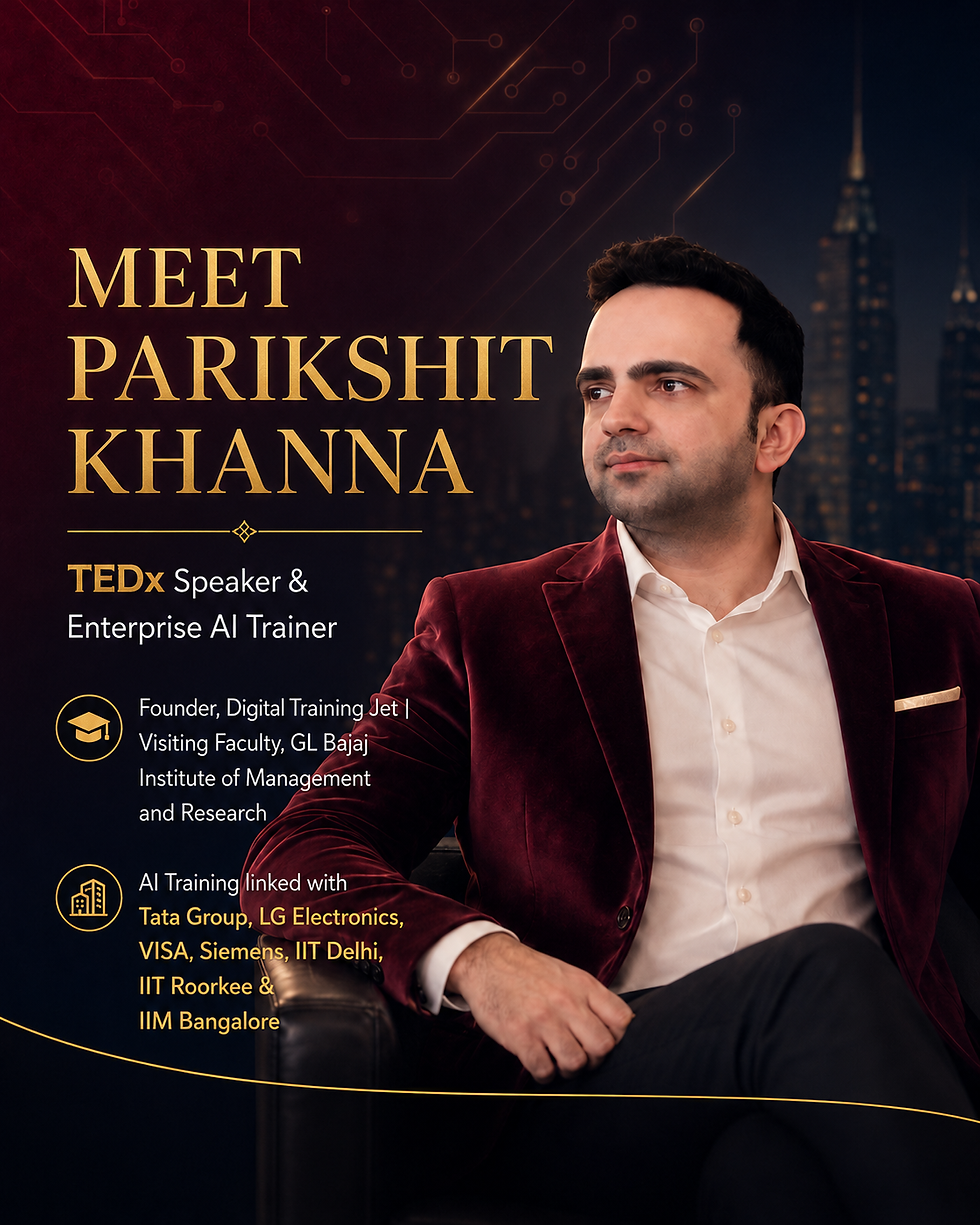
Parikshit Khanna is a TEDx Speaker, Corporate AI & Generative AI Trainer, Prompt Engineering specialist, Founder of Digital Training Jet, and Visiting Faculty at GL Bajaj Institute of Management and Research.
His professional journey includes AI training and enablement connected with leading corporations and institutions such as Tata Group, LG Electronics, VISA, Siemens, IIT Delhi, IIT Roorkee and IIM Bangalore, with recognition extending to Times Square, New York.
His expertise covers Claude AI, ChatGPT, Gemini, Microsoft Copilot 365, Prompt Engineering, Agentic AI, AI Automation, n8n, Custom AI workflows, executive AI adoption, and AI applications for Finance, HR, Sales, Marketing, Manufacturing, Healthcare and Operations.
Global Recognition
TEDx Speaker | Times Square, New York | Corporate & Executive AI Trainer | Founder, Digital Training Jet

What Makes Enterprise AI Training Different From A Normal AI Course?
A generic AI course usually teaches features. Enterprise AI training teaches operating behavior.
The difference is important. A marketing manager does not need the same workflow as an FP&A leader. A CHRO does not evaluate risk in the same way as a sales team. A manufacturing operations team may need SOP extraction and root-cause support, while an executive team needs scenario planning, decision memos and governance.
The most useful training therefore starts with job roles and business processes, then maps AI tools to those needs.
2 - FROM PROMPTS TO AI SYSTEMS

Core Modules For Corporate AI Training In USA
1. Executive AI Fluency
Participants learn what current generative AI and agentic systems can do, where they fail, and how leaders should evaluate opportunities without getting trapped in model hype.
2. Prompt Engineering for Business
Teams learn how to provide role, objective, context, constraints, examples, output format and evaluation criteria. They also learn iterative prompting, verification prompts and reusable prompt templates.
3. ChatGPT for Daily Work
Use cases can include writing, synthesis, meeting preparation, research planning, document review, structured brainstorming, communication, data interpretation and custom workflow support.
4. Claude AI for Long-Form and Document Work
Teams can practice document analysis, structured writing, policy review, synthesis, project workspaces and careful reasoning across complex source material.
5. Gemini for Google-Centric Workflows
Training can include research, multimodal analysis, content ideation and workflows that complement Google productivity environments.
6. Microsoft Copilot 365
For Microsoft-centric organizations, training can focus on Copilot-enabled work across Word, Excel, PowerPoint, Outlook and Teams, with an emphasis on productivity, review and enterprise context.
7. AI Research and Decision Support
Participants learn to build research briefs, compare sources, identify assumptions, separate facts from recommendations and prepare executive-ready summaries.
8. AI Automation with n8n, Make and Zapier
Teams learn where automation is useful, how to design a workflow before automating it, and how to connect AI steps with forms, spreadsheets, CRMs, email, documents and internal processes.
9. Agentic AI and Multi-Step Workflows
Advanced participants explore AI agents, task planning, tool use, handoffs, knowledge retrieval and human approval checkpoints.
10. Responsible AI, Privacy and Governance
Sessions can cover data classification, acceptable-use boundaries, human review, hallucination risk, auditability, sensitive information, prompt injection awareness, source validation and governance responsibilities.
From Prompting To Agentic AI: The Learning Journey
The most common mistake in corporate AI adoption is jumping directly to agents. A better learning sequence is:
Prompting -> research -> reusable workflows -> automation -> agents -> governance and scale.
This progression matters because an automated bad process simply produces bad results faster. Employees first need to understand the task, the output standard and the review process. Only then should the organization automate or delegate steps to agents.
Department-Specific AI Use Cases.

AI Training in USA 2026 enterprise AI stack with ChatGPT, Claude, Gemini, Microsoft Copilot 365, Agentic AI and n8n.
3 - ENTERPRISE AI USE CASES

Sales
Account research, lead qualification support, discovery preparation, personalized outreach, call summaries, proposal drafts, objection handling, CRM follow-up and pipeline reviews.
Marketing
Campaign briefs, content calendars, customer-persona research, SEO briefs, ad variants, social content, competitor synthesis, landing-page drafts and creative ideation.
Human Resources
Job descriptions, interview guides, competency frameworks, onboarding content, learning plans, policy Q&A, internal communications and employee survey synthesis.
Finance And FP&A
Variance commentary, management summaries, scenario narratives, board-ready explanations, finance SOPs, spreadsheet interpretation, vendor analysis and control checklists. Human validation remains essential for financial decisions and regulated reporting.
Operations
SOP drafting, process mapping, shift handovers, incident summaries, escalation notes, vendor communication, project updates, meeting-to-action workflows and recurring reporting.
Leadership And CXO Teams
Decision memos, strategy scenarios, market-entry questions, risk registers, meeting preparation, board summaries, AI opportunity prioritization and enterprise AI roadmaps.
Manufacturing
Maintenance knowledge support, quality issue summarization, root-cause brainstorming, shift documentation, training material creation, technical communication and process-improvement ideas.
Healthcare And Pharma
Research synthesis, patient-education drafts, training content, SOP support, non-diagnostic communication and knowledge workflows with strong human review, privacy controls and domain validation.
AI Training Across The USA: States And Major Business Cities
Corporate training can be customized for teams working across major US business regions. Virtual delivery makes it possible to train distributed teams nationwide, while onsite engagements can be planned according to project scope and travel requirements.
California: San Francisco, San Jose, Los Angeles, San Diego and the wider Silicon Valley ecosystem.
New York: New York City and enterprise teams across the state.
Texas: Austin, Dallas and Houston.
Washington: Seattle and surrounding technology hubs.
Illinois: Chicago.
Massachusetts: Boston and Cambridge.
Florida: Miami, Orlando and Tampa.
Georgia: Atlanta.
Arizona: Phoenix.
Colorado: Denver.
North Carolina: Charlotte and Raleigh.
Pennsylvania: Philadelphia and Pittsburgh.
Michigan: Detroit.
Ohio: Columbus and Cleveland.
New Jersey: Jersey City, Newark and enterprise teams connected with the New York metro region.
Virginia and Washington, D.C. region: enterprise, consulting, technology and public-sector teams.
The objective is not to create dozens of thin city pages. The better SEO and user strategy is one strong national authority page supported by genuinely useful state or industry pages only when each page contains unique examples, proof, FAQs and local relevance.
4 - AI TRAINING ACROSS THE USA
Sample One-Day Corporate AI Workshop
09:00-09:30 | AI landscape, business opportunities and risk boundaries
09:30-10:30 | Prompt Engineering framework with live business examples
10:30-11:15 | ChatGPT, Claude and Gemini comparison by task
11:15-12:15 | Research, documents and executive communication lab
12:15-13:00 | Department-specific use cases and prompt building
13:00-14:00 | Lunch
14:00-15:00 | Microsoft Copilot 365 and productivity workflows
15:00-15:45 | Automation with n8n, Make or Zapier
15:45-16:30 | Agentic AI concepts and human approval workflows
16:30-17:00 | Governance, data safety and review checklist
17:00-17:30 | Team capstone, KPI plan and next-step roadmap
The agenda can be shortened for executive briefings or expanded into multi-day bootcamps for functional teams and implementation groups.
What Participants Should Leave With
A good AI workshop should produce artifacts, not just notes. Depending on the engagement, teams can leave with:
A role-based prompt library.
Department-specific AI use-case maps.
Research and verification checklists.
Reusable communication templates.
AI-assisted SOP or reporting workflows.
Automation prototypes.
Agentic AI workflow diagrams.
Responsible AI and human-review checklists.
A 30-day adoption roadmap.
A measurement plan tied to business KPIs.
Executive AI Adoption: Five Questions Before You Scale
5 - EXECUTIVE AI ADOPTION FRAMEWORK
1. Use Case
What business problem are we solving, and is AI actually the right tool?
2. Data And Risk
What information will the system access, and what must remain restricted or human-controlled?
3. Workflow
Where does AI fit into the current process? What happens before and after the AI step?
4. KPI
How will we know the workflow is better? Measure time, quality, cost, revenue, risk, response speed or employee capacity.
5. Scale
Who owns the workflow, who reviews it, what training is required, and how will the organization manage updates as models and tools change?
How To Choose An AI Trainer In The USA
Before selecting a trainer or training company, ask seven questions.
1. Does the trainer teach real business workflows or only tool features?
2. Can the program be customized for your industry and departments?
3. Does the trainer compare multiple models instead of forcing every task into one platform?
4. Are participants building outputs during the session?
5. Does the curriculum include privacy, human review and responsible AI?
6. Can the trainer connect AI to automation, agents and enterprise productivity tools?
7. Is there a clear post-training adoption plan and KPI framework?
A strong trainer should also be able to say when AI should not be used. That is an important sign of enterprise maturity.
Why Parikshit Khanna Is A Strong Fit For Corporate AI Training

Parikshit's positioning is particularly relevant for organizations that need to make advanced AI understandable to non-technical and cross-functional teams. His public TEDx profile documents experience connected with major corporations and institutions including Tata Group, LG Electronics, VISA, Siemens, IIT Delhi, IIT Roorkee and IIM Bangalore, along with his role as Founder of Digital Training Jet and Visiting Faculty at GL Bajaj Institute of Management and Research.
His training portfolio spans the tools that business teams now encounter every day: ChatGPT, Claude, Gemini and Microsoft Copilot 365, while also extending into Prompt Engineering, Agentic AI, automation and n8n. That combination allows a program to move from individual productivity to repeatable team workflows.
The practical objective is simple: employees should return to work knowing which AI tool to use, how to use it, how to verify it, and how to turn the successful process into a repeatable workflow.
AI Training For Executives Vs Functional Teams
Executive Programs
Best for CEOs, CXOs, business heads and transformation leaders. Focus areas include strategy, opportunity prioritization, governance, AI operating models, investment decisions, risk, role redesign and KPIs.
Functional Team Programs
Best for Finance, HR, Sales, Marketing, Operations, Manufacturing, Healthcare, L&D and customer teams. Focus areas include daily workflows, prompt libraries, document work, productivity, automation and practical exercises.
AI Champion Or Train-The-Trainer Programs
Best for organizations that want internal capability. Selected employees learn facilitation methods, governance rules, prompt review, use-case evaluation and how to support adoption after the external trainer leaves.
Virtual, Onsite And Hybrid Delivery
Virtual programs are suitable for distributed US teams and can be delivered as executive briefings, half-day workshops, full-day programs or multi-session bootcamps.
Onsite engagements can be designed for leadership offsites, departmental workshops, sales kickoffs, innovation programs and enterprise enablement initiatives, subject to scope and travel planning.
Hybrid programs can combine a live workshop with office hours, implementation clinics, workflow reviews and follow-up sessions.
Frequently Asked Questions
Q1. What is corporate AI training?
Corporate AI training teaches employees and leaders how to use AI in business workflows with practical exercises, governance and measurable outcomes. It is different from a general consumer course because the content is mapped to roles, tools and enterprise processes.
Q2. What tools can be covered in AI training in USA?
Programs can cover ChatGPT, Claude, Gemini, Microsoft Copilot 365, Perplexity, n8n, Make, Zapier, Custom AI workflows and other tools selected according to the organization.
Q3. Is this suitable for non-technical employees?
Yes. Business-focused AI training can be designed for non-technical teams in HR, Sales, Marketing, Finance, Operations and Leadership without requiring coding.
Q4. Can the training include Agentic AI?
Yes. Agentic AI can be introduced conceptually for business teams and explored more deeply for advanced groups through multi-step workflows, tools, approvals, retrieval and automation.
Q5. Does the training include Prompt Engineering?
Yes. Prompt Engineering is a core foundation because clear context, constraints, examples and review criteria improve the consistency of AI-assisted work.
Q6. Can Microsoft Copilot 365 be included?
Yes. Microsoft-centric organizations can include Copilot use cases for Word, Excel, PowerPoint, Outlook and Teams, subject to the organization's licenses and configuration.
Q7. Can the program be customized for Finance or HR?
Yes. Department-specific training is usually more effective than one generic session because participants can practice on realistic tasks from their own function.
Q8. Is responsible AI included?
It should be. Enterprise training should address privacy, sensitive information, hallucination risk, human review, source verification, appropriate use and governance responsibilities.
Q9. Can teams receive prompt packs and templates?
Yes. Depending on the engagement, participants can receive prompt libraries, worksheets, workflow templates, adoption checklists and post-session resources.
Q10. Can the training be delivered virtually across the United States?
Yes. Virtual corporate AI training can support distributed teams across US time zones.
Q11. How long should an AI training program be?
A 60-90 minute executive briefing is useful for orientation. A half-day or full-day workshop is better for hands-on business use cases. Multi-day or multi-session programs are more appropriate for automation, agents and implementation.
Q12. What should we measure after training?
Measure adoption and business outcomes such as time saved, turnaround time, quality improvement, reduction in repetitive work, faster follow-up, better documentation, employee confidence and the number of validated workflows moved into production.
Final Thoughts: AI Training Should Change How Work Gets Done
The strongest AI training program is not the one with the longest list of tools. It is the one that changes how a team performs real work.
For US organizations, that means moving beyond isolated prompting toward a structured capability: employees understand model strengths, use AI with clear review standards, build reusable workflows, automate carefully, and know where human judgment must remain in control.
Parikshit Khanna's enterprise-focused training can be customized around that journey, from ChatGPT, Claude, Gemini and Microsoft Copilot 365 to Prompt Engineering, n8n, AI automation, Agentic AI and executive adoption.

Book Corporate Generative AI Training in USA
Contact Parikshit Khanna
For organisations that want to move from casual AI experimentation to practical, secure and measurable AI adoption, Parikshit Khanna and Digital Training Jet can develop a programme around your workforce, approved technology environment, target workflows and business priorities.
Parikshit Khanna Founder, Digital Training JetTEDx Speaker Corporate AI & Generative AI TrainerPrompt Engineering & Agentic AI Trainer
Phone / WhatsApp: +91 99972 13177 | +91 80762 50669
Website: https://www.parikshitkhanna.com/
Program Formats: Executive briefings | Corporate workshops | Functional bootcamps | Virtual training | Custom onsite engagements

Comments